Appointment Setting for B2B Sales That Actually Converts
Learn appointment setting for B2B sales through practical phone research, signal-based targeting, call structures, objection handling, qualification
“Make more calls” is incomplete advice for appointment setting for B2B. More activity won't fix a list of companies with no relevant need, contacts who don't own the problem, or meetings booked because someone was willing to talk.
Small sales teams need a stricter standard: a qualified conversation with a credible path to a business decision. That starts before the phone rings, with evidence that the account deserves attention and a clear hypothesis about why the prospect might act.
Why B2B Appointment Setting Is Not a Volume Game
A busy setter can still produce an empty pipeline. Calling the wrong accounts faster creates more activity, not more reasons for buyers to engage.
The difference between average and strong calling performance is substantial. Gong's analysis of more than 300 million cold calls in 2024 found average representatives connected on 5.4% of dials and booked meetings from 4.6% of connected conversations, versus 13.3% and 16.7% respectively for top quartile representatives, according to the published cold calling benchmarks.
Those results don't prove that a particular script or research tool caused the difference. They do show why treating every dial as equally valuable is a poor operating assumption.
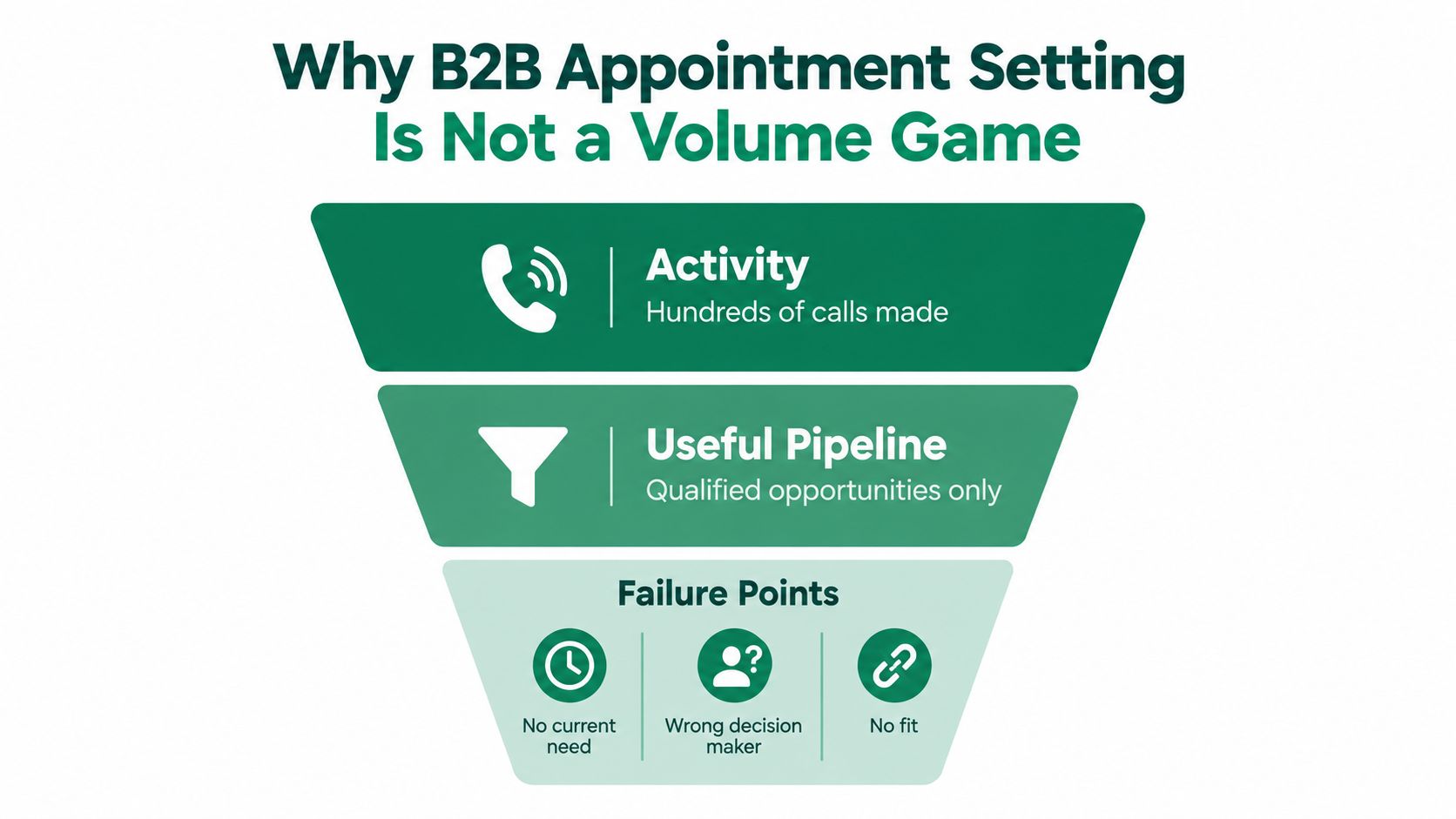
Separate activity from useful pipeline
An appointment deserves attention when the prospect understands a relevant problem, can involve the necessary people, and has a reason to explore action. A calendar invitation alone proves none of those things.
Use this distinction when reviewing setter performance:
- Activity: Did the setter make the planned attempts?
- Conversation quality: Did they reach someone who could discuss the business issue?
- Commercial relevance: Is there a plausible reason for the account to consider your service?
- Progression: Did the prospect agree to a useful next conversation, rather than accept a vague introduction?
The funnel below illustrates the distinction between doing work and creating useful opportunities.
Keep volume, but give it boundaries
Volume still matters. You can't learn much from a call process nobody executes consistently, and careful preparation can become an excuse to avoid prospecting.
The tradeoff is between enough research to establish relevance and research that delays contact without changing the decision to call. Require a credible account hypothesis, not a complete consulting diagnosis.
Operating principle: Research first, call with context, qualify before booking, and measure each stage separately.
That gives setters permission to work quickly without rewarding indiscriminate dialing. It also gives managers something more useful to coach than call count alone.
Define the Account and Decision Maker
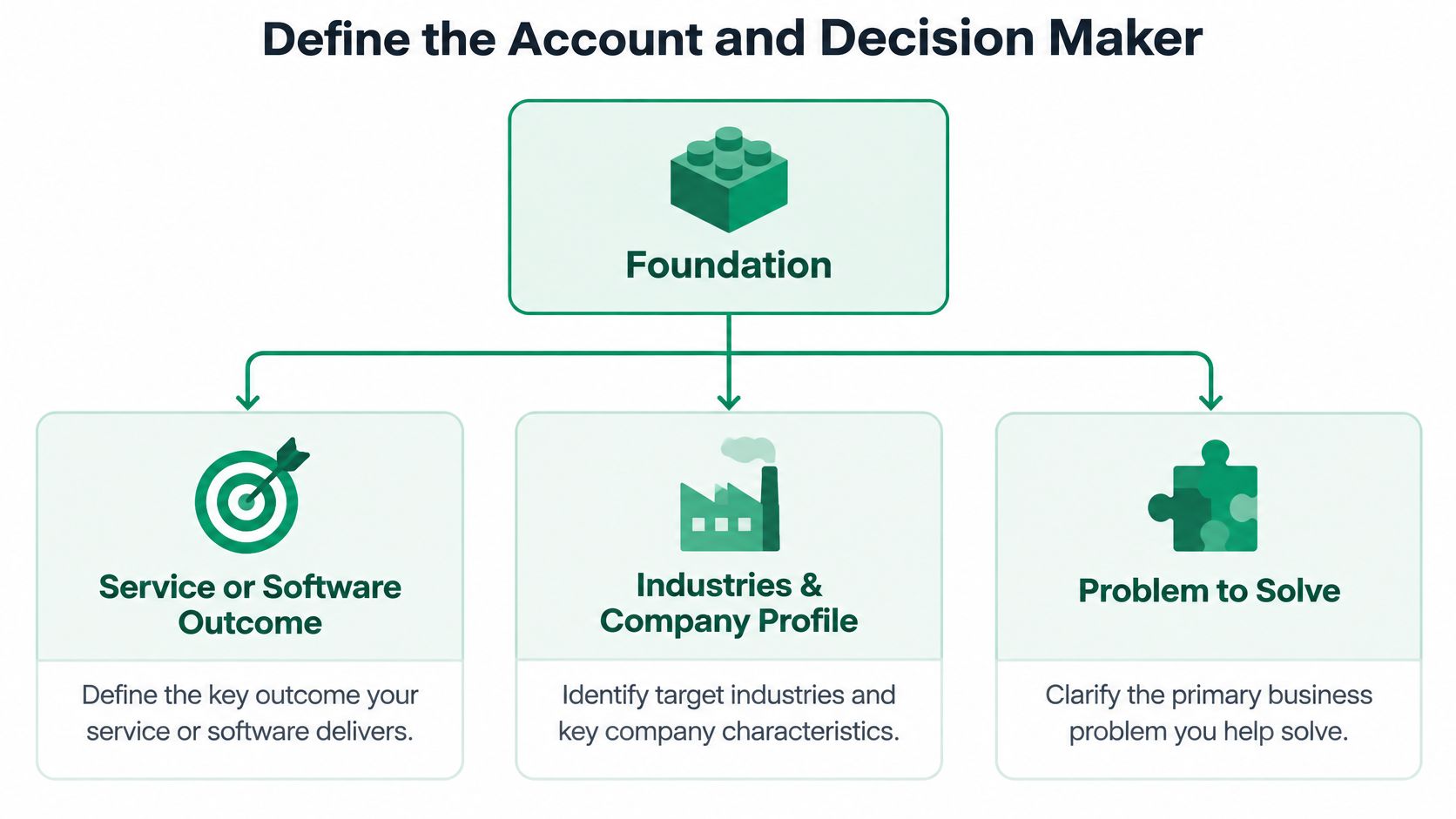
Start with the outcome you sell, not a database filter. “Manufacturing companies” is a market category. “Manufacturers preparing a production change that requires external engineering support” is an account hypothesis.
The foundation should connect your capability, the company's operating context, and the problem worth investigating. Use this hierarchy before choosing names or numbers.
Replace broad personas with ownership hypotheses
The following are illustrative targeting examples, not claims about specific companies.
| Offer | Account hypothesis | Ownership to investigate |
|---|---|---|
| ESG consultancy | A company preparing a sustainability reporting process | Sustainability lead, finance owner, executive sponsor |
| Technical engineering | An industrial business planning equipment or production changes | Engineering lead, plant manager, investment owner |
| Compliance support | A business preparing for a relevant certification requirement | Quality lead, compliance owner, operations executive |
| Workflow software | A company hiring people to coordinate a process your product supports | Process owner, functional leader, budget approver |
Don't assume the most senior title is automatically the best entry point. An operational owner may understand the issue better than the economic buyer, provided they can explain how a decision would happen.
An interested employee without that route is different. Curiosity can justify sharing information, but it doesn't automatically justify a sales meeting.
Give the setter a usable brief
Use B2B market mapping to turn broad market coverage into explicit account choices. Then prepare a short brief:
- Account hypothesis: Why could this company use the outcome?
- Likely trigger: What event would make the problem timely?
- Value hypothesis: What work, risk, or decision could your service help address?
- Disqualification criteria: Which conditions make delivery or purchase implausible?
- Meeting outcome: What should the buyer and seller establish together?
Keep uncertainty visible. Write “likely operations owner” when responsibility isn't confirmed, rather than presenting a guessed title as verified authority.
For a complementary explanation of the account preparation approach, watch the following video.
Turn Buying Signals Into Call Priorities
A funding announcement gives you a reason to research a company. It doesn't automatically give an ESG consultant, engineering firm, or software seller a reason to call.
The useful question is narrower: What changed that could make the problem you solve relevant now? Treat a public event as evidence to interpret, not proof of purchase intent.
Judge the connection, not the label
Consider a hypothetical software company that has announced funding. You could assume it needs new systems, but that assumption is broad enough to support almost any pitch.
A current job posting describing manual coordination across customer onboarding teams gives a workflow software seller a more specific hypothesis. The opening can reference the work described, then ask whether the process is under review.
Use a qualitative scorecard rather than pretending uncertain signals deserve mathematical precision:
| Criterion | Evidence to look for | Reason to hold back |
|---|---|---|
| Recency | A dated event with a plausible response window | An old announcement without a current development |
| Problem relevance | A direct connection to work your offer supports | General growth with no identifiable need |
| Decision maker proximity | A likely owner connected to the change | No clear department or accountable person |
| Source reliability | An original announcement, posting, or official document | An unsupported summary |
| Next action | A specific question worth asking | Nothing beyond “introduce our company” |
This is a practical method for evaluating buying signals for B2B services, not a claim that every event predicts a sale.
Match freshness to the event
Don't apply the same expiry rule to every signal. A leadership appointment needs evidence of a changed remit or active initiative. A regulatory deadline needs confirmation that the requirement applies to the prospect and that work remains to be done.
Before promoting an account to call now, record the proof link, publication date, relevant passage, and your interpretation. Keep the source's statement separate from your sales hypothesis.
A company event becomes useful when you can explain which problem may have changed, who might own it, and what you need to verify.
For broader context, the discussion of signal selection in B2B sales practices is useful background. Operationally, your standard should remain specific: if the evidence can't support a relevant opening question, keep researching or deprioritize the account.
Research the Account Before the Call
Suppose a compliance consultancy finds a public certification deadline that appears relevant to a manufacturer. The setter shouldn't open with "Do you need compliance help?" They should first establish whether the requirement applies, who owns preparation, and what the source states.
Fit means the company resembles a plausible customer. Readiness means there's evidence that a relevant issue may be active. Research should establish the former and support a testable hypothesis about the latter.
Complete the preparation checklist
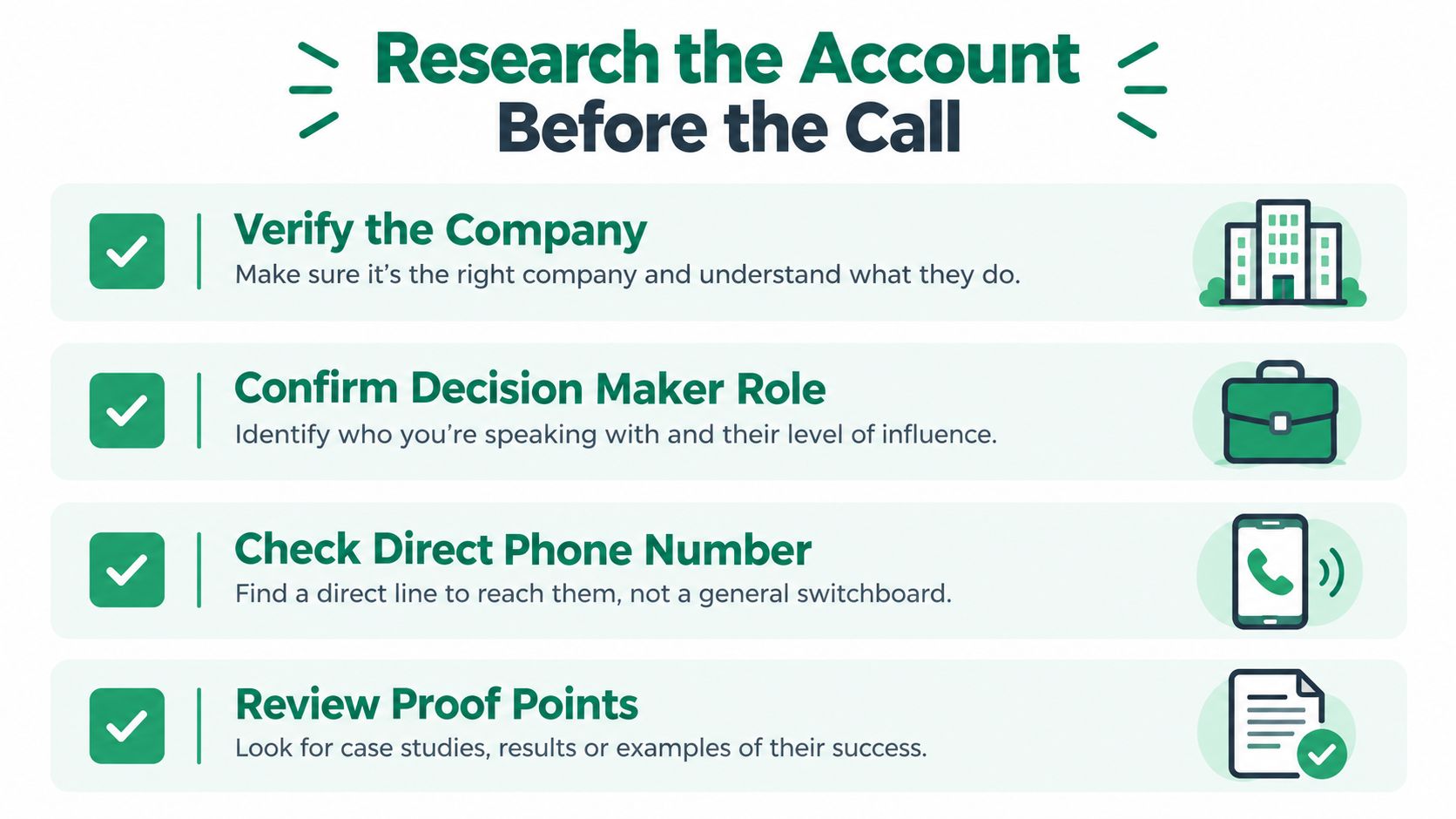
Before dialing, check the essentials:
- Company identity: Confirm the operating business, location, and relevant activity. Don't confuse a subsidiary with its parent.
- Contact responsibility: Check that the person still holds a relevant role. A title is evidence of possible ownership, not confirmation.
- Direct number: Verify that the number is associated with the intended contact and is usable.
- Trigger evidence: Open the original source and check its date, scope, and wording.
- Conversation objective: Write the uncertainty the call should resolve.
The preparation sequence should be visible to everyone making calls.
For industrial targeting, a focused resource such as a dataset of French manufacturers investing in production can support account discovery. Treat any dataset as a starting point for verification, not a substitute for checking the underlying event.
Prepare a question, not a conclusion
For the hypothetical certification account, the research note might read: “The published requirement appears relevant to this activity. Quality leadership may own preparation. Confirm applicability and whether support is needed.”
That produces a credible opener:
“I'm calling because of the published certification requirement affecting this activity. Does preparation sit with your team, or is someone else coordinating it?”
Don't imply that the company is behind schedule or exposed to a problem you haven't verified. The purpose of preparation is to make the question informed, not to manufacture certainty.
Stop researching when you can identify the account, support the reason for contact, and name the uncertainty worth discussing. Finding someone's name alone isn't enough.
Structure the Phone Conversation
A call needs structure, but it shouldn't sound like a recitation. Give the setter conversational moves they can adapt: identify themselves, explain the reason for calling, test relevance, explore impact, and propose an appropriate next step.
The visual below summarizes the progression from outreach to a substantive business discussion.

Open honestly and test relevance
Use a permission based opening without inventing familiarity:
“Hi, it's Alex from our compliance advisory team. We haven't spoken before. Can I explain why I called, and you can tell me whether it's relevant?”
Then connect the observed event to a question. In a hypothetical regulatory outreach call, that could be: “I saw the published requirement covering your activity. Has that changed your team's preparation workload, or is it already covered?”
Stop talking after the question. Don't add a service catalogue while the prospect is deciding whether to answer.
- If the issue is active: Ask what has changed and who is handling it.
- If it's already covered: Clarify whether anything remains unresolved, without challenging the answer.
- If it doesn't apply: Correct the account record and leave.
- If ownership sits elsewhere: Ask for direction rather than pitching the wrong person.
Translate the issue for the buyer
A technical buyer needs a question about execution: “Where does the current validation process become difficult?” An executive buyer needs a question about consequences: “Does this affect the operating plan, investment decision, or delivery commitment?”
These aren't competing scripts. They're different ways to investigate the same account hypothesis.
Offer a brief value hypothesis only after the prospect describes something relevant: “We support teams with that preparation work. It may be worth checking where your internal coverage ends and whether external support would help.”
Proactive contact doesn't require waiting for a form submission. In RAIN Group's 2018 research, which surveyed 488 B2B buyers and 489 salespeople, 82% of buyers accepted meetings with sellers who contacted them first, as summarized in the historical B2B sales research.
That finding isn't permission to force a meeting. Ask for one when the discussion has established a worthwhile question: “Would a working conversation with your quality owner help establish the scope and whether we can contribute?”
Qualify the Meeting Before Booking It
An easy booking can be a poor use of the sales team's time. A prospect may accept out of curiosity, politeness, or a desire to end the call.
Qualification means deciding whether a meeting deserves a place in the pipeline. It doesn't mean completing discovery on an unexpected phone call.
Use a qualified meeting contract
Agree internally on the conditions that justify booking. A practical contract includes:
- Relevant problem: The prospect acknowledges an issue your offer can plausibly address.
- Credible timing: There's an active change, deadline, or agreed reason to investigate now.
- Appropriate contact or stakeholder path: The attendee owns relevant work or can involve whoever does.
- Defined next step: Both sides understand what the meeting will establish.
- Progression potential: There's a plausible route from discussion to evaluation or a business decision.
Don't require certainty where a discovery conversation is needed. Unknown budget can be acceptable if the problem owner wants to establish scope and explain how funding decisions work.
Unknown ownership, no acknowledged issue, and no purpose beyond “seeing what you do” is a different proposition.
Replace weak bookings with useful alternatives
Consider an employee who finds your engineering capability interesting but doesn't own the planned production change. Booking a general presentation would leave the seller to restart qualification.
A stronger response is: “Who's accountable for the production change? Would it make sense to include them so we can discuss the actual constraints?”
| Prospect response | Appropriate decision |
|---|---|
| “I'm curious about your service.” | Clarify the business question before booking. |
| “Our operations lead owns this.” | Seek an introduction or joint discussion. |
| “We're assessing support for the change.” | Confirm scope, participants, and meeting purpose. |
| “There's nothing planned.” | Don't create an opportunity merely to retain the contact. |
For specialist services, the stakeholder path matters more than superficial enthusiasm. The discussion of buying signals and buying groups provides relevant context for examining who must participate.
Record confirmed facts separately from open questions in the handoff. The seller should know what the prospect said, what remains uncertain, and what they promised to prepare.
Disqualifying a weak meeting is useful work. It protects delivery capacity and makes the appointments that remain more credible.
Handle Objections and Protect the Next Step
An objection isn't an instruction to launch a rebuttal. It's a reason to decide whether to clarify, redirect, postpone, or stop.
A polite deflection gives little information. A genuine objection identifies a constraint, such as an existing provider or an inactive project. Ask a restrained diagnostic question when the prospect is willing, then accept the answer.
Respond without arguing
“I'm not the right person.”
“Thanks for clarifying. Who owns preparation for this requirement?”
Ask for an introduction only if the prospect is comfortable providing one. Record a suggested name as a referral, not as verified responsibility.
“We already have a provider.”
“Understood. Are they covering the work connected to this change as well?”
An incumbent isn't automatically a gap to exploit. If the prospect says the work is covered and they're satisfied, don't manufacture a competitive problem.
“It's not a priority.”
“Is that because the change doesn't affect you, or because the work is planned for later?”
The distinction determines whether to disqualify or agree on a relevant return point. “Later” needs an event or decision window, not an arbitrary reminder.
“I don't have time.”
“Understood. Would you prefer a short note explaining the reason for the call, or should I leave it?”
Don't turn a request for less interruption into another discovery sequence.
“Why are you calling me?”
“We haven't spoken before. I found the public notice about this change and thought your role might be relevant. I may have that wrong.”
Identify yourself accurately. Explain the source and use only claims you can support about how the contact details were obtained.
Make email a purposeful next action
"Send an email" can indicate interest or a desire to end the call. Don't insist that every email request conceal a buying opportunity.
If the prospect is receptive, ask: “What would make the note useful, the requirement itself or the scope of support?” Then offer a bounded next action: “I'll send that summary. Would you like me to follow up, or would you prefer to reply if it's relevant?”
Respect the choice. Persistence means completing an agreed action, not repeatedly overriding a refusal.
Classify outcomes before following up
Use distinct records rather than one generic follow up queue:
| Outcome | Action |
|---|---|
| Meeting held | Capture the seller's qualification decision and agreed action. |
| No response | Reassess relevance before another bounded attempt. |
| Bad timing | Record the event that would justify renewed contact. |
| Referral | Verify the new person's responsibility before outreach. |
| Wrong contact | Correct the record and research ownership. |
| Bad fit | Remove the account from the active campaign. |
| Opt out | Stop outreach and apply the request to the appropriate records. |
| Active opportunity | Assign the next action to the opportunity owner. |
Document the signal type, contact role, objection, outcome, and next action. For booked meetings, include the agreed purpose, participants, and confirmation status.
Review the constraint, not just the calendar
Track dials, live conversations, qualified conversations, meetings booked, meetings held, and qualified opportunities.
For example, 1,000 dials at a 5.4% connect rate produce about 54 conversations; applying a 4.6% meeting rate yields about 2.5 meetings, using the Gong engagement benchmark example.
That's a planning illustration, not a quota or promise. Segment actual results by account cohort, signal type, contact seniority, geography, and setter.
Low connection suggests checking contact selection and number quality. Conversations without relevance suggest reviewing targeting or the opening. Bookings without attendance require checking commitment and confirmation. Held meetings without accepted opportunities require examining qualification and handoff.
At the weekly review, have the founder or sales lead inspect outcome records, listen to representative calls, and ask sellers why they accepted or rejected meetings. Choose the clearest constraint, change the relevant part of the process, and evaluate it against comparable accounts rather than changing everything at once.
For a weekly feed of researched calling opportunities, Trefle.ai offers Noa, which provides a dated buying signal, proof link, named decision maker, verified direct number, and suggested opener. If you want execution as well as research, explore its phone first Managed Outbound service, where trained setters prospect on your behalf and book qualified meetings.