Cold Calling vs Cold Emailing for B2B Outbound
Compare cold calling vs cold emailing by speed, cost, conversion, workflow, and fit, then choose the right channel and build a practical cadence.
Your prospect list is full, but next month's pipeline isn't. You've got limited selling time, a founder juggling delivery, and someone asking whether the team should make more calls or write better emails. Neither answer helps much if nobody can explain why those prospects should care right now.
The useful answer to cold calling vs cold emailing is a decision about sequence, not allegiance. Research the account, identify the person responsible, and establish a credible reason to make contact. Then choose the channel that gets the next useful answer without wasting the buyer's attention or your team's time.
Why Channel Choice Starts With Relevance
Consider a small engineering consultancy trying to win its next project. The founder has a spreadsheet of manufacturers, job titles, and contact details. Calling feels laborious; emailing feels easier to fit between client meetings.
The underlying issue is that the spreadsheet doesn't distinguish a company planning an operational change from one with no relevant project. Changing channels won't fix that omission.
Now consider a target company advertising for a leader responsible for a new facility. That's an observable event worth investigating. It doesn't prove the company needs outside engineering support, but it gives the founder a business question to test.
Separate evidence from assumptions
A useful account record should distinguish what you know from what you suspect:
- Observed event: A dated announcement, job posting, permit, certification, or other inspectable source.
- Business hypothesis: The operational problem that event could create.
- Responsible person: The named executive or manager likely to own that problem.
- Open question: What you need the buyer to confirm before proposing a meeting.
Don't turn an announcement into a claim about budget. Funding doesn't automatically mean purchasing intent. A new executive doesn't automatically want new suppliers.
Practical rule: Before choosing a channel, write a credible answer to “Why this company, this person, and now?”
That discipline changes how you allocate effort. A verified event tied closely to your service can justify research and a direct conversation. A loose association deserves a lighter approach or further observation.
Neither channel creates a buying need by itself. Your job is to find a plausible need, test it respectfully, and stop when the evidence doesn't support further pursuit. Personal preference, whether yours or the seller's, belongs behind account relevance in that decision.
Understanding Both Outbound Channels
Cold calling means initiating a live phone conversation with a prospect outside an active sales discussion. Cold emailing means sending an unsolicited written message to a prospect who hasn't requested that sales contact. Both require the seller to earn attention before asking for commitment.
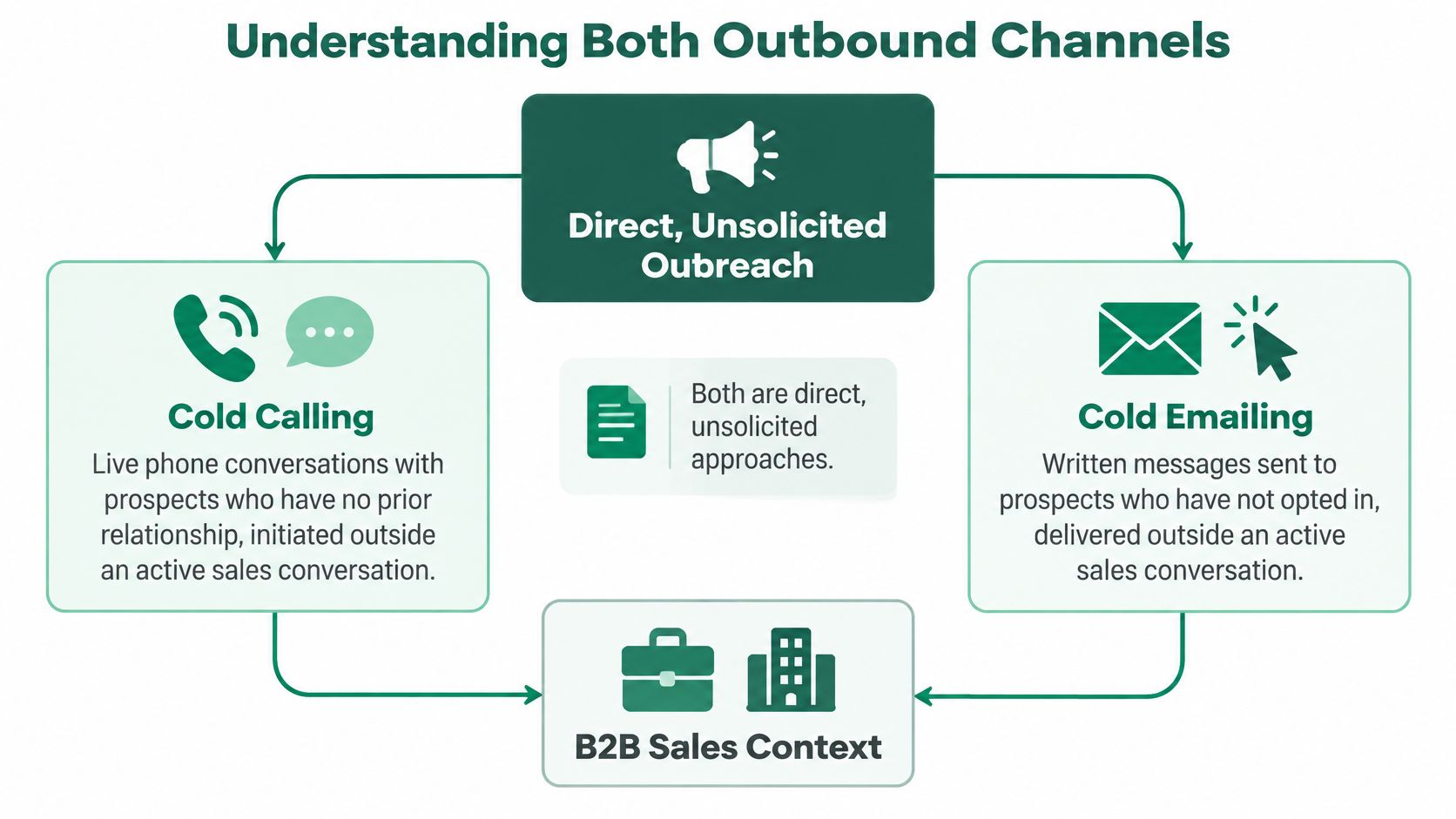
The difference is the interaction each makes possible. On a call, the representative can ask a question, hear an objection, clarify a misunderstanding, and agree on what happens next. In an email, the buyer can inspect evidence, consider the question, and forward the message without arranging a conversation.
Give each channel a distinct job
Use the phone when you need dialogue. Use email when the buyer needs something concrete to review.
That doesn't mean every organization must run the same channel mix. In HubSpot's survey of 379 sales professionals, 24% of sales organizations used cold calling as a primary channel, 25% as a secondary channel, and 19% for selected campaigns or segments. Those are descriptions of practice, not instructions for your team.
For a specialist consultancy, a call might establish whether an upcoming operational change requires outside expertise. The supporting email might summarize the relevant service and provide material the contact can share with colleagues.
For a software seller, email might introduce a narrow workflow problem. A subsequent conversation can establish whether that problem belongs to the recipient or another team.
Treat a call as an opportunity to learn and an email as an opportunity to make evaluation easier.
Keep the distinction clear in your reporting. An attempted call isn't a conversation. A delivered email isn't evidence of interest. Both channels need an explicit commercial purpose, whether that's identifying ownership, confirming an active problem, or arranging an appropriate next discussion.
Compare the Channels on Business Criteria
For a small sales team, the scarce resource is attention: the buyer's attention and the representative's working time. Compare channels on how they use both, not on which produces the largest activity count.
Cold calling and cold emailing compared
| Criterion | Cold calling | Cold emailing | Decision implication |
|---|---|---|---|
| Preparation | Requires a credible opener, accurate role, and working number | Requires an accurate address, relevant observation, and clear request | Don't launch either against unverified records |
| Reach | Depends on reaching someone during a call attempt | Allows asynchronous review | Use email when immediate dialogue isn't necessary |
| Response speed | Can resolve questions during a live conversation | Leaves response timing with the recipient | Call when clarification is worth the interruption |
| Information quality | Allows follow-up questions and objection handling | Produces written answers and forwardable context | Match the channel to the information you need |
| Scalability | Consumes representative time account by account | Easier to distribute across a larger account set | Reserve intensive calling for justified targets |
| Cost | Research, dialing, conversation, and coaching require labor | Distribution is cheaper to scale, but preparation still costs time | Include staff effort, not just software fees |
| Operational load | Requires call review, disposition discipline, and scheduling | Requires message review, reply handling, and suppression discipline | Choose a workload the team can manage properly |
| Suitable offers | Useful for complex services needing early clarification | Useful when evidence can explain a narrow proposition | Don't force a complicated diagnosis into a short pitch |
| Meaningful outcomes | Relevant conversations, qualified meetings, disqualifications | Relevant replies, referrals, qualified meetings | Compare downstream outcomes |
Understand the cost of weak contact data
A Baylor Keller Center study summarized by Outsales examined 6,264 cold calls, with 28% answered, 55% unanswered, 17% reaching nonworking numbers, and approximately an appointment for every 330 dials. That's a specific study outcome, not a forecast for a researched outbound program.
Its management lesson is straightforward: indiscriminate calling can absorb selling time without producing enough useful conversations. Inspect the list before blaming the script.
Email has a different efficiency trap. Sending more messages is operationally easier than conducting more conversations, but ease of distribution doesn't establish commercial value. Someone still has to validate the audience, make the proposition relevant, and handle responses.
My recommendation is to budget by account importance, not channel volume. Put deeper preparation behind accounts where a useful conversation could justify the effort. Use lighter written outreach where the buyer can assess the proposition without live explanation.
Build Phone First and Email First Workflows
A workflow should tell a representative what must be true before outreach, what to do during contact, and what to record afterward. A script alone doesn't provide that discipline.
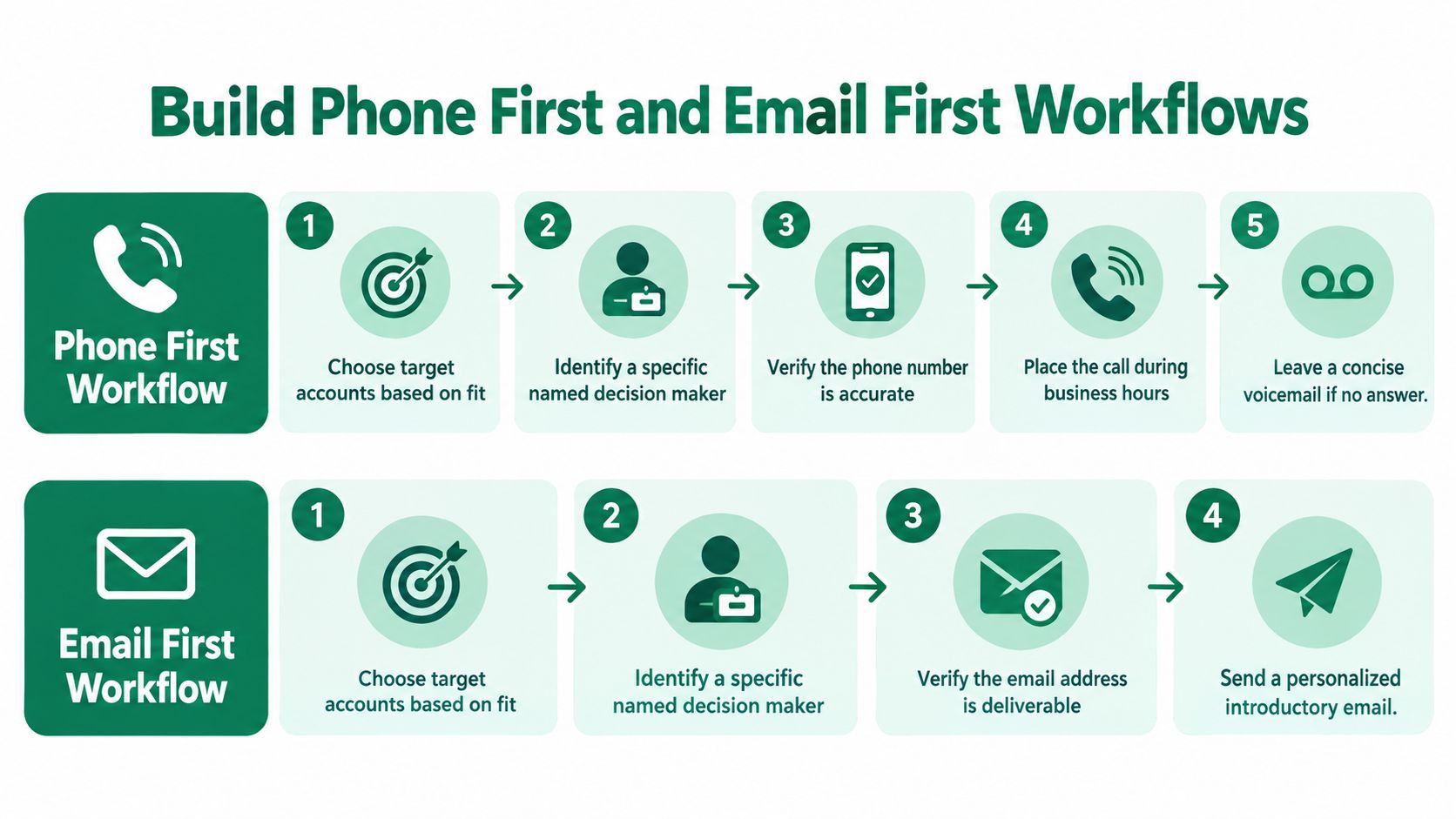
Phone first
Start with account selection, then verify the decision maker and direct number. Save the dated proof point before dialing so the representative can explain the reason for contact without improvising.
Prepare an opening that separates observation from inference. For example, a seller could mention a published hiring announcement, explain the related implementation problem their firm addresses, and ask whether that issue falls within the contact's remit. That's a suggested approach, not a claim about a real customer.
During the conversation, pursue clarification rather than a complete presentation:
- Confirm ownership: Establish whether the person is responsible for the issue.
- Test activity: Ask whether the situation has created work, difficulty, or a planned project.
- Agree on action: Arrange a relevant discussion, send requested evidence, record future timing, or close the account.
After an unanswered attempt, send a concise note identifying the reason for the call. Never imply you spoke when you didn't.
Email first
Verify the role and address, then draft around an account observation and a restrained value hypothesis. Ask a question the recipient can answer without accepting a meeting.
A useful opening email doesn't need your company history, a full service menu, and a calendar request. Give the buyer enough context to judge relevance, with supporting evidence where appropriate.
Set a preparation limit based on what the account warrants. If research keeps expanding without producing a clear business question, don't let the representative spend the afternoon polishing uncertainty.
Record the observation, source, contact, channel choice, response, and next action in the CRM. Apollo or another contact provider can support contact discovery; your representative still needs to validate why the account belongs in the campaign.
The handoff must preserve context. A follow-up call should continue the email's business question. A follow-up email should reflect the actual conversation rather than restart a generic sequence.
Match Each Channel to the Buying Situation
Buyer preferences aren't uniform. In RAIN Group's 2018 survey, email was preferred by 80% of buyers, while 57% of C-level and vice president buyers preferred phone contact; technology buyers preferred phone contact more often than financial services buyers, at 54% versus 40%.
Those findings support segmentation, not a blanket instruction to call every executive. Use seniority and industry as context, then examine the actual buying situation.
A senior technology buyer facing a timely change
Suppose a technology company appoints an executive to oversee a publicly announced infrastructure transition. You sell specialist support directly related to that transition, and you've verified the executive's responsibility and direct number.
Phone first. Ask whether the transition has created a relevant implementation issue. Don't assume the appointment means the executive has a budget or wants to outsource.
The reason to call is the connection between the announced change, the person's remit, and your service.
A consultancy prospect preparing an internal discussion
A potential sponsor is gathering material to assess whether outside help is appropriate. They need something colleagues can review before committing time.
Email first. Send a concise explanation of the problem you address, the circumstances in which you're useful, and evidence you can substantiate. Make internal forwarding easy without asking the recipient to become your unpaid salesperson.
A good fit with no visible need
A company matches your ideal customer profile, but you can't identify an active issue or explain why the timing matters. The contact's job title is your only justification.
Wait. Keep monitoring rather than adding the account to a repetitive sequence. A framework for evaluating B2B buying signals for services can help separate relevant events from background company news.
A valuable project with expensive qualification mistakes
Your firm could deliver a substantial engagement, but only if the buyer has the right scope, authority, and timing. Written material alone won't resolve those questions.
Combined sequence. Establish context through email when necessary, then use a conversation to qualify the opportunity before investing in a proposal. Send the agreed summary afterward so everyone evaluates the same scope.
The operating labels are simple: phone first for justified dialogue, email first for review, wait for weak evidence, and combine channels when evaluation requires both. Let the buyer's response override your original plan.
Plan Practical Sample Outreach Cadences
Use a cadence as a working schedule, not an obligation to keep contacting someone. The examples below are adaptable operating choices, not validated prescriptions for every market.
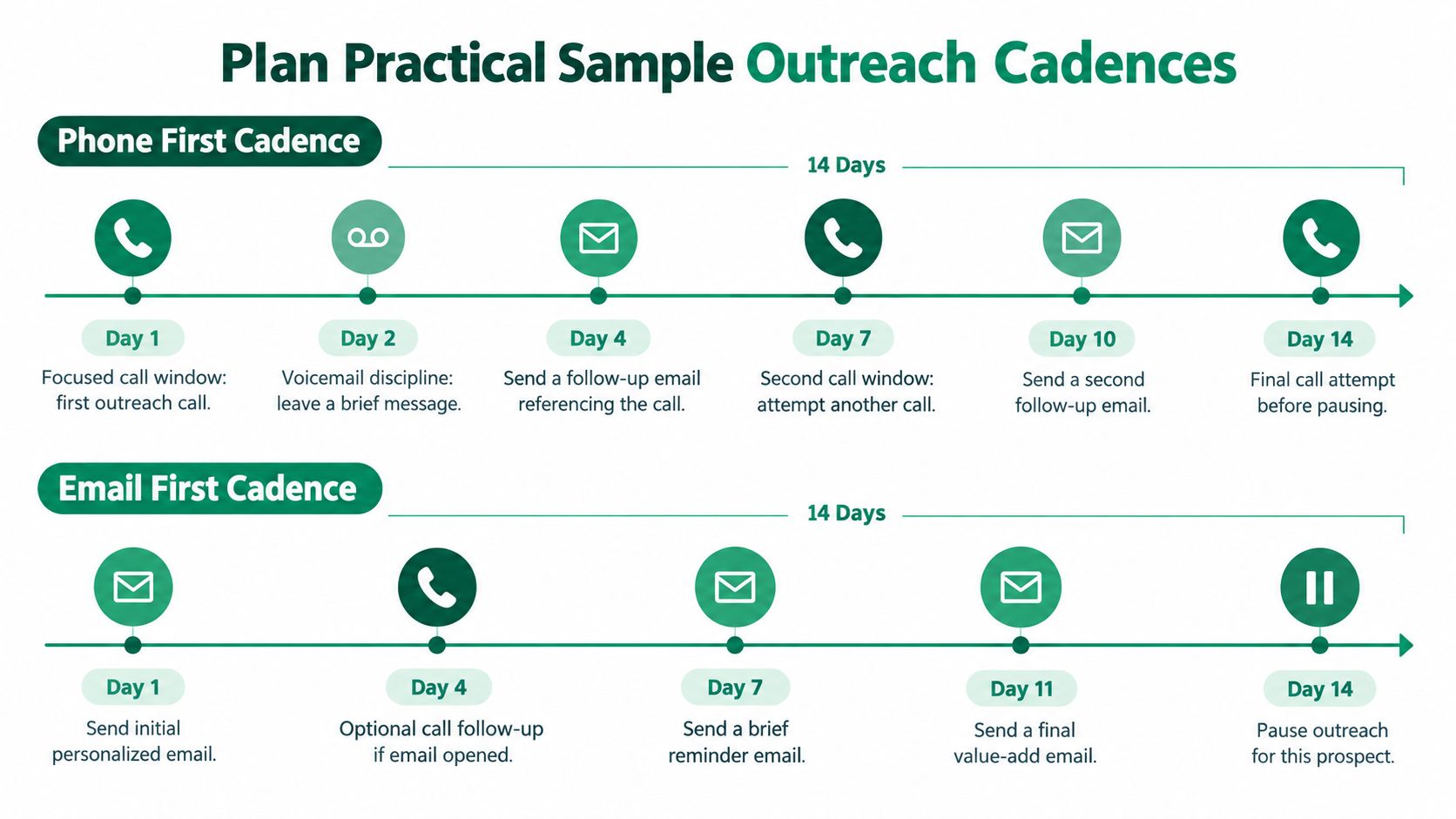
Phone first cadence
Begin in a focused call window, with the account notes visible. If the call reaches voicemail, leave a brief explanation of the business reason where appropriate, then reinforce it by email.
Make the later attempt only while the original reason remains relevant. If there's still no response, send a final concise note and pause rather than letting an automated task queue extend the sequence indefinitely.
- Voicemail discipline: Identify yourself and the issue without delivering a compressed sales presentation.
- Email reinforcement: Reference the attempted call accurately and provide the supporting context.
- Closing action: Record the pause and the event that would justify reopening the account.
Email first cadence
Send the short introductory message with an inspectable proof point and a low friction question. Follow up with clarification or useful material, not a rewritten version of the same request.
Switch to a call when the account warrants dialogue, not merely because a tracking system records an open. The optional call shown in the illustration should remain a judgment call, not an automatic response to that event.
A substantive reply changes the cadence immediately. Answer the question, follow the requested timing, or contact the person the buyer identifies.
Combined cadence
Use email to establish context before calling, or use a call attempt to make the later email recognizable. Keep the subject consistent across both so the buyer doesn't have to reconstruct your reason for contact.
A channel switch should advance the conversation, not repeat the interruption in another format.
Set a finite follow-up limit before launch. Stop on refusal, honor requests not to be contacted, and remove the contact from automation when a real conversation begins.
If another team handles outreach, include these rules with them. When assessing outsourced B2B appointment setting, require access to dispositions, objections, and agreed next actions, not just a list of meetings.
Choose and Measure the Right Outbound System
Choose the sequence before assigning the activity target. Otherwise, representatives will fill the calendar with whatever is easiest to count.
Use these decision checks during account review:
- Evidence: Can the representative show the event and its date?
- Access: Is the named person responsible, and is the contact route verified?
- Interaction: Does the next step need dialogue or written review?
- Economics: Does the potential engagement justify the preparation and follow-up?
- Restraint: What would make the team stop or defer outreach?
Call first when those checks support immediate qualification. Email first when the buyer needs evidence or room to consider the proposition. Wait when the case for contact remains speculative.
Measure the whole path
Track dials, live conversations, conversations with the target person, replies, qualified meetings, held meetings, and revenue. Segment those results by buying signal, seniority, and sequence.
Keep intermediate measures, but don't confuse them with outcomes. An answered call can reach the wrong person. A reply can be a rejection. A booked meeting can fail to meet your qualification criteria.
Define a qualified meeting before launch: the relevant role, a plausible business issue, appropriate scope, and an agreed purpose. Record disqualifications too, because they show where targeting assumptions were wrong.
Diagnose before reallocating effort
When phone connection is weak, inspect number accuracy and reachability. When relevant conversations don't progress, review the hypothesis and offer. When meetings happen but opportunities don't, inspect qualification rather than asking for more activity.
For email, separate delivery problems from audience and proposition problems. Don't ask a copywriter to solve an account selection failure.
There's also an ownership decision. Compare outbound agencies and prospecting software based on which work your team can perform: research, verification, calling, coaching, and response handling.
Judge the system by qualified opportunities relative to total effort. Include preparation and management time in that assessment. A channel that looks inexpensive in the sending tool may still consume substantial labor elsewhere.
Answer Common Channel Questions
Can email strengthen a phone first approach?
Yes. It gives the buyer written context after an attempted or completed call. HubSpot's comparison cites Gong's observational data showing subsequent email reply rates of 3.44% when outreach began with a cold call, compared with 1.81% otherwise. That association supports testing the sequence, not promising the same result.
Should we change channels when results disappoint?
Inspect the records first. Check whether people still hold the relevant roles, whether contact details work, and whether the business observation connects to your offer.
- Bad contact data: Repair the records before increasing activity.
- Wrong ownership: Find the person responsible before rewriting the pitch.
- Weak proposition: Clarify the business question before testing another channel.
What counts as meaningful personalization?
Personalization is an account detail that changes why you're contacting the buyer or what you're asking. Inserting a name or praising a company announcement doesn't meet that standard.
Use the detail to form a testable hypothesis. Keep the distinction between the published fact and your interpretation explicit.
Do opens and answered calls settle the comparison?
No. Neither establishes an active need, appropriate authority, or a worthwhile next step. Use them to diagnose execution, then judge the sequence through qualified conversations, held meetings, and commercial outcomes.
Don't optimize your team around appearing busy. Optimize around learning which accounts deserve a sales conversation and helping those buyers take a useful next step.
Trefle.ai offers Noa, which delivers call ready opportunities with a dated buying signal, proof link, named decision maker, verified direct line, and suggested opener, alongside Managed Outbound for teams that want trained setters to handle the calls. Visit Trefle.ai to discuss whether your team needs researched opportunities to work internally or a phone first service that prospects and books qualified meetings on your behalf.