What Is ICP for B2B Services Firms
What is ICP in B2B, how it differs from a buyer persona, and the steps niche service firms use to target accounts that can buy now.
An ideal customer profile, or ICP, describes the type of company most likely to get strong value from an offer and generate attractive commercial value for the seller. In B2B, it describes the account, not an individual buyer.
A founder or head of sales at a small services or software firm may be working through a familiar problem: referrals and inbound bring some opportunities, but the pipeline still depends on a cold list. The list looks busy because the companies share an industry and a rough size. Yet many have no active need, so calling them feels like pushing uphill.
The issue may not be the list's size. It may be that the target is only a loose filter, not a practical profile for choosing whom to call now. A useful ICP helps separate companies that could benefit from your offer from those that are a strong fit and have a reason to act.
The distinction matters for niche services. A consultancy selling ESG support, an engineering firm, and a specialist software provider may all target B2B companies, but the conditions that make a purchase plausible will differ. You need to decide which account traits belong in the profile, how an ICP differs from a market segment or buyer persona, and how to turn the result into a short list that a small team can actually work.
What an Ideal Customer Profile Actually Means
An ICP is an account-level description of the type of company most likely to receive strong value from an offer and generate attractive commercial value for the seller. In B2B, that means describing the organization, not a single person inside it. Research on business-to-business market segmentation places this kind of profiling within the broader practice of grouping organizations by their needs and the value they can get from a solution.
That definition has two sides. The company should be able to solve a meaningful problem for the customer, and serving that customer should make commercial sense for the seller. A company might want your service but lack the budget, internal owner, or operating conditions needed to make the work viable. Another might have the budget but no active problem to solve. Neither is automatically an ideal account.
A good ICP gives a team a shared way to make that distinction. Instead of asking, “Does this company look roughly like our past prospects?” ask whether the account has the attributes that make it a strong fit, and whether there's a current reason for it to consider buying. The answer should guide research and outreach, not just describe a market after the fact.
Profile the account, not just the person
A buyer persona describes an individual's role, priorities, and motivations. An ICP describes the company that may benefit from the offer. Both can be useful, but they answer different questions. An operations director might care about delivery effort, while the account-level profile tells you whether the company has the kind of operational challenge your service can address.
This distinction helps avoid a common dead end: building a list of people with the right job title and assuming that makes the account a prospect. A relevant title doesn't tell you whether the company fits your delivery model or has a reason to act.
A target list needs more than resemblance
If every row in a spreadsheet shares a sector and rough company size, the list may describe a broad market rather than an actionable ICP. A practical profile states what makes an account worth pursuing and what would rule it out. It should help a salesperson decide where to spend limited research and calling time.
That's the promise of an ICP for a small B2B team: not a perfect prediction, but a sharper way to prioritize accounts. The sections below distinguish a broad market segment from a working ICP, identify useful fit criteria, and show how to add the buying group and timing context that a job title or company filter alone can't provide.
How an ICP Differs from a Market Segment
A market segment is a broad group of potential customers. An ICP is the narrower subset a company should actively pursue. Think of the segment as a neighborhood and the ICP as the short list of buildings worth knocking on this quarter.
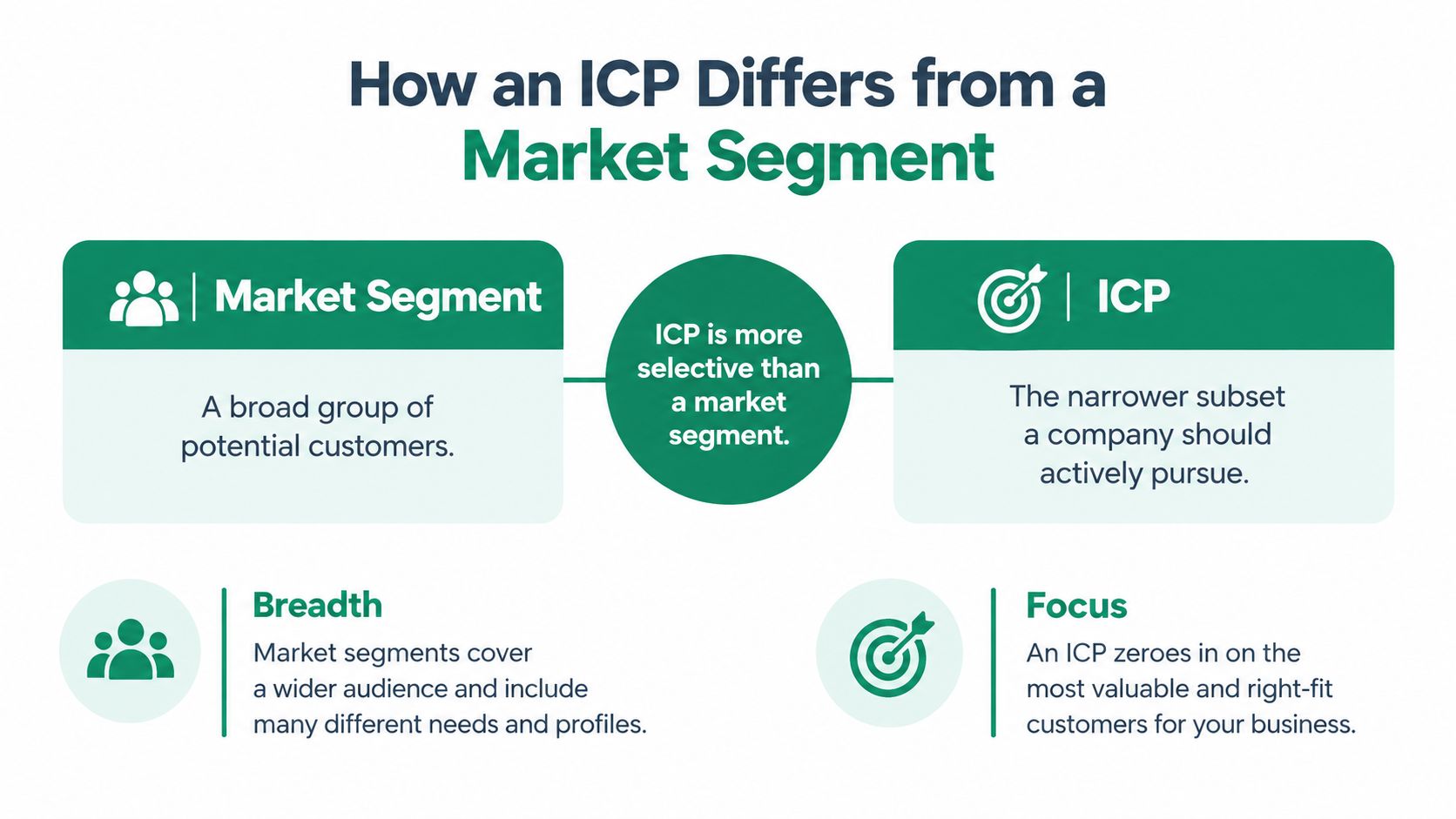
The segment helps you see the market's boundaries. The ICP helps you choose accounts inside those boundaries. A segment might be small B2B companies. To make it useful for outreach, describe the conditions that make a purchase plausible: industry, company size, revenue or budget, geography, operating model, existing technology, and the business problem being solved.
Narrow the broad group to buying conditions
For example, “small B2B companies” doesn't tell a salesperson which accounts to call first. A more actionable profile might focus on companies with 5 to 200 employees, deals above roughly $10,000, a sales-led motion, and a current trigger such as a relevant hire, funding, leadership change, certification, or regulatory deadline. The size and sales motion help assess fit. The dated event offers a reason to make contact now.
These are practical example criteria, not universal thresholds. A firm's actual ranges should reflect its offer, delivery capacity, and sales economics. The test is whether each criterion helps distinguish accounts worth pursuing from those that are merely part of the wider market.
Business segmentation is an ongoing process of grouping prospective and existing customers with similar needs within groups and different needs across groups. That makes an ICP a working cut of the market, not a slogan to put on a slide. A market-mapping approach to B2B segmentation can help turn a broad market view into a more focused account definition.
Practical rule: Keep the broad segment for market sizing. Use the ICP to decide where this week's research and outreach should go.
The distinction changes how a cold list gets used. A database may contain hundreds of companies that match a sector and size filter. The ICP should help a small team find the narrower group that fits the offer and has a plausible buying context, rather than treating every match as equally valuable.
Fit Criteria That Make an Account Worth Pursuing
Firmographic criteria help a sales team describe observable company traits. Common examples include industry, employee count, revenue, location, and organizational structure. These are useful because they can be applied consistently across a large market. They can narrow a list, but they don't prove an account is ready to buy.
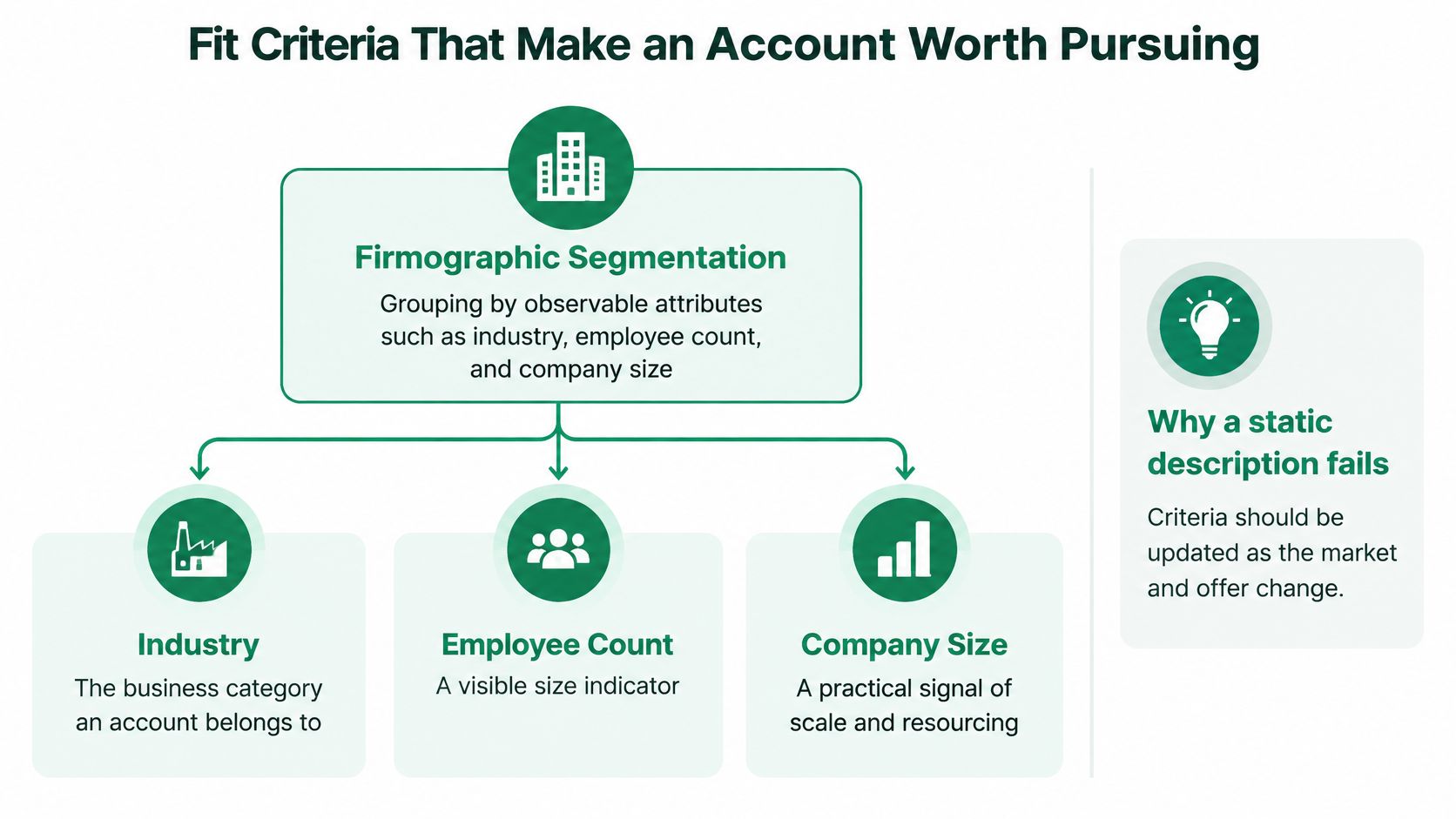
Two engineering firms with similar headcounts may have very different priorities. One may have just won a contract that calls for specialist support. The other may be cutting costs and delaying outside work. Firmographics help estimate fit. The business need and its timing tell you whether an account is worth approaching now.
Add the buying context
A useful profile describes more than the company's visible attributes. It should say what job needs to get done, which function owns that problem, what budget or deal economics make the work viable, which tools or systems affect delivery, and what evidence suggests the need is active. For a consultancy, the evidence might be a new executive or a public certification milestone. For specialist software, it might be a hiring pattern that points to an operational gap the product addresses.
Static description and buying readiness become distinct here. Fit criteria describe whether the account suits the offer. A dated signal suggests why the company may act now. A practical guide to B2B buying signals can help teams identify public changes worth checking against their account criteria.
Treat the profile as something to test
A systematic review of 88 papers on B2B segmentation organized the work into four connected stages: pre-segmentation, segmentation, implementation, and evaluation. It also notes that firmographics alone don't establish that an account is ready to buy. The review of business-to-business segmentation supports treating the ICP as a process to test and revisit, not a spreadsheet to complete once and forget.
Write down inclusion and exclusion rules that a salesperson can apply without guessing. For example, record the employee range, minimum deal value, target sector, geographic coverage, relevant technology, and live business problem that qualify an account. Then state clear reasons to exclude it, such as a delivery model your team can't support or a company without the operating conditions your offer requires.
When the profile produces weak conversations or poor-fit opportunities, check the criteria against what's happening in actual sales. The goal isn't to add every imaginable field. It's to define fit clearly, then use observable evidence to rank which fitting accounts deserve attention first.
Why a Buyer Persona Is Not an ICP
A buyer persona describes a person's role and motivations. An ICP describes an organization. A buying group maps the people whose agreement, input, or approval can affect a purchase. Each tool answers a different question, and a sales team can't substitute one for the others.
| Tool | What it describes | Question it answers | Use it when |
|---|---|---|---|
| ICP | The organization that fits the offer | Which accounts should we pursue? | Defining account-level inclusion and exclusion rules |
| Persona | One role's priorities and concerns | What matters to this person? | Tailoring a message to a specific person |
| Buying group | The people who shape or approve the purchase | Who needs to agree, and what evidence do they need? | Planning how to engage an account |
The buying group is easy to overlook when prospecting begins with a title search. Demandbase reports that 72% of B2B purchases involve complex, multi-stakeholder buying groups, which typically contain 7 to 10 stakeholders, and that 77% of buyers prioritize integration capabilities over standalone features. Demandbase's report on B2B buying highlights why a single persona can leave important concerns outside the sales conversation.
Map influence, not just seniority
A small consultancy or software firm can begin with a simple account map. Identify the business owner, problem owner, daily user, technical or compliance reviewer, finance approver, and anyone likely to block implementation. These roles may sit in different people, or one person may cover several of them.
Then prepare for the concerns each person is likely to raise. A founder may focus on revenue or risk. An operations leader may want to understand implementation effort. Finance may ask whether the case justifies the spend. IT may be concerned about integration or security work. These are useful working assumptions to validate in conversation, not labels to treat as facts about every buyer.
A recent G2 report found that in 2025, departmental leaders' influence in B2B purchase decisions increased by 6 percentage points, while end-user champions' influence increased by 5 points. G2's 2025 buyer behavior report supports looking beyond the economic buyer when deciding which people matter inside an account.
Calling the most senior person first may be inefficient if that person doesn't own the problem or lacks the evidence needed to sponsor a purchase. Start with the person closest to the need, then learn who else must be involved. A useful ICP should help identify the right account; a buying-group map helps your team understand how a decision can actually happen inside it.
ICP Examples for Niche B2B Services
The same two-layer profile can look different across service businesses. In each case, stable account fit narrows the field, while a dated trigger gives the team a reason to investigate now.
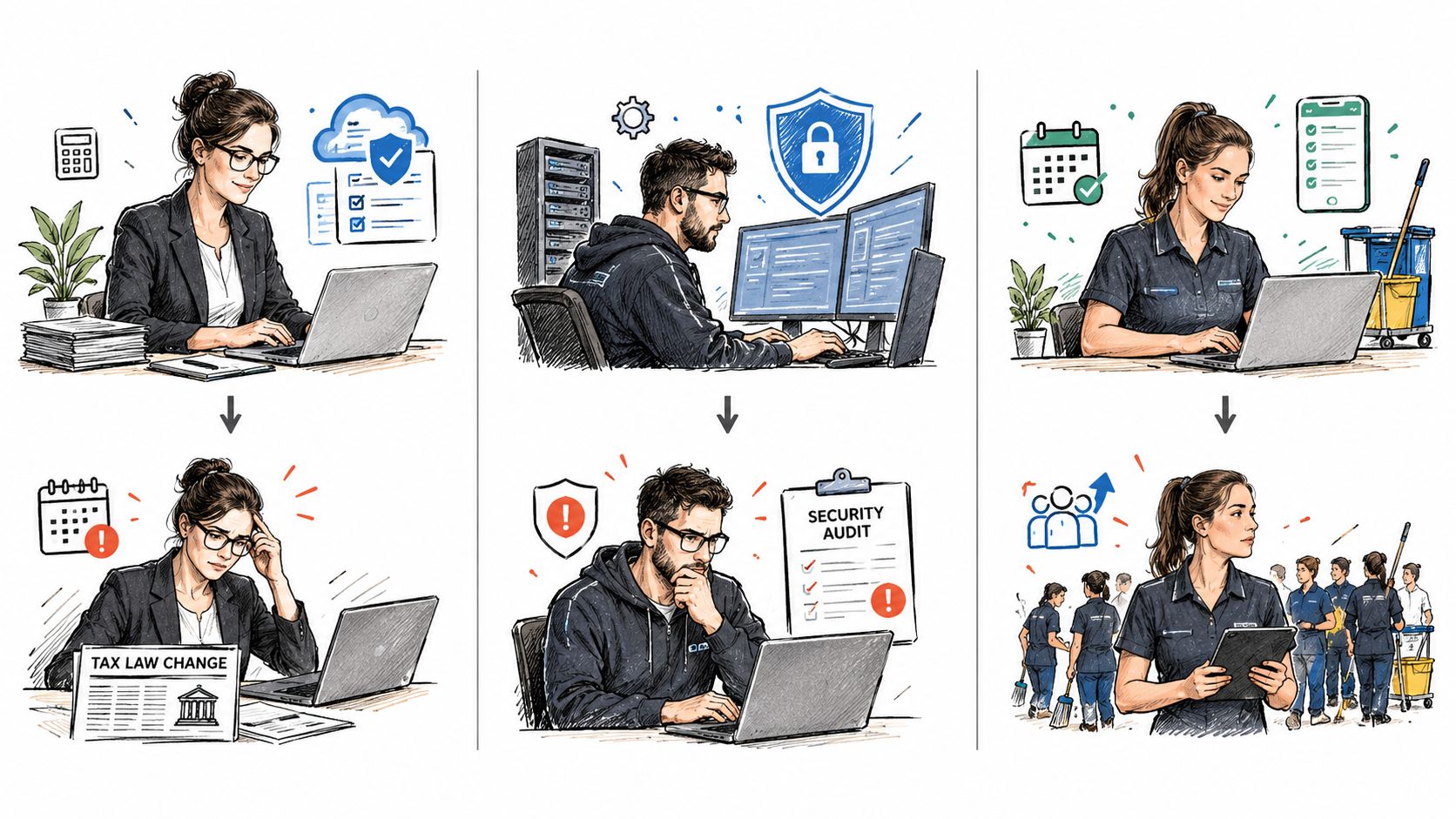
ESG and sustainability consultancy
A consultancy might focus on companies whose size, operating model, and budget suit its work. A relevant hire, such as a sustainability or CSR lead, can signal that the company is building internal ownership. A regulatory deadline or reporting obligation may make the need more immediate.
The new lead is likely close to the problem, but the founder or finance approver may still influence whether outside support gets funded. A call is rational when the consultancy can connect the visible change to a specific service it can deliver. This overview of ESG and energy consulting for lead generation offers related context for firms working in that niche.
Engineering and technical services
An engineering firm may fit based on the kind of work it performs, the delivery model it can support, and whether the account's needs are within its capabilities. A permit, certification, newly won contract, or market expansion can provide timely evidence of a project need. The project owner may feel the pressure first, while procurement or a technical reviewer can affect the decision.
A matching industry code alone doesn't make a call timely. The trigger gives the salesperson something concrete to verify and a reason to ask about the account's plans.
Compliance, strategy, or management consulting
For a consultancy serving founder-led companies without a sales team, fit may depend on an expertise-led or sales-led motion and deal economics that make the work commercially sensible. A new executive or a visible operational problem can indicate that the company is reassessing how it operates.
The executive or team responsible for the problem may be the right person to approach. The founder can still shape the decision, while finance may ask how the work will pay off.
In each example, use a compact record: inclusion rule, exclusion rule, signal, signal date, and the person who feels the problem. A dated trigger can make the account worth investigating, but it doesn't guarantee a need, budget, or willingness to engage. Confirm those conditions in the conversation.
How to Build and Test an ICP
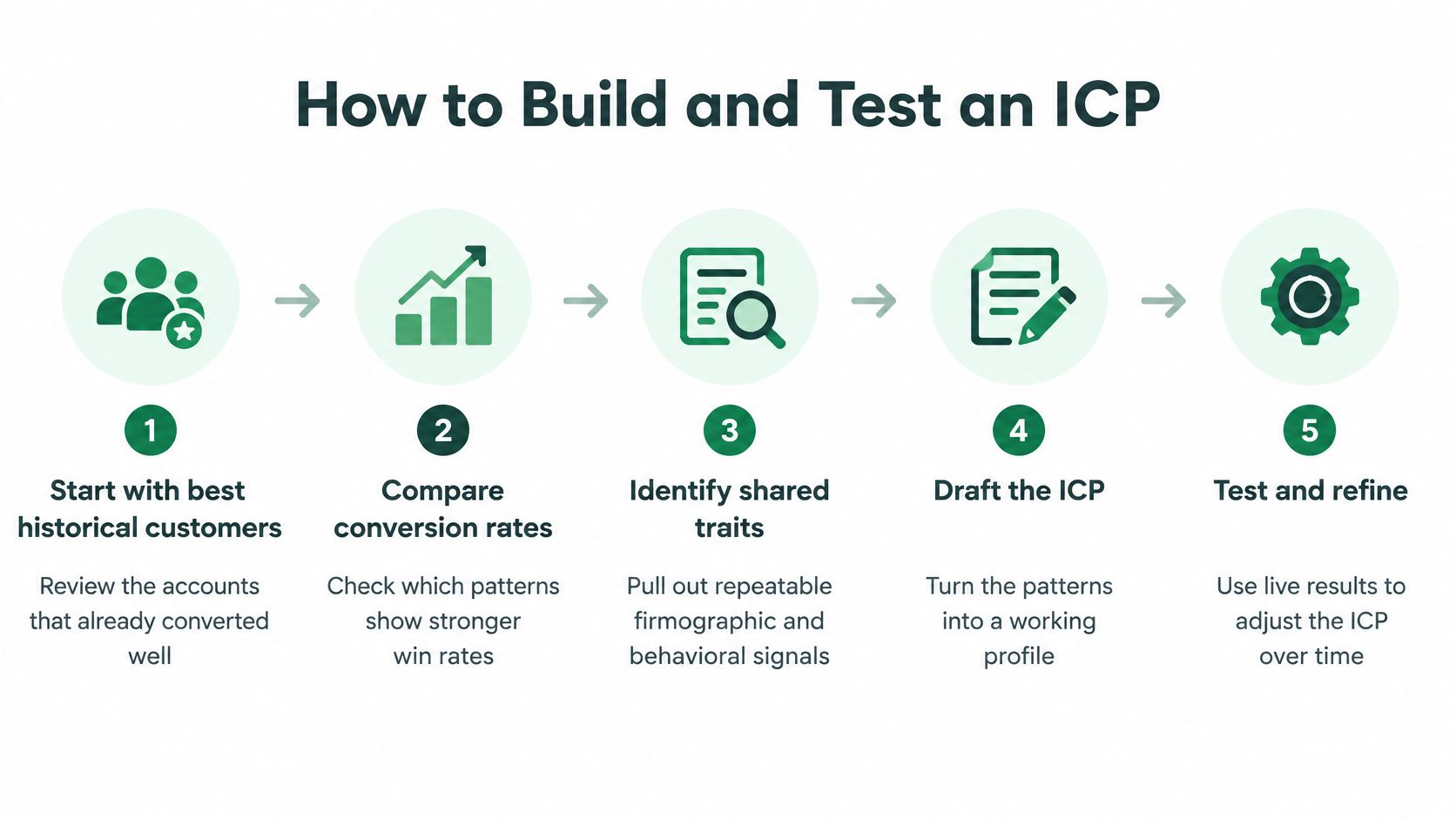
Start with the accounts your business already serves well. Salesforce describes ICPs as combining firmographic, behavioral, and environmental characteristics, including economic and regulatory conditions. It also recommends calibrating criteria against strong historical customers by comparing conversion speed, contract value, retention, expansion, and delivery cost. Salesforce's guide to building an ideal customer profile provides a useful basis for that review.
Build a profile your team can apply
Review strong customers. Compare the accounts that produced good commercial outcomes and were practical to serve. Look for recurring company traits and buying conditions, not just shared sectors.
Write inclusion and exclusion rules. Specify the account types worth pursuing and the circumstances that disqualify a prospect. Keep the rules clear enough that two people reviewing the same company would reach a similar conclusion.
Add only useful technology and operating criteria. Include current systems, delivery conditions, or organizational details when they change whether your offer can work. Skip fields that make the profile harder to apply without improving account decisions.
Record dated signals. Track relevant hiring, funding, leadership changes, deadlines, permits, certifications, or market expansions. For each signal, save its date, source, account, and the business function it affects. A signal is more useful when a salesperson can verify it and explain why it matters.
Test the resulting priorities. Look at the path from contact to qualified conversation, meeting, opportunity, and closed revenue. If the profile generates activity but not good opportunities, revise the rules or the signal logic. Score at the company level with weights a salesperson can explain, and recalibrate when results suggest the assumptions aren't working.
Choose tools for the job
Lead databases such as Apollo, ZoomInfo, and Lusha help build lists from static company and contact filters. Signal and intent tools such as Clay, Common Room, Bombora, and Cognism can add context about activity or buying interest. Those tools solve different research problems, and none replaces a clear definition of what makes an account a fit.
Trefle.ai's Noa delivers a weekly feed of call-ready opportunities with the company, a named decision maker, a verified direct line, a dated signal with a proof link, and an opening line. Its Managed Outbound service finds opportunities and prospects by phone to book meetings, while custom projects build signal-based datasets and market maps. It's not a lead database, a mass cold-email tool, or a generic lead-generation agency. Choose a database when you need broad coverage, a signal tool when you need buying context, or an execution service when research and phone outreach are the bottleneck.
Put Your ICP to Work This Week
Don't wait for a perfect profile before using it. Write a one-page version with three inclusion rules, two exclusion rules, and one public signal your team can spot, such as a relevant hire, funding event, leadership change, or regulatory deadline.
Then select five accounts that meet the fit rules and show that signal. Name the person closest to the problem instead of defaulting to the most senior title. Before calling, write one opening line tied to the specific event and its source. That makes the reason for the conversation clear and gives the prospect a chance to confirm or correct your read.
If your team lacks time to research, another static list may add volume without resolving the timing problem. A signal-based feed can help surface accounts with a verifiable reason for outreach; a phone-first service can take on prospecting and meeting booking. A custom market map can help when the first question is which accounts belong in the addressable market at all.
The test is whether your team spends less effort on companies with no current need and more time on accounts where fit and timing both hold. A working ICP should leave you with a short, explainable list of companies to contact, not just a definition to revisit later.
If you want call-ready opportunities tied to verified, dated buying signals, explore Trefle.ai. You can also review Managed Outbound for phone-first prospecting or request a custom market map to define and prioritize your addressable accounts.