30-60-90 Day Sales Plan: Phased Goals and Milestones
Build a 30-60-90 day sales plan with phased goals, daily activities, and measurable milestones for each checkpoint.
You've hired a salesperson, given them access to the CRM, and asked for a plan. Their calendar is filling up, but the pipeline still looks thin. You're trying to decide whether they need more coaching, better prospects, or just enough time for a buyer to make a decision.
A 30-60-90 day sales plan should help you make that decision. It should distinguish learning from execution, measure progress you can verify, and avoid judging a new rep on revenue that couldn't realistically close yet.
The 30-60-90 Day Plan at a Glance
| Phase | Main Goal | Core Activities | Milestone to Check |
|---|---|---|---|
| Days 1 to 30 | Learn the product, market and sales process | Shadow live calls, run role plays, build the ideal customer profile, research accounts | Written ICP and a ranked account list where each account has a dated buying signal and a verified decision maker |
| Days 31 to 60 | Turn activity into qualified conversations | Live calls, signal based messages, weekly pipeline review | Qualified conversations with decision makers and first qualified meetings on the calendar |
| Days 61 to 90 | Prove repeatability and forecast reliability | Independent prospecting, opportunity progression, forecast calls | Pipeline at or above the ramp target and a forecast the manager can trust |
The order matters because each phase exposes a different problem. Early assessment tests whether the rep understands what they're selling and who should buy it. Live execution then tests whether that understanding survives contact with buyers. Independent ownership finally tests whether the rep can prioritize accounts, move opportunities forward, and explain what will happen next without the manager supplying every answer.
Keep the deliverables concrete. A completed training module proves attendance, not competence. A rep explaining why an account fits, handling a realistic objection, and recording a defensible next step gives the manager something useful to assess. Likewise, a meeting on the calendar isn't automatically a qualified opportunity. The buyer must have a relevant problem and a credible reason to continue.
Practical rule: Advance the rep when they demonstrate the capability, not merely when the calendar reaches the next phase.
Managers also need obligations in the document. Name who approves account selection, reviews calls, resolves product questions, and removes CRM blockers. Otherwise, the rep can miss a milestone because nobody reviewed their work, while the manager interprets the delay as poor execution.
This table is a ramp framework, not a promise of full quota by day 90. Sales onboarding coverage from Gray Group International summarizes Sales Management Association research indicating that a new representative can take more than 10 months to reach full productivity. The checkpoint should therefore establish what the rep can reliably do next, not manufacture a revenue deadline disconnected from the buying process.
Why Long Sales Cycles Change the Numbers
The weak assumption behind many templates is that learning the job and completing a buying cycle fit inside the same quarter. For complex services and software, those are separate timelines.
A Sales Benchmark Index ramp study found that only 7.3% of representatives reached full productivity in fewer than three months, while 50.7% required three to six months. Treating the fastest group as the default creates an assessment problem: you can reject a capable seller before their opportunities have had time to mature.
| Role or Motion | Typical Ramp to Full Productivity | Day 90 Proof Point | Revenue Expectation at Day 90 |
|---|---|---|---|
| SDR or outbound setter | About 3.0 months | Verified accounts, qualified meetings, show rate | Partial or none |
| Account executive handling complex, larger deals | About 6.2 months, a broad AE benchmark rather than a deal size specific result | Engagement across stakeholders, stage progression, qualified pipeline | Reduced ramp quota, not full quota |
| Founder led sales with a cycle over 90 days | Not reliably measurable within the review window | Signal verified opportunities and first decision maker conversations | Pipeline and forecast reliability only |
The role benchmarks summarized by Common Room put average SDR ramp at approximately 3.0 months across 351 B2B companies, compared with 6.2 months for account executives across 158 B2B companies in a separate Bridge Group benchmark. These are reference points, not commitments for an individual hire.
Match accountability to the buying process
An SDR can be productive without closing revenue because another person owns the sale. Assess whether their meetings meet the agreed qualification standard and whether buyers attend.
An account executive needs different evidence. Can they reach the economic buyer, involve technical or operational stakeholders, and confirm the approval process? A proposal sent without those answers is weaker evidence than a discovery meeting that establishes them.
For founders, early selling also tests the offer itself. If buyers recognize the problem but won't prioritize it, increasing outreach may only repeat an unresolved positioning mistake.
When a complete buying cycle exceeds the review window, reduce the revenue expectation. Keep demanding buyer evidence and documented progress. Don't confuse patience with permission to carry unsupported opportunities indefinitely.
Set Up the Plan Before Day One
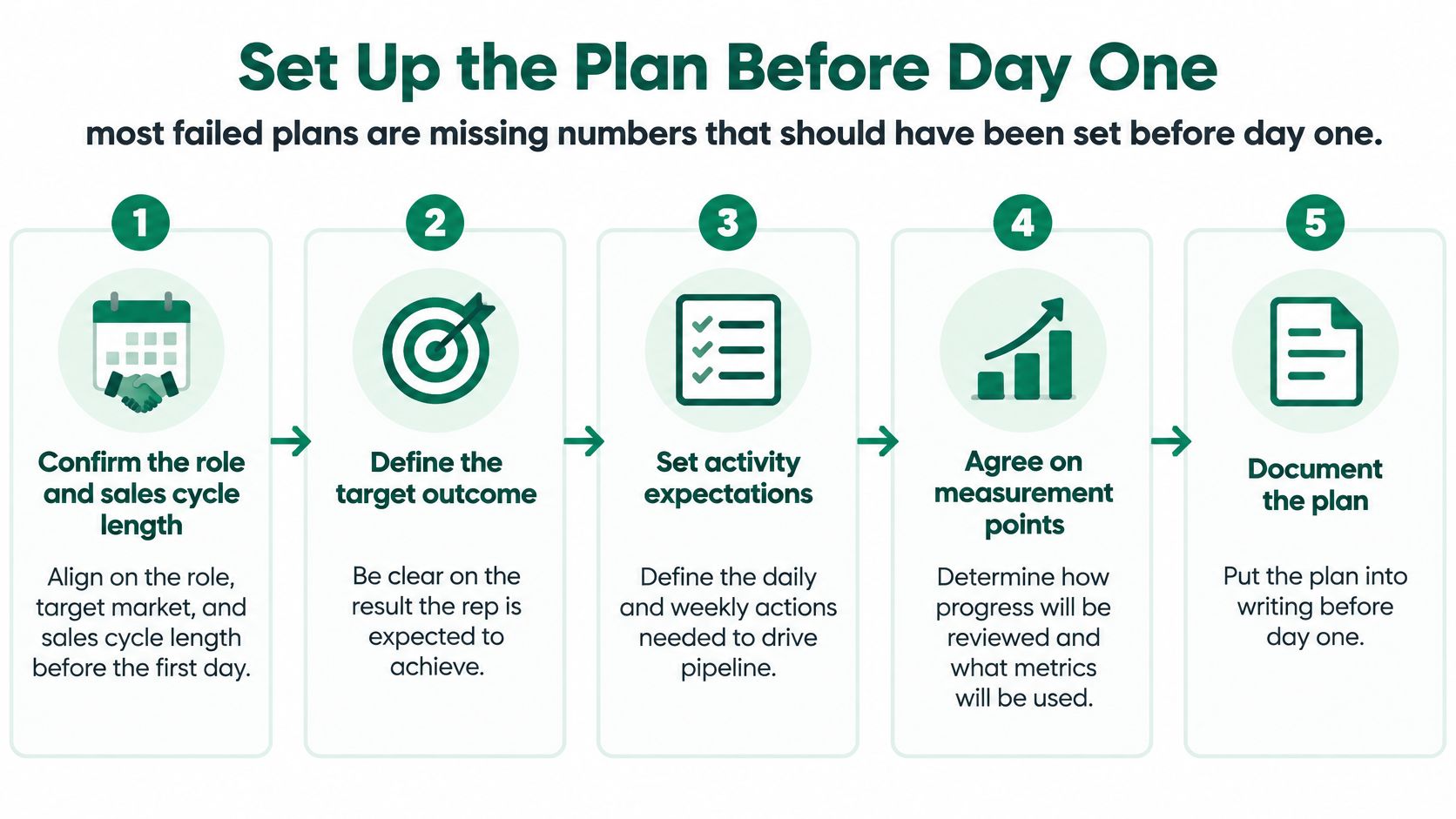
Most failed plans are missing numbers that should have been set before day one.
Use this preparation flow to put expectations into writing before prospecting begins.
Establish the operating assumptions
Confirm the role and sales cycle. Specify whether the person owns prospecting, closing, or both. Use recent completed deals to understand the interval between first substantive conversation and decision, including procurement delays.
Write the ICP and offer separately. The ideal customer profile identifies suitable companies, buyers, and exclusions. The offer explains the problem you solve, the result you deliver, and why a buyer would act now. Include triggers such as hiring, funding, new leadership, regulatory deadlines, or certifications.
Record the baseline. Export the trailing quarter's conversations, meetings, proposals, and outcomes from Salesforce, HubSpot, or your existing CRM. Separate decision maker conversations from exchanges with people who can't sponsor a purchase. If the founder is the only seller, label that baseline accordingly rather than treating it as a proven rep benchmark.
Choose the scorecard. Use verified contacts, qualified conversations, qualified meetings, pipeline value, and forecast accuracy. Define what qualifies for each metric before creating the dashboard.
Book the checkpoint reviews. At each phase boundary, review evidence, diagnose gaps, agree corrective action, and approve the next expectations. Record decisions in the same document so nobody has to reconstruct them from messages.
Check that the plan can actually run
Test measurement immediately. Confirm that the team can capture each metric using tools it already has. A dashboard that depends on missing CRM fields won't help this week.
Assign a baseline and owner. Name who maintains contact quality, approves qualification, and checks reporting. Any target without a baseline is a guess.
Agree the possible outcomes. Decide in advance what justifies a full territory, extended coaching with a dated reassessment, or a role change. Don't invent the criteria during the performance review.
A B2B market mapping process helps separate missing prospecting inputs from weak rep execution. At Trefle.ai, our Market Map includes ICP and offer definition, dynamic prospect identification, accurate emails and phone numbers, and accounts reviewed, scored, and prioritized. Your reps can run the calls from those inputs; scope and pricing are defined in a written proposal.
For a fully managed engagement, agents handle research, outreach, and follow ups, and the client's team only takes the meetings. Those are different operating models, so assign responsibilities accordingly.
Use the accompanying video alongside the written preparation checklist.
Days 1 to 30 Learn Before You Pitch
The opening phase should produce demonstrable competence and a usable target list, not pressure to manufacture revenue. Give the rep access to real buyer questions, lost deal notes, recorded discovery calls, and the people responsible for delivering what sales promises.
Build understanding in the right order
Product and offer come first. The rep should explain the buyer's problem, the boundaries of the service, and what implementation requires. Test whether they can say when the offer isn't suitable. Someone who promises everything creates delivery risk before they create useful pipeline.
Next, study customers and the market. Compare suitable accounts with attractive looking companies that don't buy. Investigate who initiates the purchase, who approves it, and what changed before the conversation began. Use B2B buying signals to distinguish a relevant account from one with a timely reason to engage.
Then teach CRM and qualification rules. Have the rep create a sample record, document a buying trigger, assign a stage, and record a next action. They should understand what evidence permits stage advancement and when an account should leave active prospecting.
Finally, develop call and message basics. Shadow live calls, practise objection handling, and score a simulated conversation against discovery, relevance, listening, and next step quality. Pipedrive's sales onboarding guidance supports manager scored simulations and a proposed day 10 ICP gate as practical ramp milestones.
A rep who can repeat the pitch but can't explain why a particular buyer should care isn't ready for independent outreach.
Make the readiness gates explicit
For an initial research exercise, give the rep a manageable account sample rather than an unrestricted database. Require a signal date, evidence link, buyer role, and verified reachable channel for each account.
- Day 10 gate: Manager approved written ICP and qualification checklist.
- Day 30 gate: Ranked account list with dated buying signals and verified decision makers, plus a manager scored simulation demonstrating readiness.
Don't use raw call count as the success measure here. Assess what the rep can explain, demonstrate, and document accurately.
Days 31 to 60 Turn Activity Into Real Conversations
The rep now needs controlled exposure to real buyers. Keep account selection narrow enough that they can recognize patterns instead of constantly switching industries, personas, and offers.
Start each working day with separate blocks for research, outreach, and follow up. Research prepares the next accounts. Outreach tests the message. Follow up keeps an interested buyer from disappearing because the rep moved on to a fresh list.
A Prospeo sales plan template recommends at least 50 outreach attempts per day and 15 meetings booked during days 31 to 60. Treat those as a published reference to test against, not a universal minimum or a ceiling. A complex technical sale may require more preparation, while a well defined segment may support greater volume without weakening qualification.
Test relevance before increasing volume
Build each message around a specific change and its likely business consequence. Say an engineering consultancy identifies a manufacturer expanding production capacity. The opener should connect that expansion to a relevant engineering requirement, then ask whether the requirement exists.
It shouldn't pretend that public evidence proves budget or purchasing intent. A signal justifies a question; the conversation establishes the need.
Record the signal category, buyer persona, response, and qualification outcome in the CRM. Change one meaningful variable at a time so the rep can distinguish a poor segment from an ineffective opener.
- Retain useful signals: Prioritize triggers that lead to substantive conversations, not merely polite replies.
- Repair weak contact coverage: If calls reach the wrong function, correct the account map before rewriting the pitch.
- Remove false positives: Exclude accounts whose apparent trigger doesn't create a problem your offer solves.
Review buyer movement every week
Inspect opportunities individually. Check the latest buyer action, the next step date, and whether the rep has identified the economic buyer. If access is missing, agree how the rep will establish it rather than filling the field with a guessed name.
Keep meeting quality visible when evaluating outsourced B2B appointment setting or internal setters. A booked slot and an attended, qualified discussion are different outcomes.
By the phase review, the rep should explain which signals work for which segments, which objections block progress, and what they'll change. If they can only report activity totals, the team hasn't captured enough learning to scale responsibly.
Scorecard Targets for Each Checkpoint
| Metric | Day 30 | Day 60 | Day 90 |
|---|---|---|---|
| Verified target accounts | Ranked list complete | Weekly additions with verified contacts | Maintained list with verified decision makers |
| Qualified conversations with decision makers | Baseline recorded | Agreed partial share of mature weekly rate | Agreed near mature weekly rate |
| Qualified meetings booked | Learning phase, no output target | Agreed partial share of mature weekly target | Agreed near mature weekly target |
| Forecast accuracy | Not yet required | Tracked weekly and reviewed | Improving against the agreed baseline |
Use role specific percentages of a mature benchmark, rather than copying another company's meeting count. Set those percentages during setup according to territory quality, available selling time, and buying cycle exposure. They should represent an achievable progression, not a disguised full quota expectation.
Define the mature rate as the steady state weekly count of qualified conversations and qualified meetings from the team baseline recorded during setup. If the baseline mixes inbound leads, founder relationships, and cold outbound, separate them before applying it to a new outbound hire.
Make pipeline and forecasting defensible
During days 61 to 90, require independent prospecting alongside opportunity management. The rep should refresh account priorities, remove stale opportunities, involve additional stakeholders, and maintain buyer agreed next steps without prompting.
Set the ramp period pipeline target from the role's revenue expectation for a complete sales cycle and the team's observed win rate. Don't multiply an existing pipeline target by another coverage factor. That double counts coverage and can encourage inflated opportunity values.
Define forecast accuracy consistently. For this scorecard, use the share of deals forecast to close in a period that close in that period, preserving the original forecast snapshot. Review it weekly from the first forecast call, and examine deal count and value separately where deal sizes differ.
An ORM sales planning example reports forecast accuracy improving from 85.7% in week 1 to 92.9% in week 6 for Q3 2025. That example isn't a universal target, and its calculation shouldn't be assumed identical to yours. Use it as an illustration of tracked improvement, not proof that a new hire should achieve a particular percentage.
Review standard: Ask what the buyer did that supports the forecast, not how confident the rep sounds.
Diagnose the gap before judging the rep
Close the review by separating input quality, selling skill, and buyer timing. A strong conversation rate with weak stage progression needs different coaching from accurate account research with poor decision maker access.
Watch for these mistakes:
- Counting unverified contacts: An impressive list is useless if the people are wrong or unreachable.
- Rewarding raw call volume: Activity without qualification can conceal poor targeting.
- Treating an early win as repeatability: Assess whether the rep can sustain the process, not whether one buyer happened to be ready.
Trefle.ai supplies signal based market maps and verified decision maker contacts so your ramp plan starts with usable accounts, not research backlogs. If you want prospecting handled for you, our Managed Outbound service books qualified meetings for your team. Visit Trefle.ai to discuss which approach fits your sales cycle and the responsibilities in your ramp plan.