Sales How to Handle Objections Step by Step
Use this sales how to handle objections guide to classify, pause, ask one question, and choose the next step.
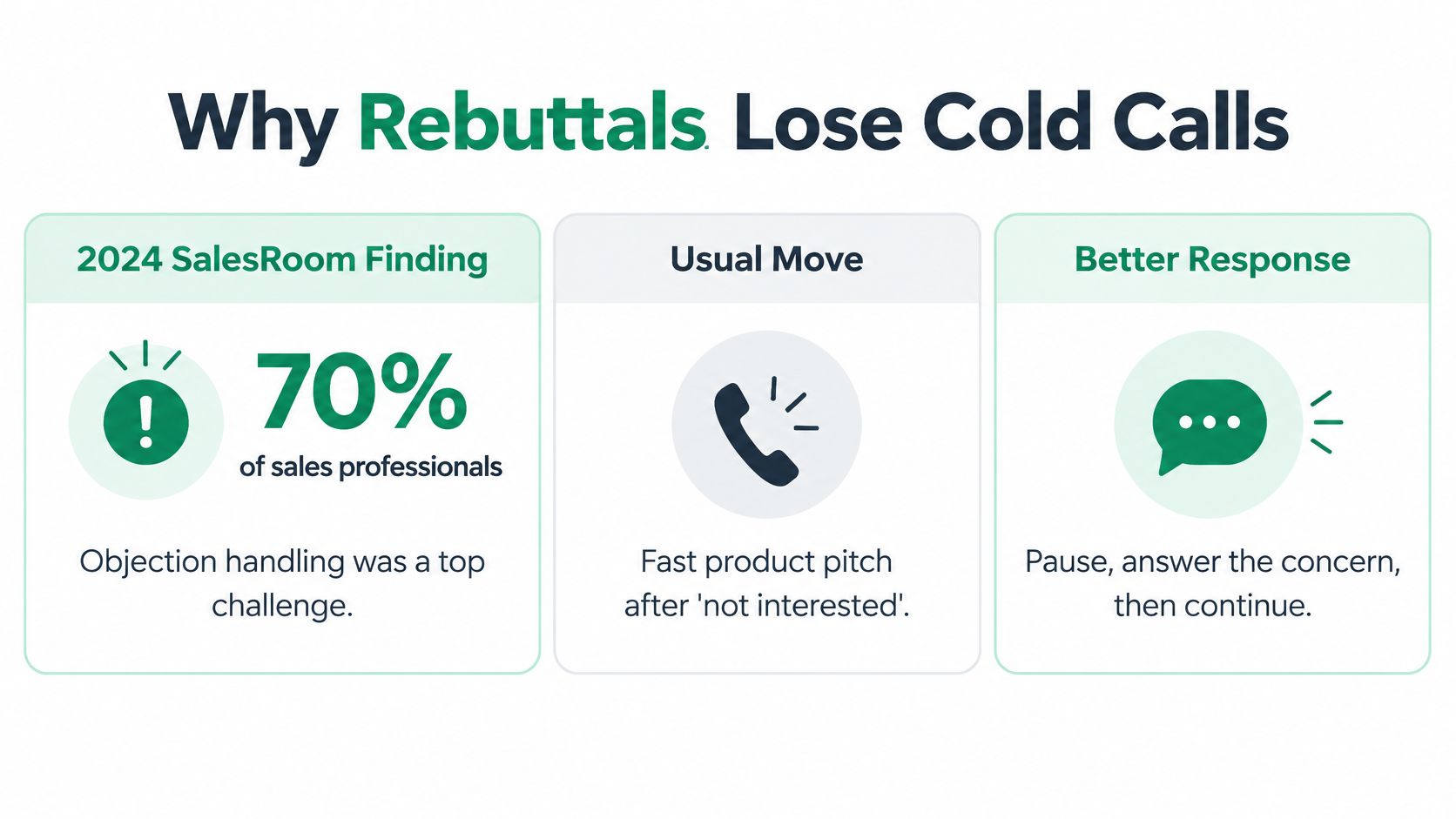
In 2024, SalesRoom reported that objection handling was a top challenge for 70% of sales professionals. The useful response isn't a sharper comeback. It's a better diagnosis of what's stopping the buyer from taking the next step.
Why Rebuttals Lose Cold Calls
Say a founder calls an operations director about prospecting support. The buyer says they're not interested. The founder immediately explains the targeting, contact verification, reporting, and meeting process.
The explanation might be accurate. It still answers a question the buyer hasn't asked. The buyer could be satisfied with an incumbent, short on capacity, outside the target market, or unwilling to discuss an unexpected call.
The words are a symptom. The constraint is what you need to identify. A product pitch before diagnosis makes the buyer work harder to end the conversation.
Replace persuasion with a decision
For founders and sales leads at small B2B services and software firms, phone time competes with delivery, hiring, and account management. You can't afford to turn every brush off into an extended discovery exercise. You also shouldn't abandon a relevant account because its buyer's first response was defensive.
Keep the work in this order:
- Classify what you heard. Separate a dismissal from a practical constraint or an existing solution.
- Answer only the constraint. Don't attach a feature tour to a narrow concern.
- Decide the next action and log it. Advance, offer evidence, arrange a justified follow up, or release the account.
The difference is visible in the response you choose after the objection.
Fix execution before adding capacity
Adding a caller won't resolve an unclear qualification standard. Buying software won't make an irrelevant opener useful. When weighing outsourced prospecting against prospecting software, decide who will own account selection, live conversations, and the judgement to stop.
A founder searching for sales how to handle objections advice needs something usable beside the phone, not a library of clever replies. A compact objection map, a repeatable response sequence, and explicit exit criteria are enough to begin. Use the classification sheet below during calls, then refine it from the constraints buyers name.
The Three Objection Types on Most Calls
Cold call objection types and the first move
| Type | Share | What they mean | First question | Next step |
|---|---|---|---|---|
| Dismissive | 49.5% | Rejecting the interruption, not always the offer | Is this not a priority, or do you already have a way to spot active demand? | Ask a short question, then stop if the answer stays vague |
| Situational | 42.6% | A constraint in fit, budget, timing, or bandwidth | Which of those is blocking a conversation this month? | Answer only that constraint and ask for a small next step |
| Existing solution | 7.9% | An incumbent, internal process, or competitor already preferred | What does the current setup miss when a new buying signal appears? | Compare on a dated signal, not a full pitch |
These shares come from Gong's analysis of more than 300 million cold calls, which reports that the five most common objections represent 74% of all objections and classifies 49.5% as dismissive, 42.6% as situational, and 7.9% as existing solution objections.
Treat the classification as provisional
The table is a routing aid, not permission to decide what a stranger secretly means. A dismissive opening can lead to a concrete constraint. An apparent timing issue can turn out to be satisfaction with the current provider.
Listen for what changes after clarification. If the buyer names an owner, a process, or a business event, use that information instead of continuing down your original script. If they explicitly decline further discussion, accept the refusal.
Dismissive objections need restraint. They don't justify an attempt to explain every possible source of value. Your immediate task is to establish whether there's a relevant conversation available at all.
A permission based clarification might be:
Fair enough. Before I let you go, is the issue that you already have enough opportunities, or that identifying them is handled manually?
If the buyer confirms a manual process, don't assume it's broken. Find out whether it produces the right opportunities at an acceptable effort level. Manual work can be deliberate and effective.
If they describe a gap, connect your response to a dated buying signal and the verified person responsible for the purchase. That is a concrete comparison. Generic claims about generating more leads aren't.
Keep training narrow enough to use
Situational objections deserve a response to the named limitation. Budget calls for a discussion of funding, scope, or value. Bandwidth calls for clarity about ownership and workload. Mixing those answers creates unnecessary work for the buyer.
Existing solution objections call for respect for switching costs. A functioning provider or internal process has advantages: familiarity, established relationships, and less implementation risk. You need a specific unmet requirement before proposing a comparison.
Build your coaching sheet around:
- Recognisable buyer language. Record the phrases your market uses.
- A permission based question. Make it easy for the prospect to clarify or decline.
- A relevant proof asset. Match evidence to the constraint, not merely the industry.
- An exit condition. Define when the caller should stop instead of improvising another pitch.
Don't train callers to deliver the table verbatim. Train them to recognise which decision they need to make.
Stop the Objection Before You Dial
According to the buyer findings summarized in Ringy's guide to handling sales objections, 94% of B2B buying groups rank a preferred vendor before speaking with a sales representative, and those early favorites win 77% of the time. A first sales conversation may therefore start after the buyer has already formed a preference.
That changes the job of cold outreach. You're not always introducing an unfamiliar category to an undecided buyer. You may be asking someone to reconsider an arrangement they already trust.
Give the buyer a reason to reconsider
A generic industry match isn't enough. Select an account because something relevant has changed, then verify the event before using it.
Useful B2B buying signals for services firms include new leadership, hiring, funding, regulatory deadlines, and market expansion. The event matters only when you can explain its connection to the problem you solve.
For a compliance consultancy, a named deadline can justify a conversation about readiness. For software that reduces research work, a newly posted research role can justify a question about how the team plans to handle that workload. Neither event proves the company needs your offer.
A hypothetical opener could sound like this:
Your careers page shows a newly posted market research role supporting the expansion team. Is finding companies with current demand part of that remit, or is the role focused elsewhere?
The buyer can correct that premise without sitting through a pitch. That's useful. A correction tells you whether the account belongs in the campaign.
Check the connection, not just the event
Before the call, confirm:
- The evidence. Keep the source and publication date available.
- The business implication. Explain why the change could create a relevant need.
- The responsible person. Verify that you're contacting someone connected to that decision.
- The opening question. Ask whether the implication is real instead of presenting it as fact.
This approach trades list volume for preparation. That trade is sensible when your team has limited calling capacity and needs conversations with a credible reason to happen.
Don't force a connection because the company fits your preferred sector. If you can't explain why this account deserves attention now, research further or move it out of the active queue. No objection script can repair a premise that isn't relevant.
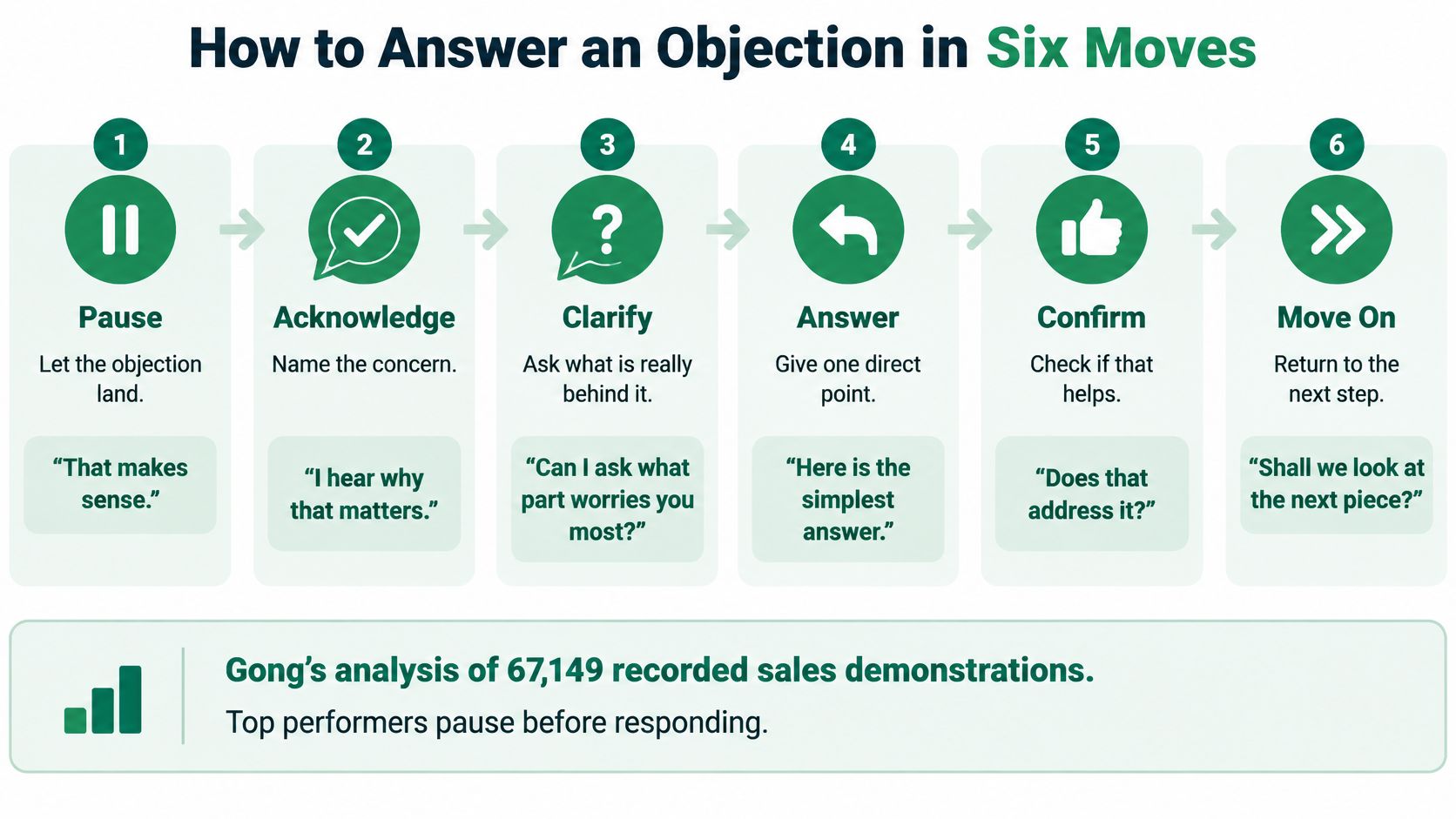
How to Answer an Objection in Six Moves
Use a sequence that creates room for the buyer to correct you. The purpose isn't to sound polished. It's to avoid answering the wrong problem confidently.
This visual provides a compact reminder of the conversation rhythm.
Run the diagnosis before the response
Pause. Let the buyer finish, including any explanation that follows the initial objection. In Gong's analysis of 67,149 recorded sales demonstrations, top performers paused about five times longer after an objection than less successful peers. After the silence, a simple spoken bridge is enough: Go ahead, I'm listening.
Acknowledge without arguing. Acknowledgement means you heard the concern, not that you accept every assumption behind it. Avoid adding a defensive qualification before the buyer has explained. Say: Understood.
Ask a clarifying question. Split plausible causes without interrogating the buyer or offering an exhaustive menu. For an initial dismissal, ask: Is that because this is not a current priority, or because you already have a way to identify companies showing active demand?
Isolate the constraint. Say back the buyer's explanation and leave room for correction. Don't transform an observation about their process into an invented pain point. Try: So the concern is whether the contacts are accurate, rather than whether you can find enough companies?
Respond with relevant evidence. Show only what addresses the confirmed issue. For contact accuracy, use a verified contact example and explain how it was checked, rather than describing unrelated functionality. Say: I can show the source for the business event and how we verified the person responsible.
Confirm before advancing. Check whether you answered the concern, then request a proportionate next step. A useful confirmation is: “Does that make sense?” Accept a correction or a refusal instead of treating either as an invitation to restart the pitch.
Keep the exchange grounded
Here's a hypothetical exchange in which the seller avoids assuming that manual work is the problem.
Buyer: We're not interested. We already research accounts ourselves.
Seller: Understood. Is the current process giving you what you need, or is there a particular gap?
Buyer: We find the companies. Reaching the right person is harder.
Seller: So contact accuracy is the issue, not account volume. I can send a relevant example showing the business event, its source, and the verified decision maker. Would that help you assess it?
Buyer: Yes. Send that first.
Seller: I'll send that example. If it meets your standard, would a review with the person who owns prospecting be useful?
The buyer has named a constraint and accepted a specific action. That's a clearer outcome than an unqualified meeting booked through persistence.
For an additional demonstration of objection handling, use the video alongside your call practice.
These behaviours are associated with successful calls, not a guaranteed conversion formula. Don't coach artificial silence or insist on a stock confirmation phrase. Coach whether the caller understood the concern, answered it accurately, and earned the agreed next action.
Short Replies You Can Say Tomorrow
In 2024, the Advertising Specialty Institute cited HubSpot research reporting that 44% of deals fail to close because objections are not answered adequately. Adequate doesn't mean long. It means specific enough for the buyer to judge whether the concern has been addressed.
Use the following hypothetical dialogues as adaptable patterns, not mandatory wording. Each requires the buyer's answer before the seller can choose an appropriate response.
Price and timing
Price
Buyer: That's expensive for an initial project.
Seller: What are you comparing it with, the current internal cost or another proposal?
Buyer: Another proposal with a narrower scope.
Seller: Let's compare the outcome and deliverables. We could scope the initial project around the priority outcome rather than discount work you don't need.
Cut: A catalogue of features offered to justify the number. A smaller scope can reduce exposure, but only offer it if you can still deliver a useful result.
Timing
Buyer: Call me next quarter.
Seller: What changes then that would make this worth discussing?
Buyer: Nothing definite. We're just occupied.
Seller: Understood. Let's leave it there rather than put an arbitrary follow up in your calendar.
Cut: A speech about why the buyer should act immediately. When there is a genuine dated trigger, record it and agree whether contact at that point would be welcome.
These examples show the level of brevity to aim for.

Capacity, incumbents, and information requests
Bandwidth
Buyer: We have nobody to run this.
Seller: Who would own the initial review if the approach looked relevant?
Buyer: Nobody can take ownership right now.
Seller: Then it's not practical to start. We should stop here.
Cut: Unsupported promises that implementation takes no effort. A low workload doesn't remove the need for an accountable owner.
Incumbent
Buyer: We already have a provider.
Seller: How does the current provider respond when a new buying signal appears?
Buyer: We receive a scheduled list, rather than updates tied to events.
Seller: If event timing matters to your team, would a dated example give you a useful comparison?
Cut: Criticism of the provider or a full replacement pitch. The buyer hasn't agreed that switching is necessary.
Send me information
Buyer: Send me some information.
Seller: What would you need to see to decide whether this is relevant?
Buyer: An example for an engineering consultancy.
Seller: I'll send a relevant example with the business event and decision maker, rather than a general presentation.
Cut: An unsolicited deck, case study bundle, and calendar invitation. If the buyer won't name anything useful, close politely rather than turning the request into a campaign.
Answer the constraint they named, then ask whether your answer resolved it.
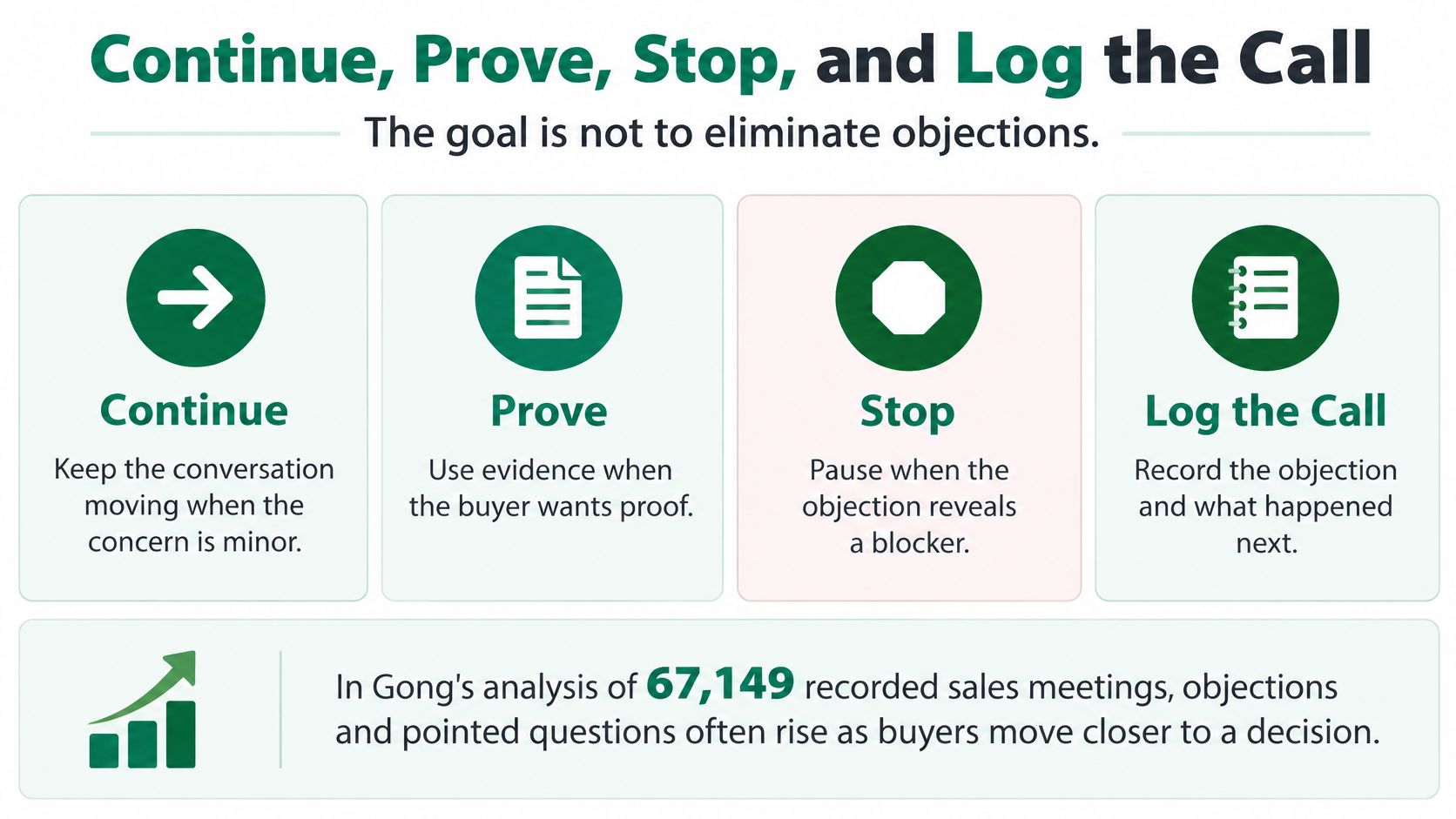
Continue, Prove, Stop, and Log the Call
An objection can signal active evaluation, but it can also be a polite way to end the call. In its analysis of 67,149 recorded sales demonstrations, Gong found that objections and pointed questions often increase as buyers move closer to a purchase decision.
Treat the objection as a diagnosis, not proof of intent. Look for observable signs that the buyer is assessing a decision.
Separate evaluation from disengagement
An engineering consultancy hears that a prospect is satisfied with its current advisor. The buyer then asks how onboarding would work with a newly appointed technical director.
That follow-up points to a specific implementation question. Ask what the director would need to approve, then answer that question directly. If the buyer names no event, owner, or condition for reconsidering, stop. Don't invent urgency or schedule another call just to keep the account in the CRM.
Keep the operating choices visible beside your calling workspace.
Make qualification visible to the whole team
For outsourced B2B appointment setting, a calendar entry alone doesn't show whether a meeting is useful. The receiving salesperson needs the reason for interest, the unresolved concern, and the buyer's expectation for the conversation.
Trefle.ai tailors every outreach message to the prospect's situation, challenges, and business context. Interested prospects are qualified, and meetings are scheduled directly with the client's team. Qualification should give the salesperson enough context to continue the conversation, not just a name and time.
Review recorded calls weekly, where recording is permitted. Listen for interruptions, unsupported assumptions, and explanations that continue after the buyer has answered. Compare meeting rate, qualified meeting rate, and downstream opportunity rate by objection class, representative, and segment.
Reward accurate qualification, including a well-supported decision to release an account. Booking a meeting is not enough.
Continue, prove, or stop
| Buyer behavior | Usually means | Do this |
|---|---|---|
| Questions on implementation, stakeholders, risk, or proof | Active evaluation | Keep discovering, then offer proof tied to the question |
| Pointed questions late in the deal | The buyer may be closer to a decision | Resolve the concern and confirm before advancing |
| “Send me information,” no stated priority, or a vague “not interested” | Low urgency or low trust | Ask what would need to be true, then disqualify if nothing is named |
Use a book or release rule: a dated reason and a named constraint can justify asking for a focused meeting with the economic buyer. They don't oblige the buyer to attend. A brush-off with no trigger and no owner should leave the active calling queue.
After each call, record:
- Objection class. Dismissive, situational, or existing solution.
- Constraint in the buyer's words. Separate what the buyer said from what you inferred.
- Agreed next step or release. Record the owner and relevant trigger, or why active pursuit has stopped.
Trefle.ai offers Noa for call-ready opportunities with dated buying signals, verified decision makers, direct phone numbers, and suggested openers. Its phone-first Managed Outbound service finds opportunities, prospects on the client's behalf, and books qualified meetings. Visit Trefle.ai to discuss which approach fits your market and who should own the next conversation.