What Is Market Intelligence and Why It Matters
What is market intelligence, how it differs from research and sales intelligence, and how B2B teams turn dated signals into decisions.

Market intelligence is the ongoing work of collecting, interpreting and routing evidence about customers, competitors and external forces so the right person can act in time. The commercial information economy around that work grew 15% in 2021, from US$102 billion to nearly US$119 billion.
Most advice still says the fix is more data. Another survey. Another competitor spreadsheet. Another alert feed nobody owns. That advice treats a market report, a rival brief and an operating habit as the same object. They are not. A founder with a small B2B services firm cannot staff a research desk, and a thicker PDF still does not name who to call on Thursday.
The ESOMAR Global Market Research 2022 report split that industry into established research at 39%, technology enabled services at 37%, and reporting at 23%. Software and data pipes are now almost as large as classic research. They still do not pick the account.
If the chain is missing, you do not have market intelligence. You have a reading list. The useful unit is smaller: one external change with a date, one account, one decision maker, one next action.
What Market Intelligence Is
Say a compliance consultancy watches one manufacturer. On Monday a ministry notice names that plant, a duty and a deadline. The notice is not a lead until someone reads it, judges that the plant now has a near term problem, and puts the operations director on this week's call list. That chain is what market intelligence is.
Market intelligence is the structured collection, processing, interpretation and distribution of information about customers, competitors, regulation and other market forces so an organization can respond to change and make better decisions. CIO's history of business intelligence traces the modern frame to Kohli and Jaworski's 1990 market orientation work. Their scope is wide on purpose. It covers external factors that affect customer needs and preferences, and it covers customers' current and future needs. That is wider than market research built only on surveys or historical demand. The capability has to be generated, shared and acted on. Later work treats it as a continuous process of acquisition, storage, interpretation and distribution.
The routing idea is older than those papers. In 1958, IBM researcher Hans Peter Luhn published "A Business Intelligence System." Luhn proposed matching incoming documents with user interest profiles and sending each item to the person who needed it. The rule that survived is plain. Information has value when it reaches the correct decision maker in time to guide action.
What a services firm actually watches
For a B2B services firm, the documents are events. Hiring. Funding. Leadership changes. Regulation. Permits. Certifications. You turn those events into account priorities and a sales decision, not into a binder.
A static contact list is not intelligence. A quarterly PDF is not intelligence either. Both can be inputs. Neither tells a partner which account changed this week, or what to say when the phone is answered.
Practical rule: If you cannot name the person who should see the item today, you have stored a document. You have not finished the job.
Neighboring practices use some of the same inputs and still answer different questions. Mixing them up is how teams buy the wrong work.
How Market Intelligence Differs from Nearby Work
| Practice | Main question | Typical inputs | Output | Enough when |
|---|---|---|---|---|
| Market intelligence | What changed outside, and what should we do? | Customers, competitors, regulation, events, plus internal context | Account priority and a decision | The firm must respond to change, not only describe it |
| Market research | What do buyers say, or what already happened? | Surveys, interviews, historical demand | A findings report | The question is bounded and a one off study will answer it |
| Competitive intelligence | What are rivals doing? | Websites, filings, news, pricing | A competitor brief | The decision is positioning or how to win a deal |
| Sales intelligence | Who should we contact now? | Named buyers, verified contacts, firmographics, triggers | A call ready account | Outreach has to happen this week |
| Business intelligence | How is our own business performing? | CRM, sales records, delivery data | Internal dashboards | The question is about our pipeline or delivery, not the market |
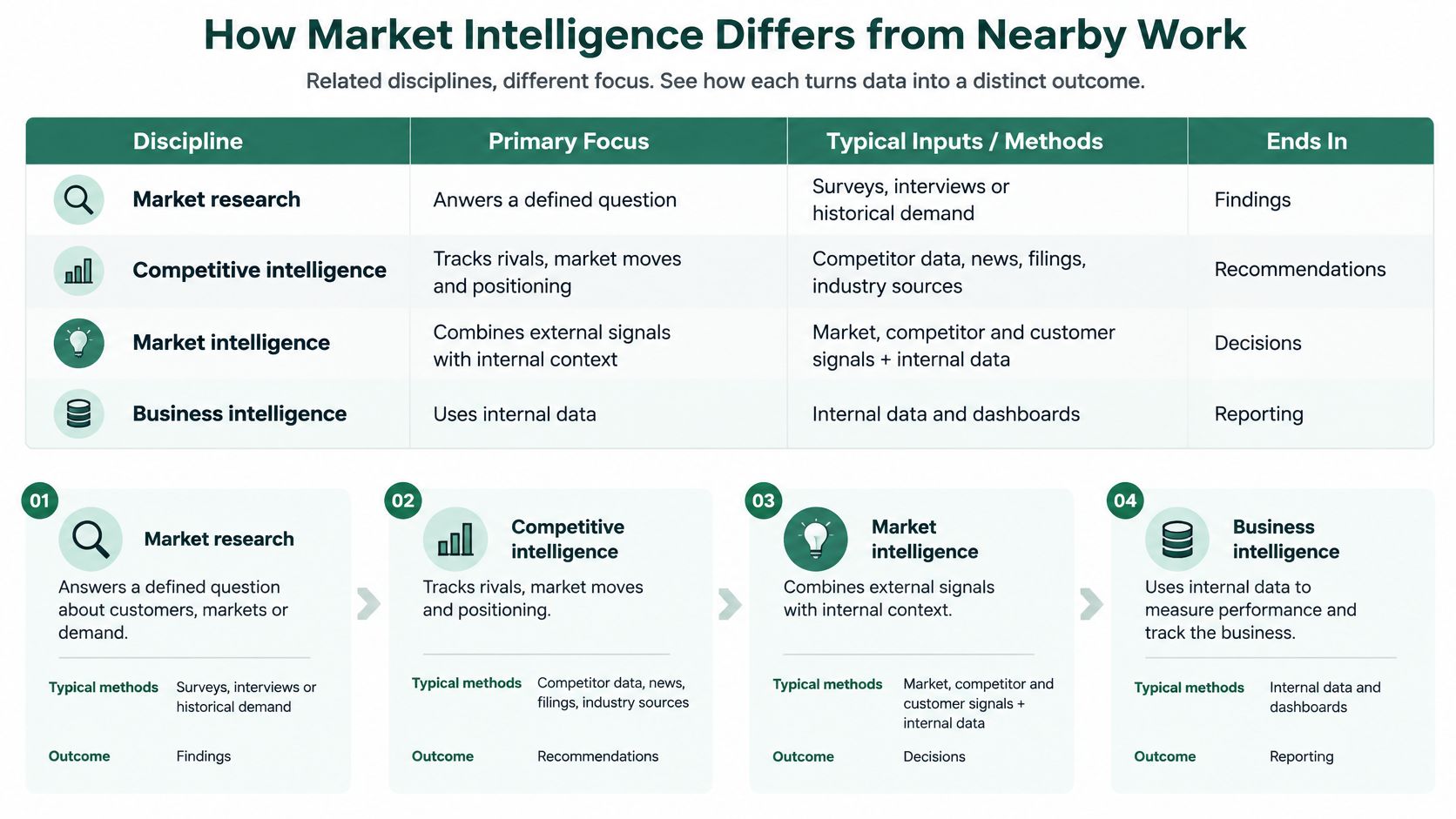
Read the rows as jobs, not as brands. Market research answers a defined question and stops at findings. Competitive intelligence watches rivals and stops at a brief you can use in positioning. Sales intelligence names who to contact now, with a person, a channel and a reason to call this week. Business intelligence reads your own performance from the CRM, the pipeline and delivery data. Market intelligence sits across those jobs. It joins an external change to internal context and produces a decision about viability, segment, price, priority or the next commercial move.
One consultancy, five different outputs
Take an ESG and compliance consultancy.
A survey that buyers say they care about sustainability is market research. It is enough when the offer question is bounded and you will not rerun the study next month. A rival's new ESG package, with pages, price hints and a launch note, is competitive intelligence. It is enough when the decision is how you position, or how you win a live deal against that rival. A named sustainability lead, a checked direct number and a reason to dial this week is sales intelligence. Won and lost deals in the CRM are business intelligence. They tell you which segment already buys, not what changed in the market on Tuesday.
A dated regulation that hits a named plant, linked to that buyer and a call this week, is market intelligence. The regulation is the external change. Your win history in that segment is the internal context. The output is a priority, not a chapter.
Sales intelligence is the account level slice of that work. It is not a synonym for the whole system. If you only keep names and phones, you can dial forever and still call firms with no current reason to buy.
Keep the row that matches the decision you must make. If you need a price test, run research. If you need to answer a rival, write the brief. If you need ten conversations, build call ready accounts from a change you can date.
Sources Worth Keeping and How to Score Them
A reliable system triangulates. It never treats every mention as equal. Primary evidence is what you can tie to a person, a filing or an observed change: interviews, surveys, regulatory notices, company filings and operational moves you can see. Secondary evidence is what someone else already summarized: analyst reports, news, trade press and republished datasets.
Competitive intelligence research archived at Aalto University treats websites, analyst reports and news as traditional sources, and treats customer voice plus social media as extra current signals. Each source fails in its own way.
| Source | What it shows | Typical error | Use it for |
|---|---|---|---|
| Interviews and surveys | Stated needs and objections | Sampling and question bias | A bounded offer question |
| Regulatory notices and filings | Dated duties and named entities | Narrow legal scope | Urgency on affected accounts |
| Company news and announcements | Funding, leadership, launches | Favorable spin | A lead to corroborate |
| Hiring and job posts | A possible capability gap | The role may be a backfill | A link to your service only |
| Analyst reports and trade press | Sector context | Lag and generalization | Background, not a trigger |
| Social and digital attention | Interest | Attention is not intent | A supporting signal only |
Surveys miss the buyers who would not answer, and the wording pushes them toward a neat reply. Company announcements stress the favorable version. A hiring post can be a backfill, a reorg or a real gap. Social attention can mean people looked, not that anyone will buy. A dated government notice that names a facility, a date and an obligation beats a generic trend article on urgency and specificity.
Five scores, not one vibe
Score each item on five separate scales.
- Recency: How old is the publication date relative to the decision you will make this week?
- Source authority: Is it the regulator, the company filing, or a repost with no original?
- Corroboration: Does a second source, of a different type, say the same thing?
- Specificity: Does it name an entity, a site, a role or a deadline?
- Commercial relevance: Does the event touch the problem your offer solves?
Do not blend those into a single gut score. A fresh rumor can be recent and still weak on authority. An old analyst note can be authoritative and still useless as a trigger.
What every account record must hold
Store source, publication date, entity, event type, geography and confidence on every item. A later reader should be able to audit why the account was on the list. For the firms this article is for, the usable unit is an account record: company, event, date, proof link, affected function, likely decision maker and a recommended conversation.
A permit or a production investment is a stronger start than a sector label. A public set such as French industrial firms with a recent production investment shows the shape of that record. It is a list of entities tied to a real event. It is not, by itself, a finished call.
A signal without a source and a date does not enter the weekly priority list.
Run a Lean Loop Instead of More Data
Another feed will not help if the team cannot turn a finding into a decision. Before adding a tool, agree on one record format and use it for ten accounts. Each record should connect a dated external change to a specific company, a likely decision maker, a business problem and a next action. AMPLYFI's 2025 market intelligence paper describes market intelligence as an operational process, not just a report or a system.
Small firms often have limited time, budgets and technical capacity for integrating data. That makes a narrow, repeatable workflow more useful than collecting information the team cannot act on.
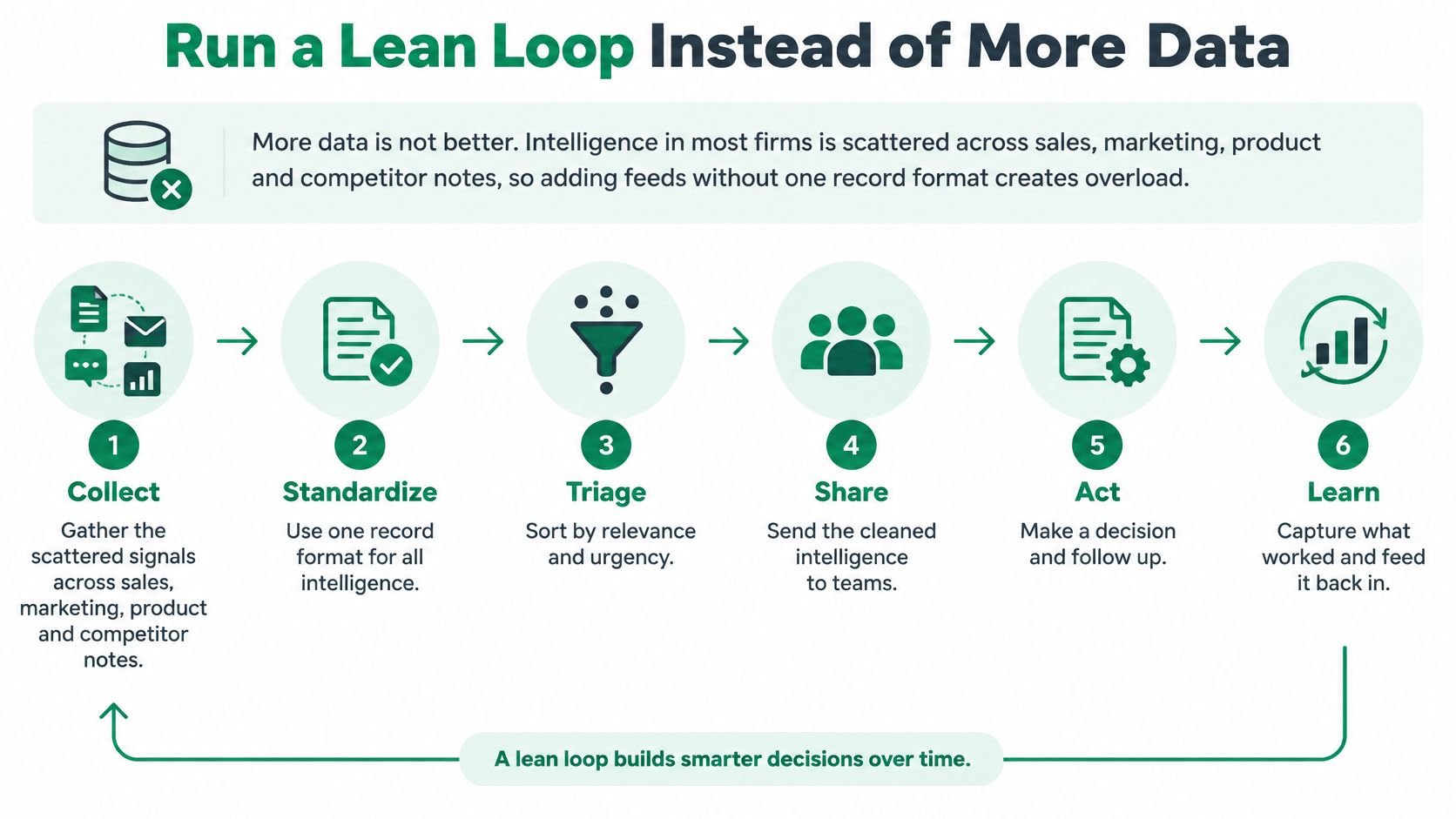
Five steps, in this order
- Name the decision first. Write the question before opening a browser: “Which ten accounts should we call this week, and for which offer?” If the answer will not change a decision, it does not belong in the workflow.
- Collect only what could change that decision. Look for a regulation, permit, executive appointment, funding round or hiring event connected to your offer. A broad industry forecast rarely identifies a company with a reason to buy now. B2B buying signals for service firms explains how such events can point to a timely sales conversation.
- Record the source, date, company and event type. Keep the signal separate from the inference. A hiring announcement is evidence; “the company may have a capability gap” is a hypothesis. Label them clearly.
- Assign confidence and exclude undated items. Apply the five scores from the previous section. Without a publication date, you cannot tell whether an event is a current trigger or an old company description.
- Specify the next action. Name who to contact, the problem to raise and what would make the conversation useful. “Send a newsletter” is vague. “Call the plant director about the March deadline, and stop if they already have counsel” gives the team a clear task.
Why a person still reviews the output
A company-level signal does not identify everyone involved in a purchase. The Demandbase State of the B2B Buyer Report reports that 72% of purchases involve complex multi-stakeholder groups, 77% of buyers prioritize integration capability, and 25% of vendors demonstrate deep understanding of buyer needs. Those figures point to a practical requirement: check which stakeholder the event affects, whether the evidence is current, and whether the proof can be used lawfully in the market you serve.
AI can find and summarize signals, while a person checks the source, identity match, context and compliance. The review keeps a plausible inference from being treated as a confirmed buying need.
Collection finds the change. Analysis estimates its commercial meaning. A weekly loop routes the strongest finding to a named person, records the action taken and archives what the team did not use.
How Service Firms Put Intelligence to Work
Market intelligence is an operating process, not a static market report. It joins internal business intelligence, such as sales records, customer interactions and delivery data, with external information on competitors, customers, regulation, technology, financial activity and broader trends. A University of Southern Queensland conference paper describes the aim as decisions on market viability, segmentation, positioning, pricing and resource allocation. For a small firm, each observation becomes an account level hypothesis. The note keeps source, publication date, entity, event type, geography and confidence, so a current trigger is not confused with an old description.
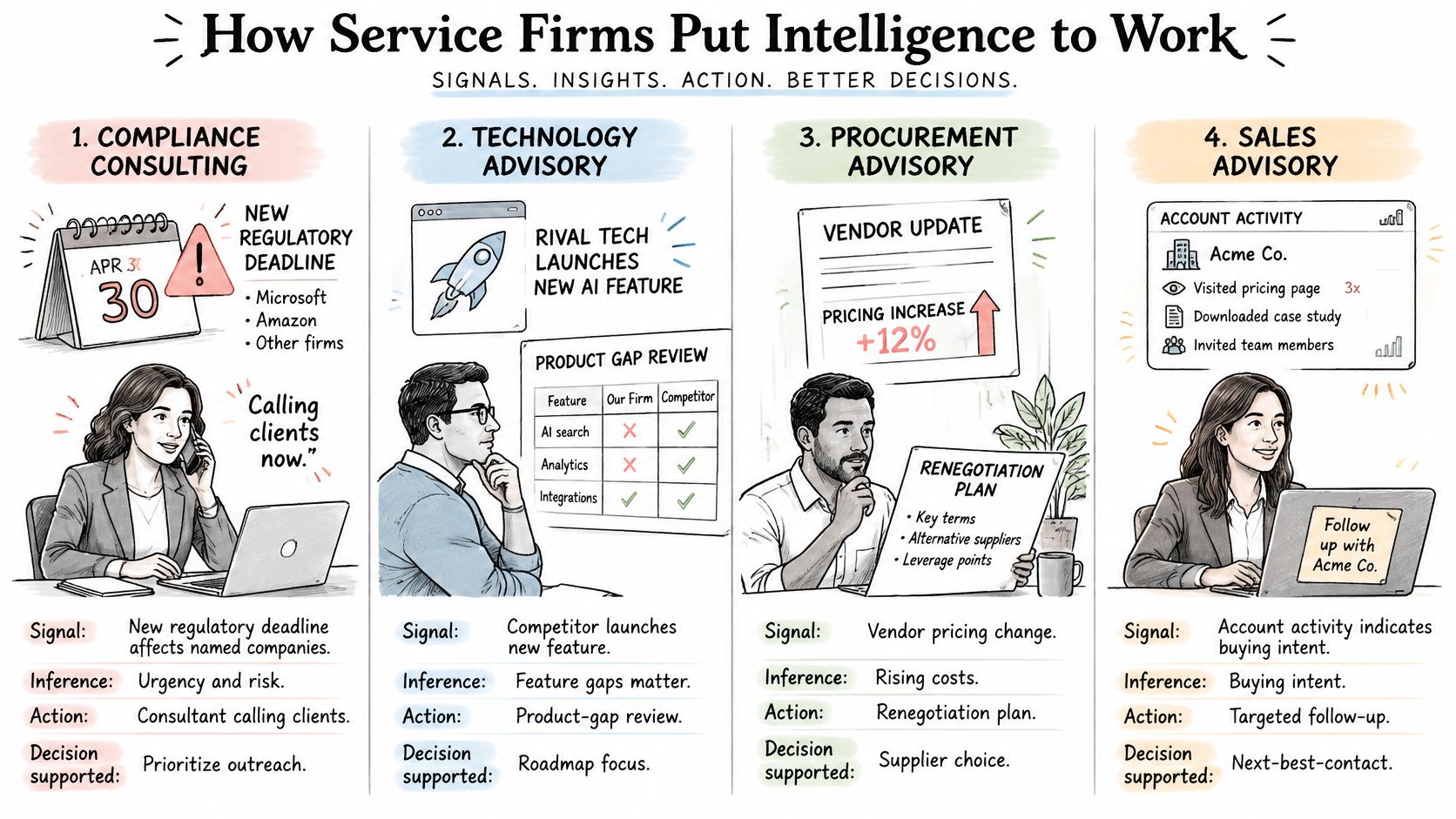
None of the four cases below proves a purchase. Each one supports a decision about who is worth a conversation, and why now.
Compliance, with a deadline attached
A regulator publishes a deadline and names the companies or sites it covers. The inference is near term demand for compliance work at those sites, not a general interest in ESG. The action is a call to the economic buyer, framed on that deadline and that site. A generic sustainability pitch wastes the evidence. Confidence stays modest until you confirm the site is in scope.
Engineering, when a permit means a live build
A building permit or a production capacity investment in the last few months implies a live project, not a timeless "manufacturer" label. The inference is that someone owns a build and may need engineering, machines or integration. The action is to reach that owner, not to work a cold list of every plant in the region. Geography matters. A permit in another country is context, not a reason to dial.
Strategy, when money and a new leader arrive together
A funding round plus a leadership change implies budget and a new mandate. The inference is that the new leader was hired to fix a problem, and that problem is the only honest opener. The action is a conversation about that problem, with the proof link in your notes. If you only have the funding headline, wait for a second source before you treat it as a priority. Company news spins.
Where your own wins overlap a hiring surge
Sales records show a segment that already buys. A hiring surge in that same segment suggests budget and operational capacity. The decision is resource allocation. Put senior time on the overlap, not on a national forecast that names no account. Internal delivery data earns its place here. It tells you which work you can staff, while the external event tells you where demand may be live.
If you are choosing who should run the calling, compare lead generation agencies for consultancies against doing the four cases yourself. The test is the same either way. Can they show the source, the date and the person, or only a volume of names?
Pick the Decision You Will Make This Week
Write one decision before you buy a tool or a dataset. Which accounts deserve a conversation in the next seven days, and which offer would those accounts buy? Ignore industry forecasts until that sentence exists. Forecasts do not book Thursday.
The minimum kit is short. A list of event types that match the offer. A record with a source and a date. A named buyer. An opener tied to the event, not to your homepage. If any of those four is missing, you are not ready to add software.
If you sell ESG, engineering, compliance or strategy services and you do not want to run the research yourself, we built Trefle.ai as agentic commercial infrastructure for niche B2B firms. It is not a lead database and not a mass email tool. A Market-Map is a one time project delivered in 5 days. It includes the ICP and offer definition, dynamic prospect identification, accurate emails and phone numbers, and accounts reviewed, scored and prioritized. Free company lists are built from a real buying signal, not from a database filter. An ongoing partnership can put qualified meetings on the calendar in 4 weeks.
You have two honest next steps. Run the loop on ten accounts yourself this week. Or brief that one decision so the map matches the offer, instead of a generic sector export.
Trefle.ai finds the B2B companies showing a real buying signal this week and turns each one into a call ready opportunity: the company, the decision maker, the dated proof and an opening line. That is market intelligence used the way a small services firm can run it, as one next call rather than another unread report. See how it works at Trefle.ai.