AI SDR Agent Explained: Capabilities, Limits and Setup
Learn what an AI SDR agent does, how it compares to a human SDR, where it fails, and how to set one up with signal-based prospecting.
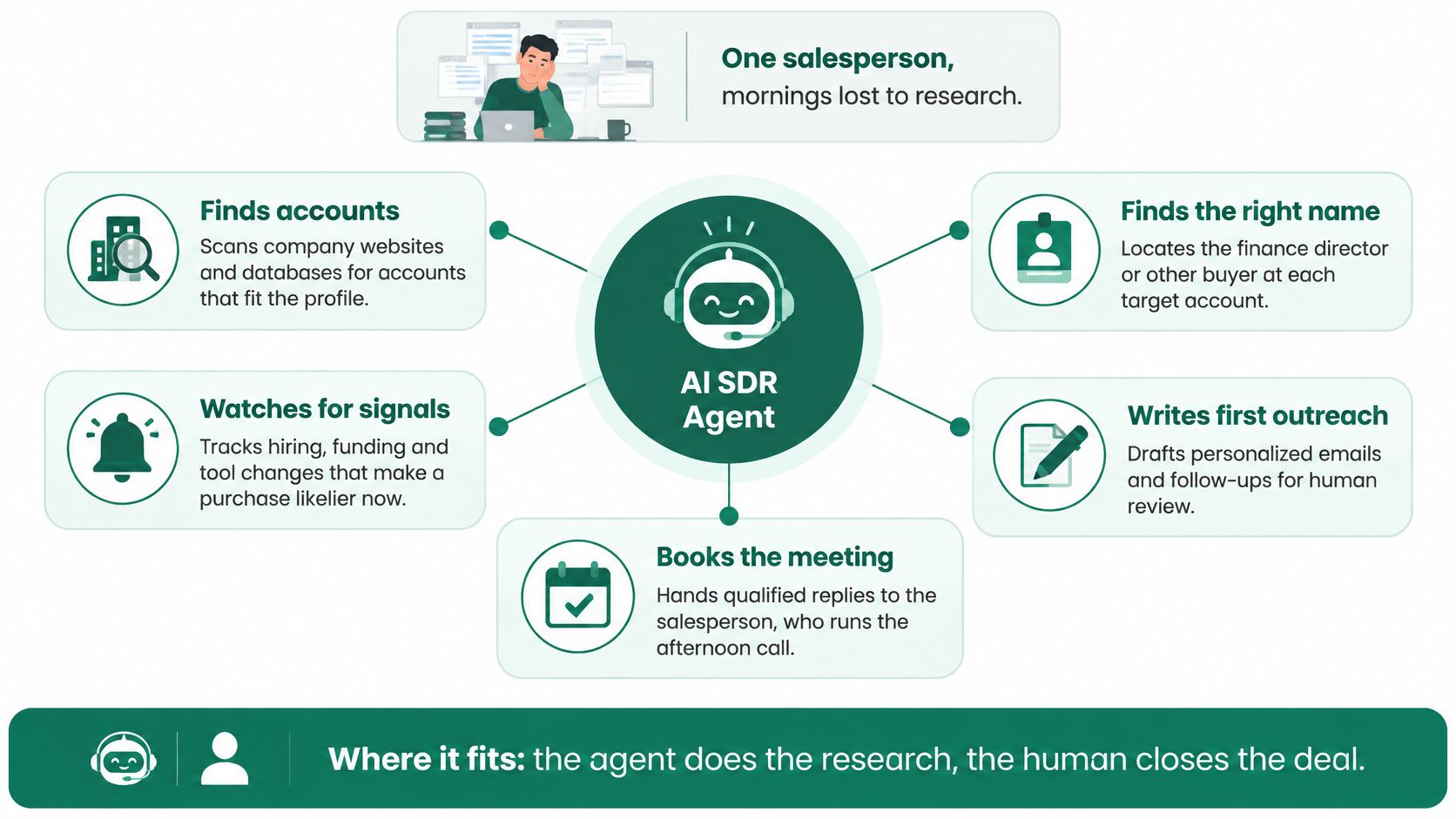
You have one salesperson. Most mornings they open a pile of company websites and hunt for a finance director's name. By lunch the list is half done. The afternoon calls never happen.
That gap is what an AI SDR agent is meant to shrink. A sales development rep is a scout. The scout finds accounts, checks they matter, and opens the door. Someone else runs the meeting. Software can take the scout's routine work. It can't sit on the call and earn the deal.
Judge the agent by the evidence it hands over, and by the calling time it frees for accounts with a dated business reason. How many records it enriches, or how many messages it sends, is the wrong scoreboard.
What an AI SDR Agent Is and Where It Fits
Say that founder is you. The salesperson isn't slow. Research ate the morning. An AI SDR agent is software that runs the prospecting loop on its own, then stops for a person before anyone dials.
The loop has five steps, in this order.
- Find accounts. Match companies to the offer, the size, and the sector you sell to.
- Verify the company and the contact. Confirm the firm is real and the name holds the role you need.
- Rank them by timing. Put a recent business change ahead of a company that merely fits a filter.
- Prepare the first message. Draft an opener tied to that change, for a human to approve.
- Route the qualified account to a person. Hand over the file so your salesperson can call.
Two products get confused with this, and neither runs that loop. A sequencing tool sends fixed templates on timers and does no research. A lead database is a static export. It starts going stale the week you download it. The agent is closer to a junior scout who repeats the same checklist all day, then waits.
This is still a new operating model, not a finished substitute for a sales team. A 2025 study by The Bridge Group surveyed 351 B2B companies, 83% of them B2B software firms, with a median revenue of $47 million and 78% based in North America. Only 1% of respondents reported AI SDRs as a distinct organizational category, and 2025 was the first year the study tracked them separately. That figure isn't "how many teams use AI." Plenty of teams already use AI for writing, research, or scoring without giving it the SDR job. Smaller firms usually start narrower, on research, signal detection, qualification, and follow up.
Practical rule: If most of the week goes to research and first touches, the loop maps to work you already do. If the week is mostly live conversations, the agent has less to take.
AI SDR Agent vs Human SDR, Task by Task
Split the workday before you buy anything. Breadth and hours sit with the agent. Live judgment sits with a person. A hybrid owner for each task keeps that split honest, which is the same question behind comparing an outbound agency with prospecting software.
| Task | AI SDR agent | Human SDR | Owner in a hybrid team |
|---|---|---|---|
| Account research (websites, filings, press) | Minutes per account, runs continuously | Hours per account, deeper context | Agent drafts, human checks |
| Contact identification | Matches role titles to company data | Knows reporting lines and referrals | Agent finds, human confirms |
| Email and phone verification | Automated checks, weaker on direct lines | Confirms by calling | Shared |
| Signal monitoring | Watches hundreds of accounts at once | Covers a few accounts a day | Agent |
| First-draft outreach | Produces many tailored drafts | Writes fewer, slower drafts | Agent drafts, human approves |
| Follow-up timing | Exact and consistent | Drifts when the day fills up | Agent |
| Live cold call | Cannot hold a conversation | Core strength | Human |
| Objection handling | Limited to prepared responses | Adapts to tone and context | Human |
| Qualification judgment | Scores on rules and evidence | Weighs budget, politics and timing | Human |
| Booking the meeting | Proposes slots | Secures the commitment | Human |
| Trust with senior buyers | Weak when messages are generic | Built over calls | Human |
| Ramp time | Days to weeks to configure | Often several months to full output | Not applicable |
| Cost structure | Software and setup, no benefits | Salary, benefits and management time | Not applicable |
The agent wins on breadth, consistency, and hours. It can watch far more accounts than one person, and it doesn't skip follow-up because a meeting ran long. The human wins wherever a live conversation or a judgment call decides the outcome. A cold call, a sharp objection, a political read on budget, and trust with a senior buyer all stay with your salesperson.
What a productivity gain actually looks like
Treat published gains as a range, not a promise. A 2025 peer reviewed study of 5,172 customer support agents found an average productivity gain of 15% after access to a generative AI assistant. Less experienced workers generally got faster and improved quality. The most skilled workers saw smaller quality gains and, in some cases, modest declines. That study covered support, not SDR teams. Separate large scale field experiments found generative AI raised sales in most tested workflows, with measured impact running from no detectable improvement to 16.3%, depending on what the system added beyond work the firm already did. The 15% figure sits in the middle of that span.
Do the arithmetic on a small team. A representative spending 20 hours a week on research and preparation could recover about 3 hours a week for live conversations, qualification, or follow up. That's the point of the owner column. The agent absorbs research and drafts. The human keeps the conversation. In 2025, 45% of sales teams surveyed by Outreach reported using a hybrid AI SDR model in which AI supports human sales development representatives. That matches the split above. It doesn't match handing the phone to software and walking away.
How Signal-Driven Sourcing Finds Buyers Now
A static list says a company fits your profile. A signal says the company is doing something that makes a purchase likelier this month. Fit answers "could they buy." A signal answers "why might they act now."
An intent label is a score from someone else's model, often a website visit or a broad category. A business event is something you can date and open in a browser. A job post, a funding announcement, a permit, a new executive. The call should name the event, not the score.
Buyers are already filtering generic pitches. Gartner reported that 73% of B2B buyers actively avoid suppliers that send irrelevant outreach. The same roundup notes that Forrester found 94% of business buyers used AI in their buying process in its 2025 survey, and that twice as many buyers named generative AI or conversational search as a meaningful information source compared with any other source. Your prospect can compare vendors quickly, and they'll ignore a note that could have gone to anyone. A dated, checkable event is what makes the first sentence specific. For services firms, the practical version of that filter is covered in how B2B buying signals work.
| Signal | Example | Likely buying consequence | Strength |
|---|---|---|---|
| New hire in your service area | Company hires a head of sustainability | Needs outside capacity or expertise it lacks | Strong |
| Funding round | Company closes a growth round | Budget available plus pressure to professionalize | Strong |
| Regulatory deadline | Reporting rule takes effect for the sector | Forced, dated purchase by a named team | Strong |
| New executive | New CFO joins within the last 90 days | Reviews vendors and inherited priorities | Medium |
| Permit or project filing | Industrial site permit filed | Engineering or compliance work follows | Medium |
| Certification or rating goal | Company targets a higher sustainability rating | Needs help closing specific gaps | Medium |
| Website visit or broad intent label | Visitor from a target domain | Unknown, may be research only | Weak |
Strong rows change a budget, a deadline, or a capability the company doesn't have yet. Medium rows are real, but they need a human read before they earn a call. The weak row is what not to rely on. A visit from a target domain might be a student, a competitor, or someone killing time.
A four-part test for any signal
Before a name hits the call sheet, run four checks.
- Is it dated? You can point to a day or a short window, not "sometime this year."
- Is there a source link? A job post, filing, or article you can open.
- Does it plausibly change a budget or a deadline? If nothing in the business has to move, it isn't a reason to call.
- Can you name the role that would feel the change? Operations, finance, compliance, or whoever owns the gap.
Fail any one check and the account goes to a watch list, not today's dials. Fewer researched accounts beat a huge generated list when each file has the company, the decision maker, source proof, timing, and an opener linked to the event. The useful count is conversations that start with a business reason the buyer recognizes.
A short walkthrough of how a signal becomes a reason to call is worth watching before you set your own grades.
One Account Followed From Signal to Booked Call
Say a 12-person sustainability consultancy sells reporting help to manufacturers in one region. They have no SDR bench. The founder calls in the afternoons.
In week one the agent scans 400 manufacturers and logistics firms and flags nine with a dated signal. Six drop at review. Three show conflicting headcount between sources, so nobody can tell which file is current. Two have no matching decision maker. One signal is old, from a project that already shipped. Each drop has a reason you can say out loud. The three that remain each have a date, a link, and a role that fits the offer.
The strongest is an 80-person packaging manufacturer that posted a sustainability reporting lead on Monday. The agent writes one evidence record. Company, role, posting date, source link, likely buyer (the operations director), a confidence level, and a recommended opener that mentions the posting. Nothing in that record is a guess about "intent." It's a public hire plus a person who would feel the gap.
A human checks the director's role on LinkedIn on Tuesday morning and calls that afternoon. Voicemail. A second call on Thursday reaches the director. She confirms the company is preparing its first mandatory report and has no internal lead yet. The hire is an attempt to build that, and outside help is still on the table. A scoping call is booked for two weeks out. If you don't want the founder making those second calls, booking B2B meetings with an external setter is the same handoff, just with someone else on the phone.
What made the path work wasn't volume. Nine flags became three calls and one meeting. The buyer heard a reason in the first sentence because the file carried a dated trigger, a proof link, a named buyer, and an opener tied to a post she already knew about.
A call list of three accounts you can defend will beat a list of ninety you can't explain.
Where AI SDR Agents Fail and When a Human Takes Over
Full automation sounds tidy until you look at how buyers really behave. The stronger model is human led. The agent compresses research. A trained person supplies context, trust, and the decision to call.
Gartner's survey of 645 B2B buyers found that 45% used generative AI during a recent purchase, yet 69% preferred to validate AI generated insights with a sales representative. Buyers used an average of seven information sources, and 51% believed GenAI was more likely to produce misleading information. Your prospect may already have an AI summary of your category. They still want a person when the claim matters. An agent that only multiplies touches doesn't fill that gap. It has to preserve the evidence and give the seller a precise reason to call.
Hand the conversation to a human when any of these show up.
- A high value account. A logo that would change the quarter gets a person on the first touch, not a sequence.
- Conflicting company data. Headcount that differs by a factor of two between sources means the file isn't ready.
- A regulated purchase. Compliance, safety, or public-sector rules need a seller who can speak to constraints.
- A senior decision maker. A CFO or managing director will notice a generic note immediately.
- A signal that needs interpretation. A hiring post might mean growth, or it might mean someone quit and they're backfilling.
Three ways the agent burns trust
Wrong-role contacts damage credibility fast. Calling a plant manager about a finance reporting deadline tells them you didn't look. Stale signals linger after the event has passed, so you congratulate a hire who started eight months ago. Generic messages are obvious to a specialist buyer. In a consultancy, one of those notes can cost you the account for a year.
The audit line is simple. The agent can reliably find a dated hiring announcement and attach the link. Only a person should decide whether that hire means an urgent outside need. Extraction is a software job. Interpretation is a sales job. For specialist B2B services, a bland automated message hurts credibility faster than it creates pipeline.
Set Up and Pilot an AI SDR Agent in Six Steps
Don't turn the agent on across the whole market. Configure it, gate it, and run one short test where your calling habits stay the same.
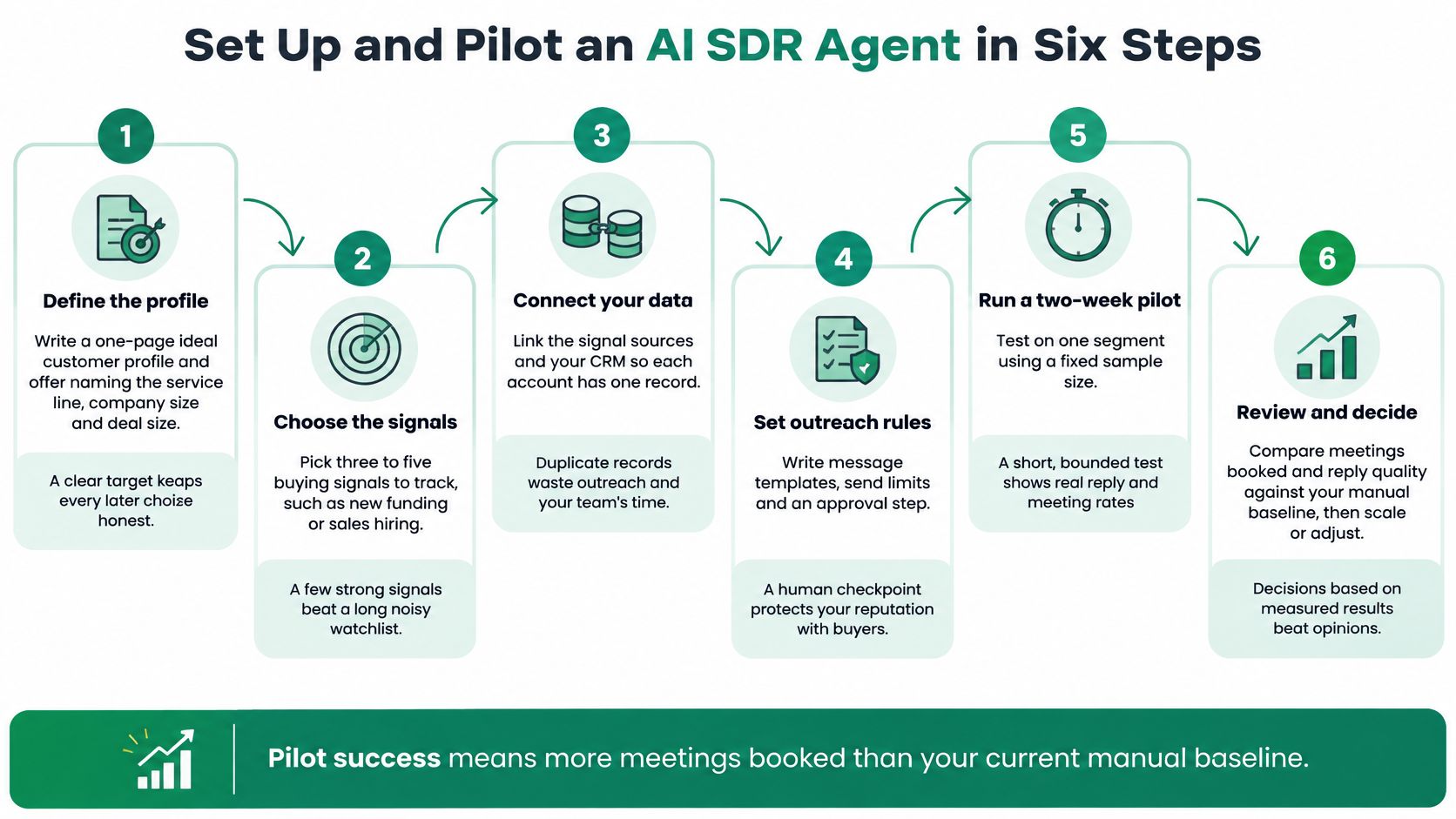
- Write a one-page ideal customer profile and offer. Name the service line, company size, and deal size. A vague profile makes every later score meaningless.
- Choose three to five signals and rank them. Use the strength grades you already trust. A short list beats a noisy watchlist.
- Set the evidence fields. Every account needs the company, a dated signal, a proof link, a decision maker, a confidence level, and a next action. If a field is empty, it isn't callable.
- Put a human QA gate before any call. A person confirms the role, the date, and the link. This step stops wrong-function contacts.
- Run a two-week pilot on one service line and one region. Review every account before a call. Keep the calling process identical, so any difference comes from prioritization, not from a new script or a new caller. Set the go or stop rule before day one. Continue only if most signals pass the date and link check, decision-maker matches hold on review, and more conversations start with a named reason. Stop if the team spends more time fixing records than calling.
- Decide with the metrics below, not with activity totals. In our own delivery, interested prospects are qualified and meetings are scheduled directly with the client's team, which is the outcome the pilot should be able to show.
What to measure
| Metric | What it reveals | Warning sign |
|---|---|---|
| Signal validity rate | Share of signals with a valid date and a proof link | Many undated or unlinked signals on the call list |
| Decision maker match rate | Share of contacts whose role fits the offer | Calls routinely reach the wrong function |
| Reachable phone rate | Share of contacts with a working direct line | Most calls end at a switchboard |
| Signal to conversation rate | Share of signalled accounts that start a real conversation | Calls made but no reason cited by the buyer |
| Time saved per verified opportunity | Calling and research hours freed for each qualified account | Hours saved but no added meetings |
| False positive rate | Share of flagged accounts with no real buying need | Rising share of accounts dropped at human review |
Before you buy, ask the vendor to show a date and a source link on every signal, and to let a person reject a record. Confirm consent and opt-out rules for automated email and calls in each market before the first send. Rules differ, and a pilot is not a reason to skip them.
Benchmark against the work you already do
If your team already has reliable account data, an agent that only summarizes websites adds little. Measure what it adds on top of the current research process. Precision of high-intent accounts, proof on each signal, decision-maker match, a working phone number, meeting conversion, and false positives. Run the comparison on the same market and the same weeks, with the same person calling.
Records enriched and messages sent are not evidence of value. They rise even when the call list is noise. In the EcoVadis Consulting work, Trefle.ai built a market map aimed at companies scored Committed and Bronze and booked meetings with the right economic buyers. That's one option for signal-based lists. The test is still the same. More calling time on accounts with a dated reason, and evidence a buyer would recognize in the first sentence.
Trefle.ai finds the B2B companies showing a real buying signal this week and delivers them as call-ready opportunities, with the company, the decision maker and a verified direct line, the dated signal and its proof link, and an opening line for the call. If you'd rather not staff the phone yourself, Managed Outbound is phone-first. We find the opportunities, prospect on your behalf, and have trained setters book qualified meetings. See how that fits a small sales team at Trefle.ai.