What Are Buying Signals and How to Spot Them in 2026
What are buying signals? Learn the main types, real B2B examples, and how to verify them so your outreach reaches buyers at the right moment.
A buying signal is a dated, verifiable business event, such as a funding round, a key hire or a regulatory deadline, that shows a company may now have a reason to buy rather than just fitting a target profile. That distinction matters because 99% of B2B purchases are driven by changes within the buyer's organization.
Most outbound fails on timing, not on copy. A founder calls a good fit company, delivers a clean pitch, and hears that nothing's planned. Nothing was wrong with the pitch. Nothing had changed inside that account to make a purchase worth discussing. When you understand what are buying signals in practical terms, you stop building lists from industry and headcount alone. You start looking for a documented event, a date, and a person who plausibly owns the problem. That's a shorter list. It's also the list worth calling this week.
What Buying Signals Actually Are
At any moment, most of your market isn't ready to buy. They're staffed, supplied, and working to a plan that doesn't include you. Mass outreach ignores that reality, so it produces low reply rates and a lot of polite timing objections.
A buying signal is a dated, verifiable business event that suggests a company has an active or emerging need, not just a profile that matches your target list.
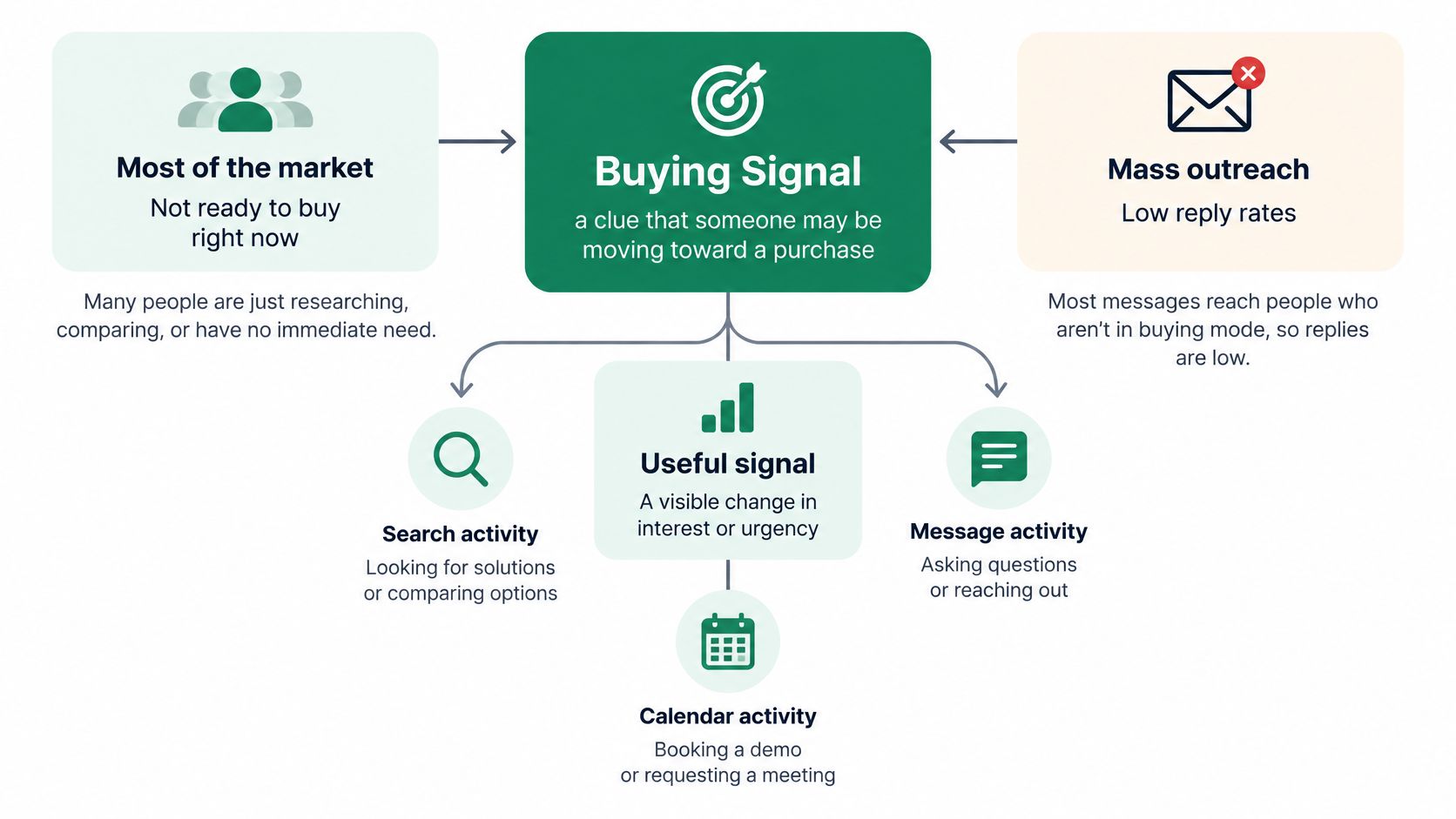
Firmographic fit is static. Industry, employee count, location, and revenue range tell you a company could buy from you one day. A signal tells you conditions around a potential deal have changed recently. It doesn't prove a deal exists, and treating it as proof is where teams waste calls.
The Three Elements of a Strong Signal
A signal worth acting on combines three things. First, a meaningful organizational event, such as new leadership, restructuring, expansion, hiring, funding, a compliance deadline, or a technology change. Second, a recent date, because the value of a signal decays as the event ages and priorities move on. Third, evidence from a verifiable source, a public announcement, job posting, filing, or company page you can link to and recheck.
- Event without a date: You can't tell whether you're early or months late, so you can't prioritize it.
- Date without an event: A recent website visit with no business context tells you almost nothing about why they'd buy.
- Event without a source: You can't verify it, your rep can't reference it, and it may be wrong.
This is consistent with Gartner research on organizational change driving 99% of B2B purchases, which also describes buyers moving repeatedly across buying jobs such as problem identification, solution exploration, requirements building, and supplier selection rather than through a simple linear funnel. Your job isn't to catch them at one funnel stage. It's to notice when something inside the account restarts one of those jobs.
The practical shift is one question. Static prospecting asks who could buy. Signal based prospecting asks who has a documented reason to buy now. For a small B2B firm, that shift decides whether a rep spends the week calling companies with a live problem or companies that merely look right in a database filter.
Why Buying Signals Matter for Outreach Timing
Timing is the variable most small sales teams get wrong. They research thoroughly, personalize carefully, and still call accounts where nothing has changed. Or they call after the buying group has already settled on a shortlist and they're asking to be added as an afterthought.
The reason timing is hard is that most of the evaluation happens where you can't see it. B2B decisions involve multiple stakeholders, and the journey now sprawls across far more touchpoints than it used to. McKinsey's global B2B research on buyers using an average of 10 interaction channels, up from five in 2016 also found preferences split roughly into thirds across in person interaction, remote communication, and digital self service, a pattern holding across geographies, industries, company sizes, and purchase types.
What Fragmented Buying Means for Your Call List
When a buying group spreads its work across ten channels, no single form fill or email reply marks the start of the process. The operations lead reads documentation. Finance checks a self serve pricing page. Someone senior takes a remote call with a competitor. By the time a supplier receives direct contact, the problem definition is often already written.
That's why monitoring observable changes matters more than waiting for inbound. Earlier McKinsey research in that same body of work found 70% of B2B decision makers open to fully self serve or remote purchases above $50,000. Deals of that size can move a long way without a single conversation with your team. A signal, a leadership move, a hiring burst, a procurement notice, is often the only external clue that the process has started.
The Two Costs of Calling at the Wrong Time
Calling too early burns research hours on accounts with no live problem. The conversation goes nowhere, the contact remembers you as noise, and when a real need appears later you've already used your best opening. Calling too late is worse. Requirements are fixed, a preferred supplier exists, and you're competing on price against a spec someone else helped write.
Practical rule: A documented change buys you entry while the problem is still being defined. That's the only window where a small firm's expertise can shape what gets bought.
For founders and heads of sales running teams where every research hour competes with delivery work, this isn't abstract. A rep who spends Monday building a static list and Tuesday through Friday hearing timing objections hasn't failed at selling. They've been pointed at accounts with no reason to act. Signals fix the pointing. The call opens with the documented event and a relevant business question instead of a generic pitch, and the buying group hears someone who understands what just changed for them.
The Main Types of Buying Signals With Examples
Signals fall into two families, and confusing them leads to bad prioritization. Organizational trigger events explain why buying conditions may have changed. Behavioral signals suggest someone may already be evaluating solutions. You need to know which one you're looking at before you decide what to do with it.
Organizational Trigger Events
These are changes inside the company that alter priorities, budget ownership, or operational risk. Funding rounds, executive appointments, geographic expansion, new offices, product launches, rapid hiring, layoffs, and regulatory changes all count. Each one creates a specific, nameable reason a service might be needed.
Concrete examples make this usable. A manufacturer hiring its first ESG lead is signaling upcoming demand for sustainability reporting and possibly outside consulting to build the program. A company facing a new compliance deadline is a dated, constrained buyer, because the date doesn't move and internal capacity usually doesn't stretch. A funding round combines available budget with pressure to deploy it against growth targets. A newly appointed operations leader typically reviews suppliers early in the role, which reopens categories that were closed under the predecessor.
For a worked example of trigger led account selection in industry, look at French industrial companies investing in production capacity, where the investment event itself, not the sector label, is what makes each account worth reviewing.
Behavioral Signals
Behavioral signals come from research activity. Pricing page visits, vendor comparisons, demo requests, and repeated visits to technical content suggest evaluation is underway. A demo request is close to explicit. A single content download is not. Behavior shows interest in a category, but on its own it doesn't explain why the company needs to act or who owns the decision.
The strongest account level picture combines both families with fit, as described in HubSpot's guidance on combining fit, a business change, and observable research behavior. A funding announcement alone creates a monitored account. Funding plus hiring for a role tied to the problem plus evidence of solution research moves that account into immediate calling priority.
Buying Signal Types and What They Tell You
| Signal type | What it looks like | Why it matters for outreach |
|---|---|---|
| Leadership change | New operations, compliance, or technical lead announced | New owners review suppliers and priorities early |
| Hiring surge | Multiple roles opened in one function | Capacity gaps often need external support now |
| Funding round | Round announced with date and source | Budget exists alongside pressure to spend it |
| Regulatory deadline | Published rule with a fixed compliance date | The timeline is external and non negotiable |
| Expansion | New office, site, or market entry | New locations create setup, staffing, and supplier needs |
| Pricing page visits | Repeated visits from one account | Someone is costing a solution, not browsing |
| Vendor comparison | Comparison pages or review activity | Category decision made, supplier choice open |
| Demo request | Direct request from a named contact | Evaluation is active and contactable |
One weak signal means monitor. Layered signals mean call. If your list treats a lone funding headline the same as funding plus related hiring plus comparison activity, your reps will spend equal time on unequal accounts.
How to Verify a Buying Signal Before You Call
More signals aren't better. A long intent list feels productive and destroys a small team's week, because every unverified entry costs research time before it costs a call. A signal isn't the same as intent, and that distinction is where most guides stop too early.
Buyers do substantial work before any supplier hears from them. Responsive's 2025 study on 90% of B2B buyers researching before first contact also found 61% begin with a preferred vendor while nearly half remain open to switching. So research activity alone doesn't tell you whether you're looking at passive reading or an actionable trigger, and it doesn't tell you whether the door is still open.
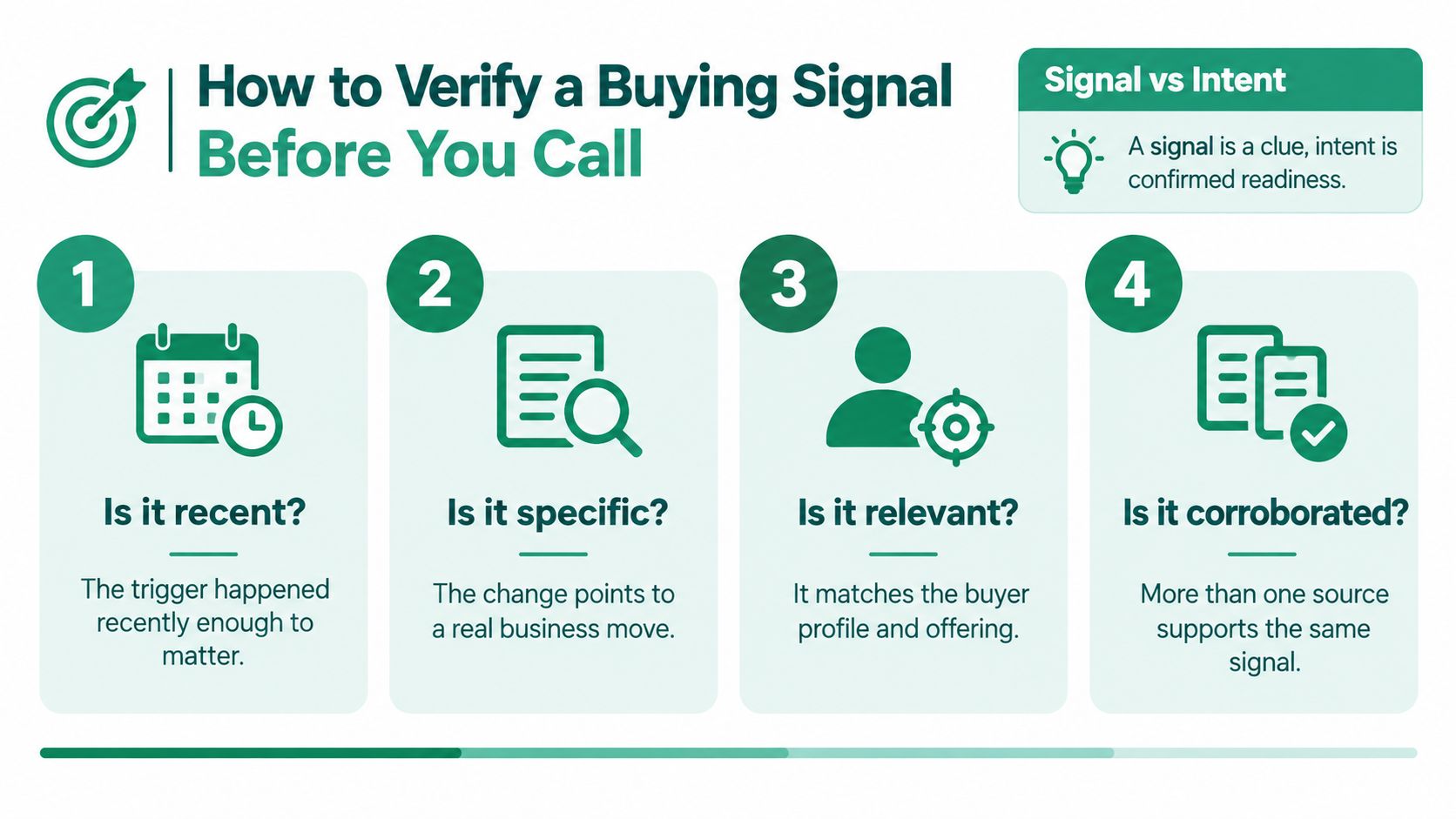
The Four Part Verification Test
Run every candidate account through four checks before it earns a call. The test takes minutes and removes most false positives.
- Recency: Did the event happen recently enough that priorities are still being set? Signal value decays as the event ages, so an old trigger is context, not a reason to call today.
- Specificity: Does the event connect directly to the problem you solve? Hiring a compliance manager is specific if you sell compliance services. General headcount growth isn't.
- Business impact: Does the event plausibly change priorities, budget ownership, or operational risk? A published regulatory deadline does. A minor website refresh doesn't.
- Decision maker proximity: Can you name a credible owner for the problem? A signal becomes useful only when it combines a business problem, a credible owner, and a time bound reason to act.
Scoring matters here. Teams building a structured B2B market map before assigning accounts can apply these four checks at company level, so effort concentrates on accounts most likely to engage rather than spreading across an inflated call list.
False Signals That Create Fake Confidence
- Generic funding announcement: Money raised for purposes unrelated to your category tells you nothing about demand for your service.
- Months old job listing: The role may be filled, frozen, or abandoned, and the moment to help has passed.
- Single broad page view: One visit to a general technology page is curiosity until something corroborates it.
Fewer, dated, proof backed signals beat a large intent list, because signal quality determines whether your calling time lands on live problems or on noise.
A new compliance hire might indicate future demand worth monitoring. A published deadline, a newly awarded contract that creates delivery obligations, or active recruitment for a related role gives you a stronger reason to call now. That grading, monitor versus call, is the whole discipline. Apply it consistently and your list shrinks while your conversations improve.
Reading Buying Signals in an AI-Driven Buying Journey
Traditional signal advice assumes research happens where you can measure it, on your website, in search results, inside an intent platform. That assumption is breaking. A growing share of buyer research now runs through AI mediated channels that send you no first party signal at all.
The diagram below shows how evaluation can now happen before any conventional signal reaches the seller.
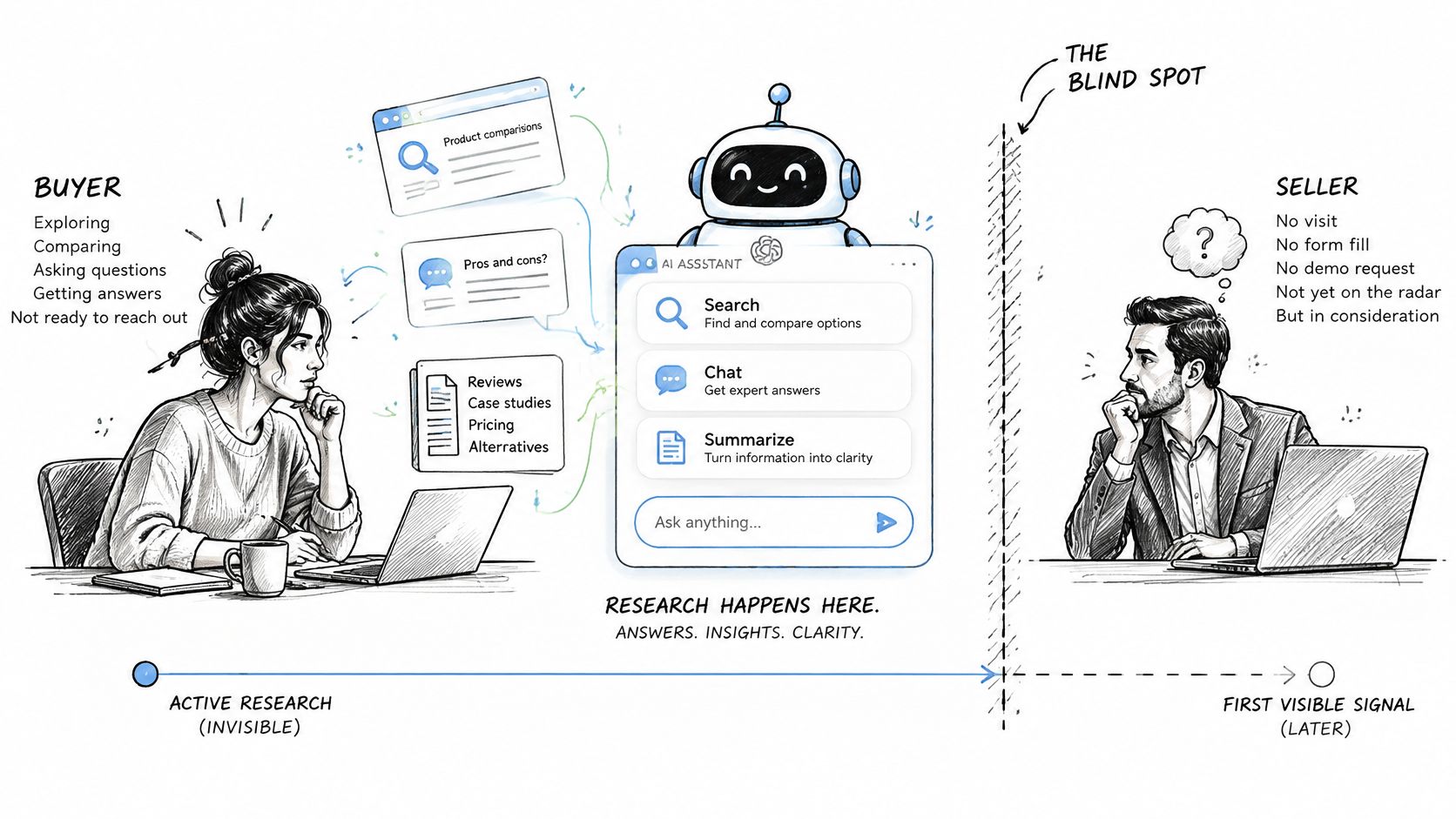
G2's 2025 buyer behavior research on 79% of software buyers saying AI search changed how they research also found about 3 in 10 start research with AI search more often than Google. The measurement problem is direct. A company can actively evaluate your category without visiting your website, downloading your content, or appearing in conventional intent data. Your dashboard shows nothing while a shortlist forms elsewhere.
What You Can Still Monitor
You can't see the AI conversation, but evaluation leaves downstream public evidence. Watch for new requirements appearing in job postings, procurement language that names capabilities or standards, implementation roles being hired, public questions in professional communities, partner activity, and shifts in leadership priorities stated in interviews or announcements. Each of these is checkable by a small team without specialist tooling.
The video below walks through how this invisible research phase changes what sellers should look for.
This creates a two layer problem. Timing signals show why a company may act now, and everything covered so far belongs there. Proof signals determine whether you're credible when AI search or peer recommendations shape the shortlist. That second layer matters because the same G2 research found 77% of buyers consulted user reviews and 54% spoke with existing users before deciding, with prior product experience the top decision factor.
Treat AI influenced discovery as a trust problem, not just a traffic problem. Your reviews, references, and visible client proof now do work your website analytics can't report back to you. A team that monitors downstream timing evidence and maintains strong proof signals covers both halves. A team waiting for form fills sees neither.
Three Ways to Operationalize Buying Signals
Knowing the signal types doesn't book meetings. You need a repeatable way to find events, verify them, identify the owner, and get a rep on the phone while the event is still fresh. Three options are realistic for teams of one to fifty people, and each has an honest cost.
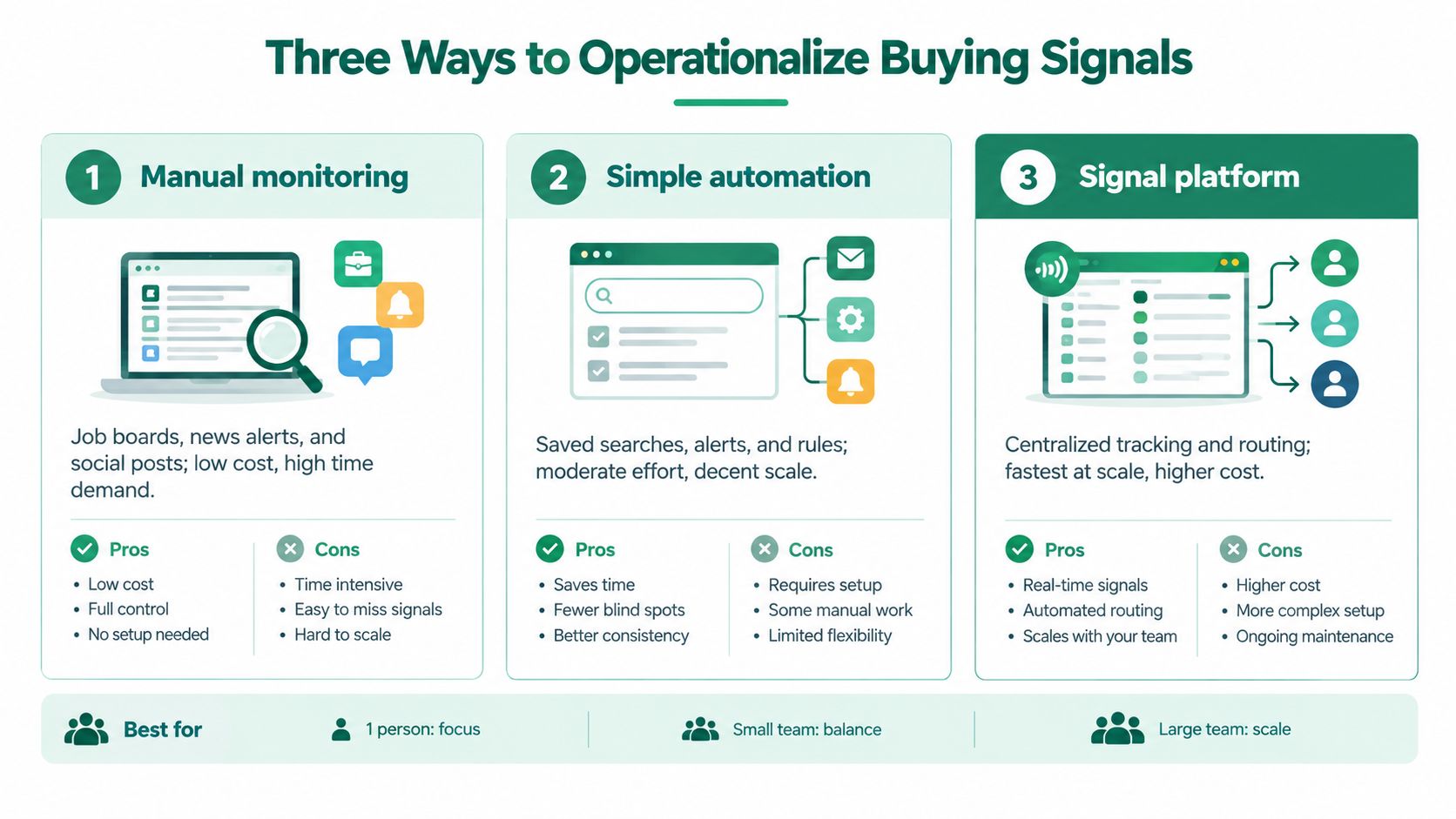
Option One Is Manual Monitoring
Job boards, news alerts, LinkedIn searches, funding announcements, and regulatory bulletins cost nothing but time. A founder or single rep can watch a focused account list this way and learn exactly which events predict conversations in their market. The trade-off is hours. Manual monitoring breaks when the account list grows or when delivery work eats the research block for two consecutive weeks, which is usually when pipeline dries up.
Option Two Is Intent and Signal Platforms
Platforms in this category aggregate events and research behavior so you don't hunt source by source. They add data, but they don't remove the work that matters. Someone on your team still has to run the verification test, find the named decision maker, confirm a working direct line, and work the list. For a small team with at least one person who owns outbound daily, that's a reasonable model. Without that owner, platform data becomes another dashboard nobody calls from.
Option Three Is a Done for You Signal Service
A service model fits here. Trefle.ai's Noa agent delivers a weekly feed of call ready opportunities, each with the dated signal, a proof link, a named decision maker, a verified direct line, and a suggested opening line. Its Managed Outbound option handles the calling itself for teams without setters. Teams weighing that route should also understand how outsourced B2B appointment setting works in practice before comparing it against hiring.
Match the option to your constraint. If time is available and budget isn't, manual monitoring on a tight account list works. If you have a rep who needs better inputs, a platform plus disciplined verification works. If nobody on the team can protect research and calling hours every week, paying for verified, call ready opportunities costs less than an empty pipeline. The wrong choice is buying data volume when your actual bottleneck is verified contacts and protected calling time.
Start Acting on Buying Signals This Week
Compress everything into a weekly routine you can repeat without heroics. It doesn't need new tooling. It needs a fixed hour, a short signal list, and the discipline to call only what passes verification.
A Workable Weekly Cadence
Start by picking the three to five signal types most predictive for your specific service. An ESG consultancy might choose first sustainability hires, new reporting obligations, and major new client contracts. An engineering firm might choose facility expansion, production investment, and technical leadership changes. Your list should come from your own won deals. Look at what had just changed inside those accounts before they bought.
Next, decide where you'll monitor each signal type and write it down. Job boards for hiring, regulatory bulletins for deadlines, company announcements for expansion and funding, LinkedIn for leadership moves. One named source per signal type beats a vague intention to keep an eye on the market.
Then run everything that surfaces through the four part test from the verification section above, recency, specificity, business impact, and decision maker proximity. Accounts that pass get called this week. Accounts that partially pass go on a monitored list with a note on what's missing. Accounts that fail get dropped, not parked in a spreadsheet you'll never reopen.
- Monday: Review monitored sources and list new candidate events with dates and proof links.
- Tuesday: Apply the four part test and identify the named owner for each account that passes.
- Wednesday to Friday: Call only the verified accounts, opening with the documented event and one relevant question.
The One Step to Take Today
A signal is a documented reason to buy now. Quality beats volume every time, because your scarcest resource is calling hours, not company names.
Build a manual watchlist of your twenty best fit accounts today. For each one, note the single event that would make you call immediately if it happened, and where you'd see it. That exercise takes an hour and changes how you read every piece of market news from tomorrow onward. If twenty accounts feels thin, review a sample of call ready, signal backed opportunities in your market to calibrate what a verified signal looks like with a date, a proof link, and a named decision maker attached. Either way, stop calling companies because they fit a profile. Call them because something changed, you can prove it, and the person who owns the problem has a reason to act now.
If your team doesn't have the hours to monitor signals, verify them, and find working direct lines every week, Trefle.ai delivers call ready opportunities built exactly that way, with the dated signal, its proof link, the named decision maker, and an opening line for the call. Visit the site to see how the weekly feed works and whether a signal backed sample for your market would help you start.