Sales Prospecting Process: A Step by Step Guide for 2026
Learn the sales prospecting process in seven stages: pick accounts with buying signals, verify buyers, run calls, qualify replies and hand off to closers.

You've got a list of companies that look like a fit, a call block on the calendar, and no clear reason to start with one account instead of another. So the team works through the list, leaves generic voicemails, and hopes persistence will make up for weak timing.
A better sales prospecting process starts by treating research time as the scarce resource. Call fewer accounts, but give each one a dated, verifiable reason to engage. At every stage, write down what you've established and set a test for moving forward.
The Sales Prospecting Process at a Glance
B2B buyers may combine digital self service, remote conversations, and in person meetings during one purchase, so a fixed sequence of calls and emails won't fit every account. McKinsey's global B2B Pulse research found that 83% of B2B decision makers in February 2021 considered omnichannel engagement as effective as, or more effective than, traditional sales approaches, up from 54% at the beginning of the pandemic (McKinsey's B2B Pulse research).
| Stage | Output | Done when | Usual owner |
|---|---|---|---|
| 1. Define ICP and offer | Written ideal customer profile and offer | Two people describe the same buyer | Founder or Head of Sales |
| 2. Detect signals | Dated list of company events | Each event has a source, a date, and a reason | Researcher or SDR |
| 3. Score accounts | Ranked list for the week | Top accounts each have a signal inside its freshness window | Sales lead |
| 4. Verify company and buyer | Verified account record | Correct entity, live website, working direct line, right title | Researcher |
| 5. Write the opener | One-line reason to call | The opener names the signal and asks one question | Caller |
| 6. Call and sequence | Logged outcomes for every touch | Each touch has a result and a next-step date | SDR |
| 7. Qualify and hand off | Meeting booked with a brief | Closer accepts the brief and the meeting time | SDR and closer |
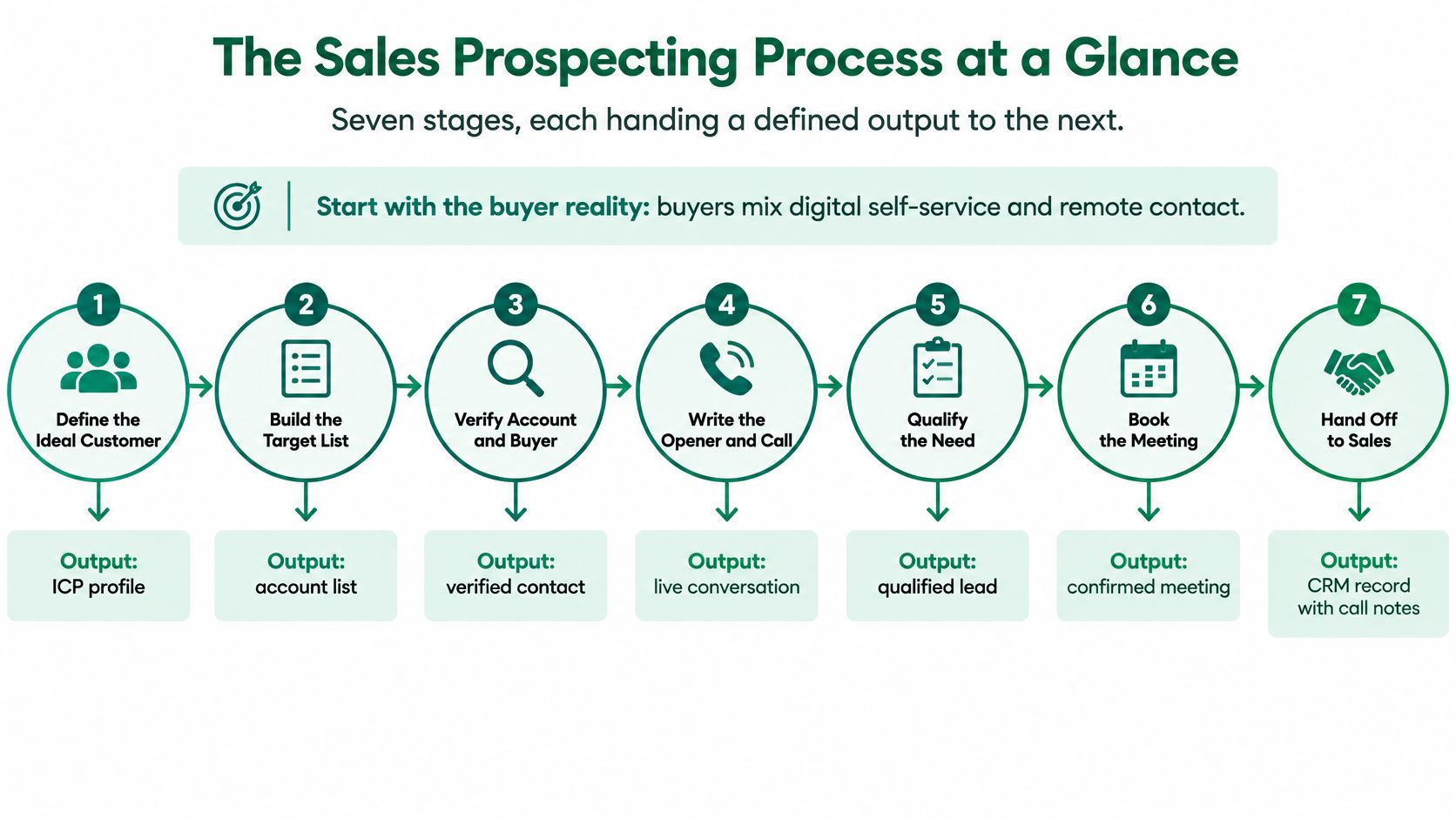
The order matters. First define who you can help and what you offer. Then find a reason the account may need it now, rank the accounts, verify the buyer, and use the signal to start a relevant conversation. Call by phone when a human conversation is useful, and give buyers digital proof or follow-up material to evaluate in their own time.
Stages two and three decide much of the result. A well-researched contact at the wrong account still makes for a wasted call. If a stage has no written output, it isn't a stage yet.
Defining the Ideal Customer Profile and Offer
Every later decision inherits the definition you set here. If your ideal customer profile is vague, researchers will fill the gaps differently, and callers will spend time arguing about whether an account belongs on the list.
Write the profile in five fields: sector and NAF codes, headcount range, geography, service line, and the job title that owns the budget. Make each field specific enough to rule companies out. “Manufacturers” is a starting point, not a useful profile. “Manufacturers in these NAF codes, within this headcount band and geography, with a compliance lead responsible for reporting” gives the team something to check.
Then write your offer in one sentence that names the problem, outcome, and deliverable. For example: “We run an emissions audit for manufacturers that need to prepare for a new reporting requirement.” That sentence should explain why the target company might care, not just what your firm does.
Market mapping helps turn this definition into a usable set of company criteria. A practical guide to B2B market mapping can help you organize the market around your target buyer and offer.
Set an exit test
Attach a value hypothesis to each signal you plan to use. If a company hires a sustainability manager, the hypothesis might be that the team needs help building its reporting process. If a reporting deadline is approaching, the consequence of doing nothing could be an incomplete audit trail or missed preparation work. These are reasons to ask a question, not claims to make about a prospect's situation.
Test the profile with two people on the team. Give them the same sample of companies and ask each to identify ten that fit. If their lists differ by more than two names, sharpen the definition before building a larger list. Keep the profile and signal hypotheses in a shared document, then review them against closed accounts. A good ICP excludes most of the database, not just the obviously unsuitable companies.
How to Pick Accounts Worth a Call This Week
A static list creates a timing problem. A company can fit your ideal customer profile and still have no reason to speak with you now. Gartner figures cited in industry coverage say 61% of buyers prefer a rep-free buying experience and spend only 17% of the buying journey with supplier representatives (the buyer statistics coverage). Your best chance isn't to add more generic touches. It's to call when there's a credible reason the company may need your service.
Before scoring, set an evidence standard. Each signal needs a named source, a date, a decision maker, and a clear explanation of how the event could create demand. A company announcement with a date and named source is useful evidence. A vague impression that a business “seems to be growing” isn't.
The windows and weights below are starting rules to test against your own closed deals, not universal benchmarks.
| Signal | Freshness window | Weight (1 to 3) | Services example |
|---|---|---|---|
| New hire in a role you sell to | 90 days | 3 | Sustainability manager hired before an ESG audit project |
| Regulatory or reporting deadline | Up to 6 months before the deadline | 3 | Reporting rule that applies to the company's sector |
| Funding round closed | 90 days | 2 | Series A closed, with budget for outside advisers |
| New leadership in the buying function | 90 days | 2 | New CFO or Head of Operations in the first quarter |
| Certification or permit issued | 30 days | 1 | Quality certification or site permit that requires a study |
| Market or office expansion announced | 90 days | 2 | New site or country that needs engineering or compliance support |
These signal types are useful for services firms because the trigger may be an operational event, not a visible search for software. A guide to buying signals for B2B services can help you think through which events connect to your offer. For example, a new site permit could create an opening for an engineering firm, while a reporting deadline may be relevant to a compliance consultancy.
Apply one simple scoring rule
For a practical first pass, count a signal's weight only while it's inside its freshness window. Two weighted signals inside their windows means call this week. One means nurture. No signals means skip. If a signal ages out, move the account to nurture rather than keeping it at the top of the queue.
Start with a list of 30 to 50 accounts a week so each call can have meaningful research behind it. Score at the company level, then verify the contact before dialing. A newly hired sustainability manager, a funding announcement, and an applicable reporting deadline shouldn't carry the same meaning for every business; compare the signal with the service you sell.
Treat a 90-day window for a new hire as a working hypothesis. Check it against your last ten closed deals before relying on it. Review the other weights and windows the same way. Better prospecting often means acting faster on fewer well-supported accounts, not sending more touches to a larger list.
Verifying the Account and Finding the Right Buyer
A wrong number or wrong title can waste an otherwise sound sequence. Verify the company first, then match the buyer to the event. In France, Trefle.ai identifies companies through their SIREN numbers, which can help establish that a record refers to the right legal entity.
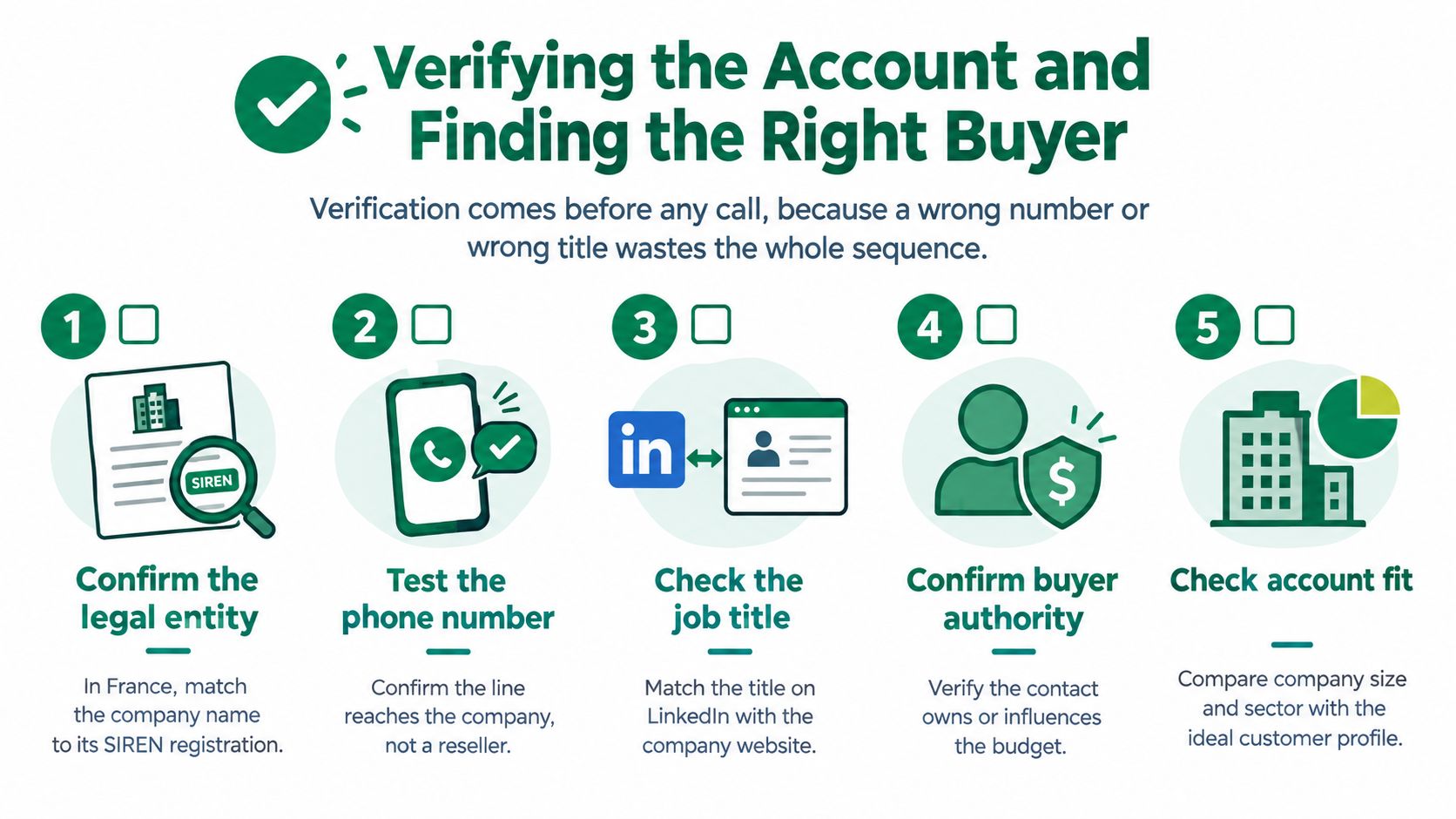
Confirm the legal entity. Match the company name to its SIREN registration. Similar names can point to separate entities, so don't assume an announcement refers to the company you intend to call. Record the legal name and identifier together.
Check company size, sector, and website. Compare headcount and NAF code with your ICP. Open the website and check that it's live and that the business matches the signal. A permit for one subsidiary may not be relevant to another entity in the same group.
Match the buyer to the signal. A new sustainability manager may be the right operational contact, while budget could sit with the CFO or Head of Operations. In a very small firm, the founder may own both the problem and the buying decision. The trap is assuming the person with the most relevant title also controls the budget.
Check the contact route. Compare the title with the company website and professional profile where available. Test the email and make one call during working hours to confirm that the number reaches the intended company or desk. Don't treat a number for a reseller or unrelated office as a direct line.
Record the evidence. Put the source and date beside each important fact in the account record. Trefle.ai identifies the people responsible for buying and gathers their email addresses, professional profiles, and phone numbers as part of its contact research.
Verification rule: Two sources should agree before a number goes into the CRM. If one field remains unconfirmed but the other details hold up, keep the record in progress and mark the uncertainty.
The aim isn't to make every record perfect before anyone can work it. It's to avoid acting as if a guessed title or untested phone number is verified. That distinction helps the caller decide whether to proceed, research further, or exclude the account.
Writing the Opener and Making the First Call
“Hi Marie, I saw your team posted a carbon accounting role on 3 March. Are you building that in house, or testing outside help?”
That opener gives the prospect a specific reason for the call and an easy question to answer. A 2025 report describes an industry standard near 2% for calls that become meetings, while its own dataset reported 6.7%; the same coverage puts average cold call duration at about 93 seconds (the 2025 cold calling report). Those figures don't prove that calling works across the board. They underline how much results can depend on list quality, timing, targeting, and the first line.

Keep the opening short
Build the opener from four parts:
- Your name and company: Identify yourself plainly.
- The dated signal: Say what happened and when, without implying you know more than you do.
- One question: Ask how the company is handling the issue, or whether the work is planned internally or with outside help.
- An exit line: Give the prospect room to answer or decline, rather than forcing a pitch.
The first thirty seconds should establish relevance, not explain every service you offer. If the prospect asks for detail, give a short answer tied to the signal. If the contact is generic, you're relying on luck; if the buyer's role connects to a recent business event, you can ask a question with context.
A workable attempt pattern is to call, leave a one-line voicemail, and retry at a different time of day within three working days. If there's no conversation, add an email or professional-network touch that refers to the same signal. Before dialing, confirm the calling and opt-out rules that apply in the buyer's country, and log each attempt and outcome.
Watch this short video for another perspective on making the call.
Track connection rate and qualified conversation rate, not dials alone. A call-first approach makes sense when the evidence is strong enough to justify interrupting someone and a live conversation can clarify the next step. Trefle.ai's outreach messages are adapted to the prospect's situation and business context rather than sent as generic mass outreach.
Qualifying Replies and Knowing When to Stop
Persistence isn't the same as repeating yourself. RAIN Group's research surveyed 488 buyers representing $4.2 billion in purchases across 25 industries and 489 outbound sellers. It found that 53% of top performers needed five or more touches to generate a conversion for a new account, and top performers were more likely than other sellers to connect after two or three touches (RAIN Group's prospecting research). What each touch adds matters more than a fixed count.
Use consistent reply rules so an SDR doesn't have to improvise the next step:
- Interested: Book the meeting within five working days while the signal is fresh.
- Not now: Set a dated follow-up tied to the event, such as a funding close or reporting deadline.
- Already have a provider: Record the provider and recheck in six months.
- Wrong person: Ask who owns the budget, then update the contact record.
- No answer: After about eight touches across three weeks, pause the account for 90 days.
Qualify the need, not just the interest
Ask four questions during a live conversation:
- Is there a problem with a business cost or consequence?
- Who owns the budget?
- Is there a date or event shaping the decision?
- What happens if nothing changes?
If the account can answer three of those four questions, move it to the closer with a brief. If fewer are clear, nurture the account until there's better evidence. A friendly conversation isn't automatically a qualified opportunity.
Stop immediately when the contact opts out or the account is clearly disqualified. For everything else, make the next attempt earn its place: add evidence, sharpen the role-specific hypothesis, or ask a timely question. The same generic message repeated across a sequence creates noise; a useful new angle creates learning.
Measuring Stages and Fixing Weak Conversion
Activity alone won't tell you where the process breaks. Gong's analysis of 300 million calls found that average representatives connected with 5.4% of dials, compared with 13.3% for top-quartile representatives. Among connected conversations, average representatives booked meetings from 4.6% of conversations, versus 16.7% for top performers (Gong's cold-calling analysis). The useful lesson isn't “make more calls.” It's to identify which stage is holding back results.
Track these as separate numbers: dials, connects, qualified conversations, meetings, and held meetings. Break them down by signal type, role, industry, and opener. That way, a team can see whether a new-hire trigger produces more useful conversations than a general expansion announcement, instead of treating every attempt as equivalent.
| Symptom | Likely cause | First fix |
|---|---|---|
| Connect rate under 5% | Stale numbers or a role that doesn't own the topic | Re-verify numbers and call the buyer title tied to the signal |
| Many connects, few qualified talks | Opener lacks a dated reason or turns into a pitch | Rewrite it around the event and ask one question |
| Qualified talks, few meetings | No specific next step proposed | Suggest a time before the call ends |
| Meetings booked, many no-shows | No confirmation or unclear agenda | Confirm 24 hours ahead with a one-line agenda |
| Good meetings, few wins | Handoff brief is incomplete | Add the signal, pain hypothesis, and objections |
Fix the first stage that breaks
If meetings don't convert, don't immediately rewrite the meeting script. Check whether the accounts had credible signals, whether the contact owned the topic, and whether the opener made a clear reason to talk. A weak meeting often starts with a weak qualification decision.
Review connects and qualification weekly. Review signal performance monthly, and retire signals that stop producing qualified conversations or meetings. Don't reward call volume when the underlying account data is stale or the caller can't explain why the company is being contacted.
Set Your Handoff Rules This Week
A closer shouldn't have to research the account from scratch after accepting a meeting. If the handoff leaves out the event, the contact's role, or what was said on the call, the meeting starts cold.
Record these details in the handoff note: company and size; signal with its date and source; buyer's name and role; a one-sentence problem hypothesis; what the contact said; objections raised; and the agreed next step with a date. The closer's acceptance test is simple: named buyer, dated signal, confirmed meeting time. Send an incomplete handoff note back to the SDR.
Set the weekly operating rules
- Choose the signals. Keep the ones that connect to your offer and retire the rest.
- Build the list. Select and score 30 to 50 accounts for the week.
- Verify before calling. Check the company, contact, and direct line.
- Make and log the calls. Record the outcome and next-step date for every touch.
- Review on Friday. Check connects and meetings, then change one part of the opener for the next list.
Researchers should own verification and follow-up administration. SDRs should own calls and meetings, with the closer responsible for accepting the handoff. A coordinated outsourced B2B appointment-setting process can cover research, outreach, and follow-ups so the client's team focuses on taking qualified meetings.
Choose whether to run the work in-house or buy research and calling capacity from an outside service. If you're unsure whether your signals justify the effort, start with a small list and judge it by qualified conversations and accepted meetings, not the size of the database.
Trefle.ai's Noa delivers a weekly feed of call-ready opportunities with a dated buying signal, proof link, named decision maker, verified direct number, and suggested opener. If you want the research, outreach, and follow-up handled for your team, explore Trefle.ai and decide whether a signal-led prospecting process fits your next list.