What Is Cold Calling in Sales? a 2026 B2B Guide
What Is Cold Calling in Sales? A practical B2B guide to the process, real call benchmarks, legal rules and when phone-first beats email.
Cold calling is an unsolicited phone call from a seller to a prospective buyer who has not asked to be contacted, made to test whether a business problem exists and to secure a next step.
You've probably been here. Referrals slowed down. Inbound is quiet. Someone suggests you just pick up the phone, and you open a spreadsheet of names you don't trust. If you're a founder without a phone team, that moment feels risky and vague at the same time. Is this legal? Is it dead? And what are you asking for if someone answers?
The plain answer is that what is cold calling in sales depends less on your script than on your timing. A call to a random account is an interruption. A call to a company with a dated reason to talk now is a test of fit. That distinction runs through everything that follows.
What Cold Calling Means in Sales
Cold calling is a seller starting an unsolicited phone conversation with a prospective buyer who never asked to be contacted and hasn't engaged before. The purpose is narrow. You test whether a relevant business problem exists now. Then you ask for one next step, such as a discovery call.
Think of it as knocking on the door of a company you chose from a map. You can state your reason in one sentence. That's different from knocking on random doors on a busy street and hoping someone is kind.
Three Tests You Can Apply
- No prior request: The person didn't ask for contact, fill in a form, or reply to an email. If they did, you're making a warm call, not a cold one.
- A live conversation: A cold call isn't a blast of voicemails or a recorded message. It's a two way exchange where you can listen, qualify, and stop if the fit isn't there.
- A purpose beyond closing: You're not trying to sell the full service in a few minutes. You're checking whether a problem exists and whether a longer conversation is worth both sides' time.
A warm call follows an email reply, a referral, an event, or a shared connection. The buyer has some reason to recognize you. A cold call has none of that, so your reason for choosing this account has to carry the opening.
That is also what separates structured prospecting from dialing strangers. A proper call combines account selection, a verified contact, a relevant opener, qualification, and compliance with telephone rules. Remove any one piece and you're left with volume for its own sake.
So is cold calling dead? No. It fails for teams that dial unfiltered lists. It still works for teams that choose accounts carefully and can name a current reason to call.
Self-check: Before you dial, ask this. Does this prospect have a reason to expect this call, even if they've never heard of me? If you can't answer in one sentence, the account isn't ready.
Legal and Ethical Rules for B2B Cold Calling
Many founders assume B2B means the consumer rules don't matter. That assumption gets teams into trouble, because business lists often contain personal numbers, sole trader lines, and old data. Check lawfulness before you choose an account, not after you've written the opener.
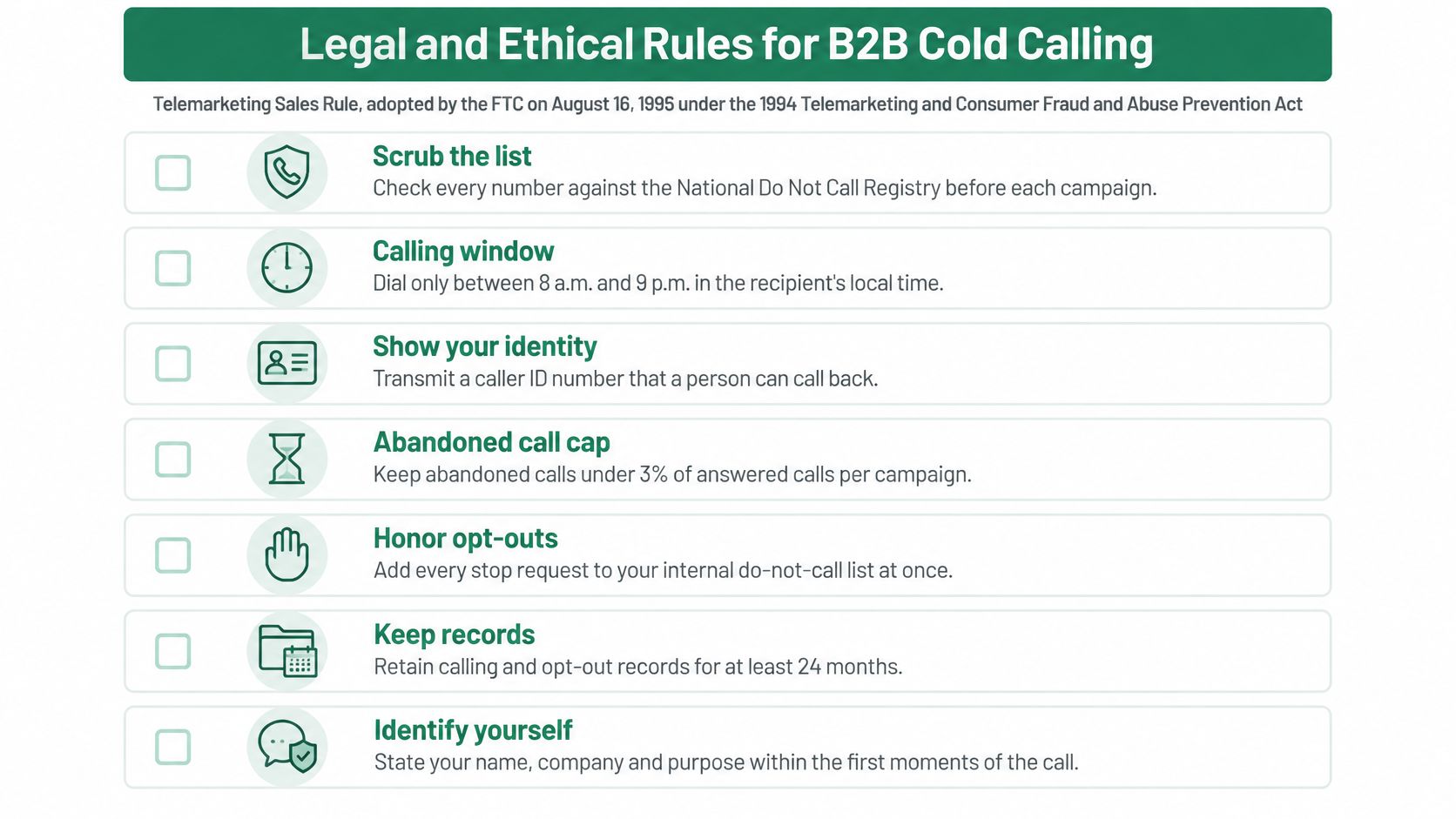
In the United States, Congress passed the Telemarketing and Consumer Fraud and Abuse Prevention Act in 1994, and the FTC adopted the Telemarketing Sales Rule on August 16, 1995. Under the FTC summary of the Telemarketing Sales Rule and Do Not Call requirements, unsolicited calls are generally barred before 8:00 a.m. or after 9:00 p.m. in the recipient's local time, and you must not call someone who has asked your specific company not to call.
The National Do Not Call Registry began accepting consumer registrations on June 27, 2003, with enforcement from October 1, 2003. It's primarily consumer focused. For B2B teams, that means you still need to separate business numbers from personal numbers, keep accurate records, and respect the privacy and telemarketing laws that apply where the person sits.
Checks Outside the United States
If you call the UK, check business lines against the Telephone Preference Service and the rules in PECR. If you handle personal data in the EU, GDPR affects how you source, store, and justify contact details. Don't treat a number found online as permission to keep and reuse it forever. Record where it came from and why you believe it's a business contact.
Rules differ by country, and they change. A small firm calling three countries needs three checks, not one global assumption.
The Ethical Baseline Before Any Dial
- State who you are: Give your name, your company name, and a callback number early.
- Show a real caller ID: Never mask it or display a number nobody can return.
- Honor opt-outs the same day: Log every request at once and suppress that number across the team.
- Stop after a clear no: A polite check on timing is fair. Arguing isn't.
- Protect personal mobiles: Don't call a personal mobile without a clear business basis for that specific number.
Here's the practical sequence. Scrub the list. Confirm the number is a business line. Note the source. Confirm the local calling window. Only then do you research the trigger and write the opener.
This is general information, not legal advice. Confirm the rules for every country you call with counsel before you run a campaign. Verified decision maker data and a specific business reason aren't polish for a small B2B firm. They're the foundation that keeps the call defensible.
Turning a Cold Account Into a Warm Call
A verified phone number only proves you can reach someone. It says nothing about whether the company has a problem right now. That gap kills most cold calls before the second sentence.
Published figures on cold call success vary widely, largely because each source defines "success" differently: a booked meeting, a qualified conversation, a closed deal. Roundups such as HubSpot's sales statistics roundup collect numbers that sit far apart for exactly that reason, and the benchmarks section later in this article explains why no single average should drive your planning. The reliable lesson across sources is the same: list quality and timing matter more than a universal script.
So ask a better question. When is a cold call no longer really cold? A call stops being cold the moment you can name a dated, verifiable event tied to your offer, a reason the prospect should have expected someone to call about. A trigger works like a concert ticket. It is only valid for a specific date.
| Trigger | Where to find it | Why it opens the call |
|---|---|---|
| New executive in a relevant role | Company announcements, press releases, professional profiles | A new leader often reviews vendors and priorities in the first months |
| Funding round | Press coverage, funding databases | New budget and pressure to scale operations or services |
| Hiring for a role your service supports | Job boards, company careers pages | Open roles signal a capacity gap or a new initiative |
| Regulatory deadline | Government and sector regulator publications | A dated compliance requirement creates an urgent, budgeted need |
| Certification or permit | Issuing body registers and company news | A new credential or approval often brings new obligations |
| Market expansion | Press, new office or site announcements | New locations need local support, suppliers and processes |
Date It or Drop It
Check the publication date. Confirm the event is still current. Save the link as proof. If you can't do all three, the item is background, not a reason to call.
An example helps. A funding round announced last week supports a call about scaling operations. The same round from eighteen months ago is company history, not a reason. The firm looks identical in a database. Only one version gives you timing.
A generic intent score has the same flaw. It may suggest interest, but it doesn't tell the decision maker why you called today. A dated trigger does, in language the buyer can verify independently.
Score Before You Dial
Review and score every account so outreach focuses on prospects with the highest potential and strongest buying signals. Call the strongest matches first. Park weak accounts instead of filling a dial quota with them, because twenty weak calls produce less than five timed ones.
For a deeper view of how to read these events, see this guide to B2B buying signals for service firms. The discipline is simple to state and hard to fake. You need account level relevance and contact level accuracy at the same time.
Timing does the heavy lifting. A warm reason answers the buyer's first silent question: why me, and why now?
How a B2B Cold Call Works, Step by Step
A good call looks simple from outside. Underneath, each step protects the next one. Skip the early steps and the conversation has nothing to stand on.
The flow below shows the full sequence before you work through it in detail.
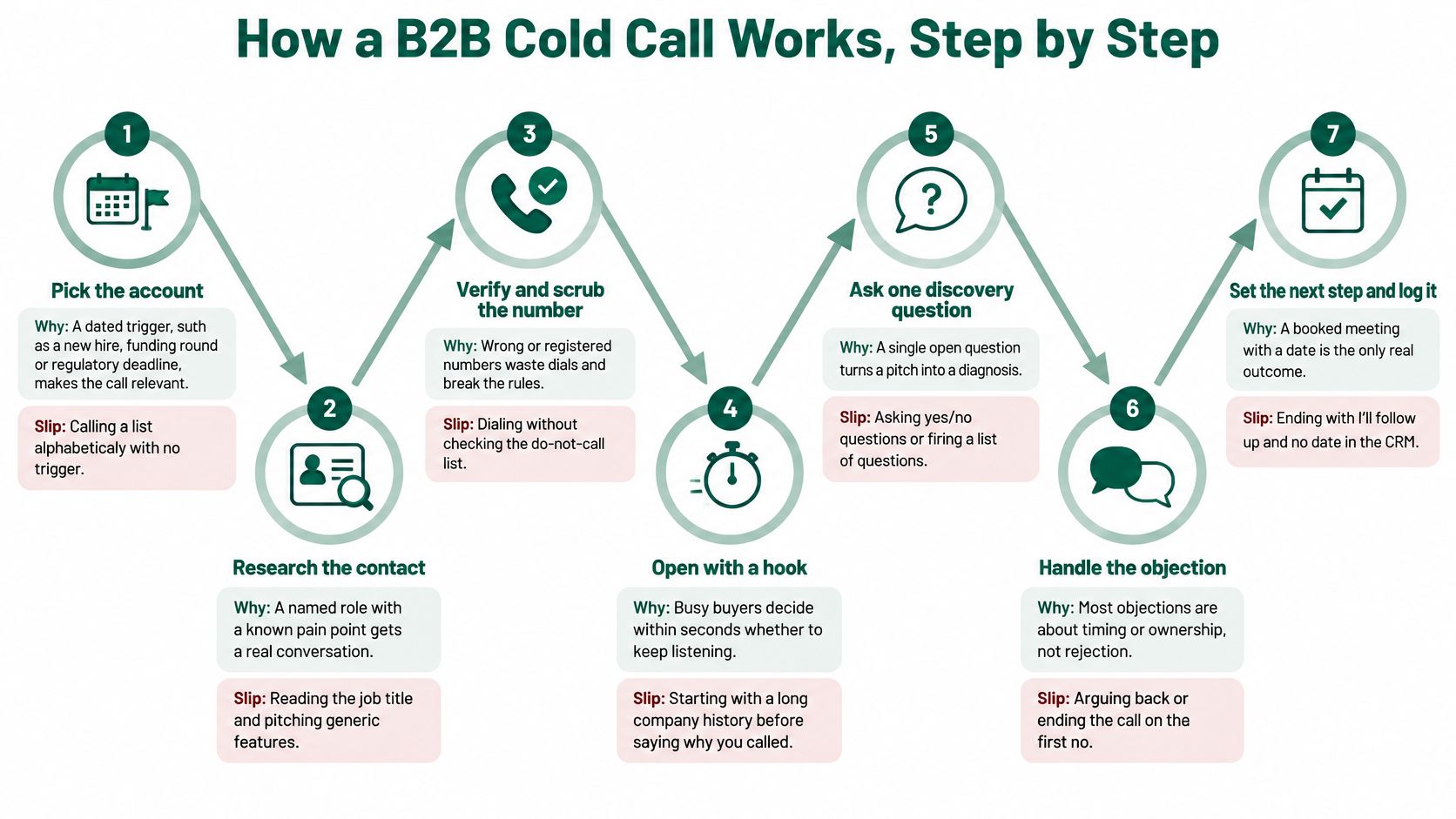
- Pick the account for a dated trigger. A new hire, funding round, or regulatory deadline earns you a hearing. Calling a static list in alphabetical order is the common slip.
- Confirm the decision maker and direct line. Check the person's role, then verify the number and keep business and personal lines separate. We identify the people responsible for buying solutions and gather their accurate emails, LinkedIn profiles, and phone numbers at this stage, because unverified data fails first.
- Write one sentence linking your service to the trigger. Your opener is only as strong as that link. If the sentence could fit any company in the sector, rewrite it.
- Open fast. Give your name, your company, the trigger, and one question. For example, you hired a compliance lead this month, how are you preparing for the next audit? Avoid generic openers such as how are you today.
- Ask two or three qualifying questions. Ask about the current problem, who owns it, and when it must be solved. Then listen more than you talk.
- Ask for one specific next step. Offer a short discovery call on a named day. Vague interest rarely becomes a meeting, which is why some teams study how outsourced B2B appointment setting handles this handoff.
- Log the outcome and set a follow-up. Record what you learned the same day and set the next attempt within a few business days. Many meetings come on later attempts, not the first dial.
This short video walkthrough is useful for hearing how the opening and qualification sound when they're paced well.
Gatekeepers and Voicemail
When a gatekeeper asks the purpose, answer with the trigger in one sentence. Don't pitch features to someone whose job is to route you. Courtesy plus a concrete reason is your best route through.
If you reach voicemail, leave a short message with your name, the trigger, and a callback number. Then send one email naming the same trigger. Don't leave a long product story nobody asked for.
A good call sounds unremarkable. A brief exchange with a gatekeeper. A few focused minutes with the decision maker. A clear next date on the calendar. If the answer is no fit and no problem, that's also a useful result. You learned it in minutes instead of chasing the account for weeks.
Cold Call Benchmarks and What They Mean
Read cold call numbers in two stages. Connect rate is the share of dials that reach a prospect. Meeting conversion is the share of live conversations that produce a booked meeting. Mixing those stages makes every benchmark look better or worse than it is.
| Benchmark | Reach rate | Next-stage result | Outcome per 1,000 dials |
|---|---|---|---|
| Average reps (Gong, 300 million calls) | 5.4% connect rate | 4.6% of connects become meetings | about 2.5 meetings |
| Top reps (Gong, 300 million calls) | 13.3% connect rate | 16.7% of connects become meetings | about 22 meetings |
| Residential real estate study (2011) | 28% answered | 19 appointments from 6,264 calls | about 3 appointments (1 per 330 dials) |
| Cognism connected calls (2024) | 9,247 connected calls | 5,265 conversations | Not reported on a per 1,000 dial basis |
| Average cold call success (recent reports) | 2% to 3% success | Varies by definition | Not reported consistently |
Gong's analysis of more than 300 million cold calls found average representatives connecting on 5.4% of dials and converting 4.6% of connects into meetings, while top representatives reached 13.3% and 16.7%, according to Gong's guide to mastering cold calls. At 1,000 dials, that's about 54 connects and 2.5 meetings at average performance, versus about 133 connects and 22 meetings at the top benchmarks, using those same reported rates.
The older residential study needs a clear limit. In the 2011 Keller Williams work covering 6,264 calls, 28% were answered, 55% were not answered, and 17% were disconnected, producing one appointment per 330 dials, as described in this review of whether cold calling is dead. That's a historical baseline from random consumer real estate calling. It isn't a modern B2B benchmark.
Cognism adds a useful mid funnel check. In 2024, 9,247 connected outbound calls resulted in 5,265 conversations in Cognism's state of cold calling analysis. A connect still doesn't guarantee a real conversation.
List quality and calling execution compound. Reaching more valid prospects and converting them better beats simply dialing more, because both stages multiply.
Standardize your definitions before you compare teams. These are vendor and study benchmarks, not a universal market average. Use them to find your weak stage, not to forecast meetings you haven't earned yet.
Phone-First or Email-First by Situation
Lead with the phone when the deal justifies a live conversation, the problem is time sensitive, or the decision maker is hard to reach by email. Lead with email or LinkedIn when volume is high, the offer is simple, and the buyer expects written detail first.
That's the verdict in one line. The situations below show where it holds and where it flips.
| Situation | Lead with phone | Lead with email or LinkedIn |
|---|---|---|
| Complex services with deals above roughly 10k | Yes, a live conversation surfaces the problem faster | Use as a follow-up after the call |
| Senior decision maker with a verified direct line | Yes, a direct line reaches the buyer without a gatekeeper | Use after voicemail or a missed call |
| Time-sensitive trigger such as a deadline or new funding | Yes, speed matters and the reason is fresh | Use to send the dated reason before the call |
| Low-value, self-serve product | No, call cost exceeds deal value | Yes, sequences scale at low cost |
| Niche market with few decision makers | Yes, each account deserves a real conversation | Use for nurturing between calls |
| Unverified or outdated phone numbers | No, dials are wasted until data is verified | Yes, use after enrichment and checking |
| Buyer who asks for written detail first | No, a call adds friction | Yes, send the summary, then call to book |
When the Verdict Flips
A verified direct line can turn a risky phone attempt into a useful one. You reach the person who owns the problem, and you can test timing in minutes. An unverified list does the opposite. It makes phone outreach expensive, because your team spends selling time discovering bad numbers.
Deal shape matters too. A consultancy sells judgment on a specific problem. That rarely fits in a short email. A simple product with a clear price can often be judged in writing, so a call first may annoy rather than help.
If you're weighing whether to build this motion or buy support, this comparison of prospecting agencies versus software lays out the tradeoffs. Either way, don't judge the channel until the data underneath it is clean.
Phone-First Doesn't Mean Phone-Only
The strongest sequences often combine both channels. Call first to start the conversation. Follow with an email that restates the agreed next step. Or send one email naming the trigger, then call after a no answer so the prospect has context.
What doesn't work is mixing channels with mixed messages. If the email says one thing and the call says another, you look disorganized. Email only warms a contact before a call when it names the same dated trigger you'll open with.
Decision rule: If you can name the decision maker, verify the line, and state a fresh trigger, call. If any one of those is missing, fix it in writing or with research first.
Run a Two-Week Phone Pilot Before Scaling
Don't settle the phone question with opinions. Run a small pilot this month and measure it against the funnel stages you defined earlier.
Choose a focused set of accounts, each with a trigger dated within the last month. Verify one decision maker and a direct business line for each. Write a dated opener per account, then call each contact up to a few times on different days so one busy morning doesn't decide the result.
What to Track
- Connects: How many dials reached the named prospect.
- Conversations: How many connects became real exchanges about the problem.
- Meetings booked: How many conversations produced a dated next step.
Use the same definitions for every caller. If one person logs a gatekeeper chat as a conversation and another doesn't, your pilot proves nothing. Keep notes on why calls failed, not just how many you made.
The Decision Rule
If your connect rate is near the average benchmark covered earlier and meetings are booked, scale the motion. Keep it phone-first for high value accounts and widen the trigger list carefully.
If connects are low, fix the list before the script. Verify contacts, separate personal numbers, and tighten the triggers. A better opener can't rescue calls that never reach the right person. If conversations happen but meetings don't, work on qualification and the specific next step instead.
If research is the bottleneck, a provider route is one option among several. You can hire internally, buy data and enrich it yourself, or use a done for you model where agents handle the research, outreach, and follow-ups, and your team only takes the meetings. Our custom Agentic Sales Infrastructure route is an ongoing partnership with meetings expected in about 4 weeks.
Measure before you commit budget or headcount. Two honest weeks will tell you whether you have a targeting problem, a data problem, or a channel worth scaling.
If your pilot shows that research is eating your selling time, Trefle.ai supplies call-ready opportunities with a dated signal, a verified decision maker, a direct number, and an opening line, or runs phone-first Managed Outbound where trained setters book the meetings for you. Start with the accounts that have a reason to talk this week and visit Trefle.ai to see how that would work for your market.