Cold Calling vs Warm Calling: When Each Wins in B2B
Cold Calling vs Warm Calling compared: conversion rates, call playbooks and when a small B2B team should use each in 2026.
One appointment per 330 dials. That was the result of a controlled Baylor University study of cold calls, reported by Martal's cold calling benchmark review. It's a useful corrective to the idea that a busy phone queue means a healthy pipeline. The important question in cold calling vs warm calling isn't whether the phone works. It's whether you have enough context to justify asking this buyer to stop working and listen.
Cold Calling vs Warm Calling at a Glance
Cold calling reaches companies with no known need and wins on reach and volume. Warm calling reaches buyers who already have context and wins on yield per call.
That distinction matters when you're allocating a small team's time. A founder with useful introductions faces a different decision from a sales rep entering a new market without relationships.
Cold calling vs warm calling side by side
The numerical planning ranges below come from Optif's call conversion benchmark summary, which reports average cold call conversion near 2% to 3%, warm call conversion around 15% to 25%, and the corresponding workload ranges shown here.
| Criterion | Cold calling | Warm calling |
|---|---|---|
| Prior relationship | None with the buyer or company | Referral, past contact or engagement |
| Dial to meeting yield | About 2% to 3% on average | About 15% to 25% from call to meeting |
| Dials or conversations for one meeting | About 40 to 50 dials at 2% to 2.5% | About 4 to 7 qualified conversations |
| Main cost | Dial volume and list research | Scarce referrals and intent data |
| Interruption risk | High unless the call has a dated reason | Low when context is current, high when stale |
| Scalability | Scales with a verified list | Limited by network or signal supply |
| Best first move | Open with a dated trigger, not an introduction | Name the referrer or shared event |
Read the denominators before the percentages
These ranges use different definitions. A dial isn't a qualified conversation, and a call to a referral isn't equivalent to a call prompted by anonymous website activity. Compare the direction of the gap, not an exact multiplier between rows.
A dated trigger can make an unsolicited call behave more like a warm conversation. It doesn't create a relationship or prove purchase intent.
Planning rule: Most small B2B teams need both call types. Protect time for credible warm opportunities, then use targeted cold calls to reach suitable accounts outside your network.
Choose your next block of calling time by the constraint you face: insufficient reach, insufficient relevance, or insufficient access to the buyer.
What Cold and Warm Calling Mean in Practice
A cold call is a first conversation with a buyer who has no prior contact with you and no known need for your offer. You selected the company because it fits your market, not because someone asked for help.
A warm call starts with an existing link. That might be a trusted referral, a past conversation, engagement with your company, or a business event that makes your offer relevant now. These aren't equally strong connections, so your opener should acknowledge what you know.
The grey zone is where judgement matters
Say a manufacturer advertises for a sustainability officer. An ESG consultancy could contact the person responsible for the programme and explain that the vacancy prompted the call. The useful question is whether the company needs outside support while it recruits.
That's technically unsolicited outreach. It's also more relevant than calling every manufacturer in a directory with the same sustainability pitch.
The caller must separate evidence from inference. The vacancy is evidence. A budget for consulting is an inference, and the conversation should test it rather than present it as fact.
Calling has always required a process
Telephone selling developed after commercial telephone availability in the late nineteenth century; the Bell System published a telephone canvassing manual in 1927, and cold calling had overtaken postal mail as a common prospecting route by the 1980s, according to The Quota's history of cold calling.
The lesson isn't that callers eventually found a better script. Calling became repeatable through access to phone numbers, trained people, structured conversations and organised follow up.
Use this working definition in your CRM guidance:
A cold call reaches a buyer with no known need or prior contact. A warm call reaches a buyer whose relationship, context or dated trigger makes the conversation relevant.
Keep the original lead source visible too. A referral and a public hiring signal should never become indistinguishable records.
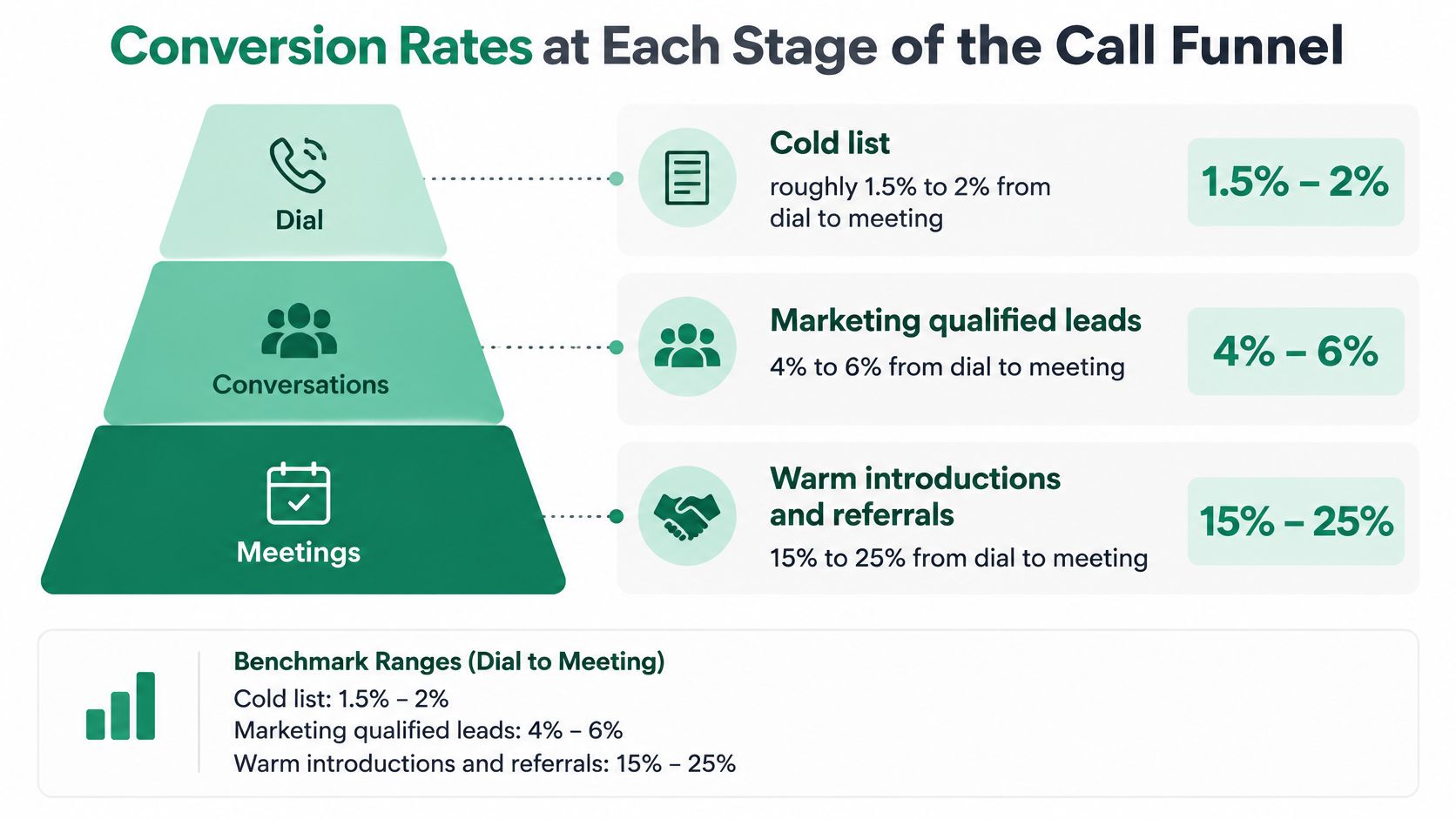
Conversion Rates at Each Stage of the Call Funnel
Reported call yields by call source
| Call source | Reported yield | Definition or source |
|---|---|---|
| Cold list | Roughly 1.5% to 2% | Dial to meeting, Martal comparative benchmark |
| Marketing qualified leads | 4% to 6% | Dial to meeting, Martal comparative benchmark |
| Warm introductions and referrals | 15% to 25% | Dial to meeting, Martal comparative benchmark |
| Genuinely cold calls | About 0.3%, one appointment per 330 dials | Controlled Baylor University study of 6,264 calls, reported by Martal |
| Average cold call | About 2% to 3% | Call to booked meeting, Optif benchmark summaries |
| Stronger cold teams | About 5% to 8% | Call to booked meeting, Optif benchmark summaries |
The table separates source categories because combining them produces an activity target that nobody can interpret. The comparative benchmarks concern meetings per dial, while other summaries use call outcomes with less consistent definitions.
This visual shows the source categories rather than a universal forecast.
Translate yield into workload
For a hypothetical planning example, suppose a cold campaign produces meetings from 2% of dials. Making 400 dials would produce eight meetings. Suppose a separate warm campaign converts 15% of qualified conversations: 40 conversations would produce six meetings.
Those are arithmetic scenarios, not promised results. They also don't prove the warm campaign costs less. Someone had to generate the referrals, qualify the engagement and prepare the calls.
Include that preparation when comparing meetings per rep hour. Otherwise, a warm campaign can appear almost free because the work happened outside the calling block.
Find the weak stage
Track these measures separately for each source:
- Dial to connect: Did a person answer? Poor results suggest bad numbers, unsuitable calling windows or inaccessible contacts.
- Connect to meaningful conversation: Did you reach the relevant person and establish a business topic? Gatekeepers and mistaken role assumptions belong here.
- Conversation to meeting: Did the buyer agree to a useful next step? Low performance can indicate weak relevance, an unclear offer or premature qualification.
- Meeting show rate: Did the meeting happen? A booked slot without attendance isn't a completed sales conversation.
For another perspective on the calling process, use the accompanying video.
Use benchmarks to estimate capacity and identify questions. Set operating targets from your own source definitions, buyer roles and observed outcomes. Don't change the script to fix a contact data problem.
Which Criteria Decide the Winner for Your Team
Contactability comes before persuasion. A good reason to call won't help if the number belongs to a former employee or the contact doesn't own the problem.
Scrap.io's outbound benchmark review reports answered call rates of approximately 13.3% for SDRs using verified data, compared with about 14.4% for account executives calling warm leads. That narrow gap concerns answers, not meetings. Verified numbers can improve access without creating commercial relevance.
Assess access, fit and timing separately
Start with a contact gate: confirm the person's current responsibilities and test the direct line. Then rank the account's business context rather than letting a good telephone record inflate its priority.
Use this ordering:
- Recency first: Check when the event happened, not just when your tool discovered it.
- Business impact next: Identify what the event changes operationally. Funding without a relevant spending plan is weak evidence for your particular offer.
- Role relevance: Confirm that the recipient owns the affected process, budget or outcome.
- Evidence strength: Prefer an attributable announcement, vacancy or official document over an unexplained intent label.
A dated funding event or compliance deadline generally deserves more attention than an anonymous pricing page visit. A new executive deserves priority only when that executive owns the problem you solve.
Our guide to B2B buying signals for services can help turn broad event categories into account selection rules.
Score the account without hiding disqualifiers
In your CRM, record company fit, verified role, tested phone, event date, proof link and the reason your offer applies. Mark each field as confirmed, uncertain or absent.
Don't average away a failed prerequisite. A fresh event shouldn't compensate for an irrelevant offer. Give role ownership and company fit veto power, then use event urgency and evidence quality to rank eligible accounts.
Compare the economics alongside that score:
| Criterion | What to record |
|---|---|
| Cost per meeting | Research, calling and follow up labour divided by meetings held |
| Time to first meeting | Elapsed time from list preparation to a held meeting |
| Predictability | Whether suitable accounts can be replenished consistently |
| Scalability | Research capacity, caller capacity and available signal supply |
Run matched cohorts against your static list. Keep dial counts, caller training, offer and calling windows comparable. Separate contactability improvement from conversation conversion improvement.
Illustrative example: A rep could spend a day cycling through a large static contact list or researching a smaller set of accounts with relevant events. Don't assume the researched group wins. Measure which group reaches a held meeting sooner, including preparation time, and whether those meetings qualify.
When Each Call Type Earns Its Place
A cold call isn't automatically poorly timed. A warm call isn't automatically welcome.
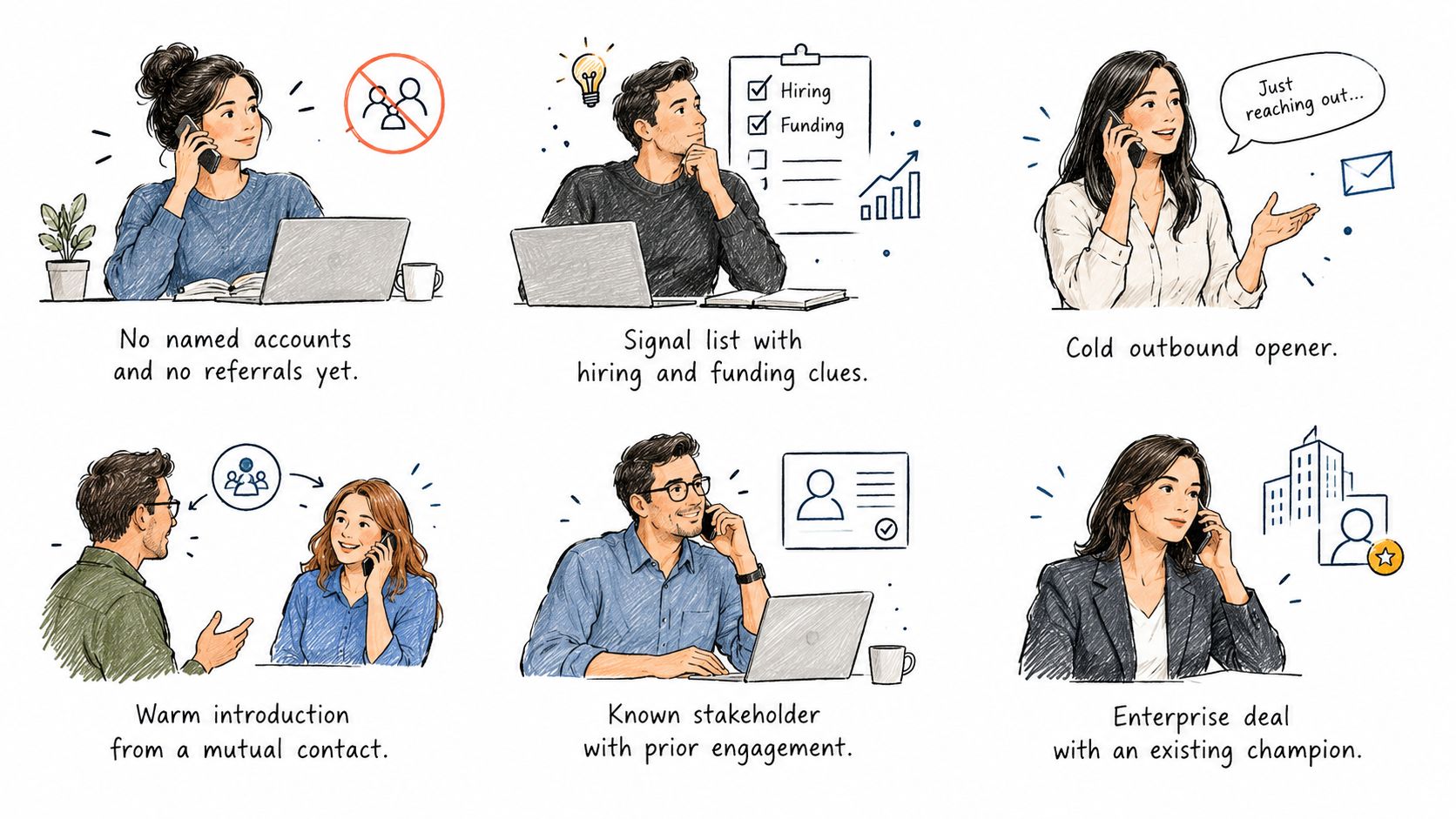
Which call type to lead with, by situation
| Situation | Lead with | Why |
|---|---|---|
| No named accounts and no referrals yet | Cold calling on a signal list | Reach matters more than warmth at the start |
| Founder with past clients and peers who can introduce | Warm calling and referrals first | Trusted introductions deserve priority |
| Enterprise deal with an existing champion | Warm calling through the champion | The introduction carries credibility |
| Dated trigger in the last few days | Cold call that opens with the trigger | Context makes an unsolicited call relevant |
| Long sales cycle with few accounts | Warm calling and referrals | Account access matters more than call volume |
| Only anonymous visits or weak signals | Email or waiting | The interruption cost outweighs the signal value |
The practical choice is between approaches suited to the account, not between permanently cold and warm sales teams.
Set a threshold for interrupting
Market Intelligence Tools' buyer outreach summary reports that 82% of buyers accept meetings at least sometimes from proactive sellers, while 73% of B2B buyers actively avoid suppliers that send irrelevant outreach. Those findings support selective outreach, not blanket permission to call.
A pricing page visit indicates activity, but an anonymous visit doesn't identify the buyer or establish a project. A leadership appointment identifies a person, but it doesn't establish demand. A regulatory deadline can establish urgency, but only if it applies to that company and your offer addresses the resulting work.
For an engineering consultancy, a permit tied to a relevant project may justify a call to the project owner. For a software vendor, hiring into a workflow that its product supports may justify a question about how the team will manage the added work.
Interruption threshold: Call when you can establish a dated event, a relevant owner and credible evidence of a problem your offer could address. Otherwise, take a lighter step first.
Test the awkward cases
A referral from someone the buyer barely knows provides little borrowed credibility. Ask the referrer to explain the connection and why the conversation would help. Don't present a loose acquaintance as a trusted endorsement.
A strong trigger aimed at the wrong role fails for a different reason. A compliance deadline does not justify pitching an unrelated department head just because you have their mobile number.
Neither case calls for a more forceful opener. Improve the connection or find the responsible person before asking for time.
Playbooks for Cold Calls and Warm Calls
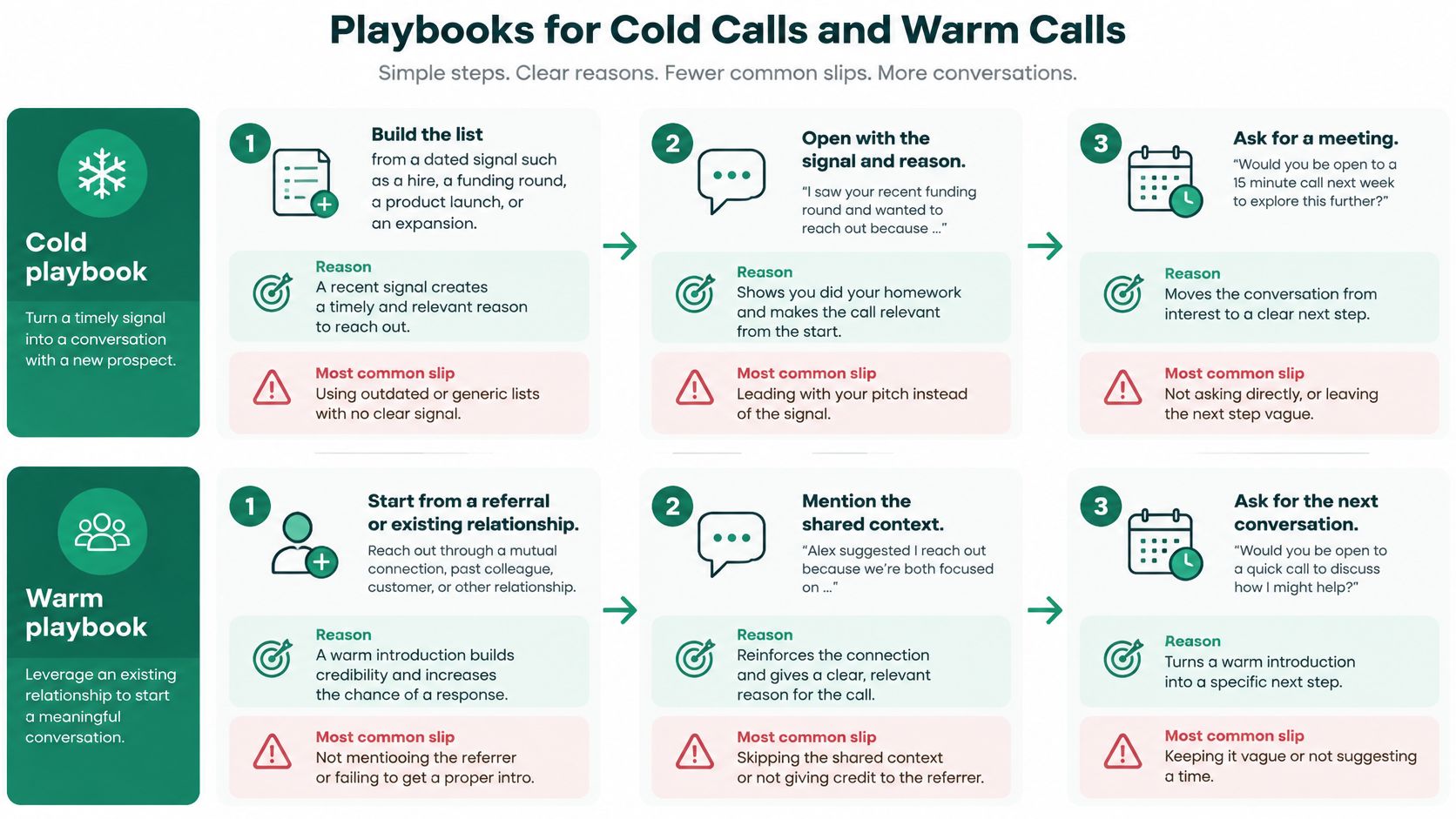
Preparation should produce a usable call, not a research dossier. The caller needs a relevant fact, a credible contact and a question that can confirm or reject the opportunity.
These tracks show the basic progression. The detailed steps keep the conversation grounded.
Cold calling playbook
Build from an attributable event. Use hiring announcements, funding news, permits or applicable deadlines. The common mistake is collecting interesting company news without explaining why it creates work your offer can address.
Confirm the buyer and direct line. Check current responsibilities before calling. Repeatedly dialling an untested number creates activity without testing your proposition.
Open with the event and its relevance. For an illustrative sustainability call, explain that the advertised role prompted you to ask about support during recruitment. Don't claim that hiring proves the company needs a consultant.
Ask a diagnostic question. Find out whether the work is already covered, deferred or still being scoped. Listen for an actual timing window or a clear no instead of steering every response towards a meeting.
Use a stopping rule. I would pause an unanswered sequence after the third attempt unless the buyer has requested further contact, because Krisp at Work's prospecting benchmark summary reports that 93% of conversations occur by the third attempt. Treat that as a capacity rule, not proof that a particular buyer will never answer.
Log what happened against the event. Separate invalid contact, wrong owner, no current need, later timing and qualified interest. A single unsuccessful status prevents the next caller from learning anything.
At Trefle.ai, we identify companies using public and private data, hiring trends, company news, LinkedIn activity and market signals. We identify the people responsible for buying solutions and gather their accurate emails, LinkedIn profiles and phone numbers. Each company in the dataset includes a ready to use sales angle for first contact.
Warm calling playbook
Name the real connection immediately. State the referrer or shared conversation accurately. A generic company introduction wastes the context that made the call worth taking.
Check timing before pitching. Ask whether the topic is still active and whether this is a suitable moment. Prior interest isn't permanent permission.
Explore the specific problem. Start with what the referrer or buyer raised, then verify it. Don't turn a narrow request into a tour of everything you sell.
Propose a concrete next step. Offer a dated working session with a defined purpose, such as reviewing the implementation constraint. Avoid an unspecified catch up that neither person can prepare for.
Follow the buyer's window. Record the agreed timing and send only the information needed for that step. Continuing your standard cadence after receiving clear instructions makes a warm conversation feel automated.
A useful call can end without a meeting. A clear no, a correct owner or a genuine future window improves account selection.
If callers need help executing rather than finding contacts, define qualification and handoff standards before choosing outsourced B2B appointment setting. Include an easy opt out and a self serve next step for buyers who prefer to investigate without a sales conversation.
Set Your Call Mix for the Next Quarter
Don't choose a permanent winner between cold and warm calling. Run a quarter with explicit allocation rules, then change the mix using held meetings and labour costs.
Start with a manageable operating plan
Choose the signal categories. Pick events closely tied to your offer, such as relevant hiring and an applicable compliance deadline. Write down what would disqualify each account before building the list.
Divide calling time from your current baseline. Reserve capacity for referrals and agreed follow ups, then allocate the remaining blocks to selected outbound accounts. Use B2B market mapping to check that the available market can support that workload.
Separate the funnel records. Keep contact access, substantive conversations, bookings and attendance distinct for each source. Include research and follow up time in the labour record.
Schedule an early review. Compare matched static and event selected cohorts once there's enough activity to inspect. Look at disqualification reasons and meeting quality, not just bookings.
Reallocate hours deliberately. Give more capacity to the approach producing suitable held meetings per hour. Retire exhausted sequences, and reassess a signal category only after checking whether callers reached the right people.
Update the ranking at quarter end. Keep the events associated with relevant conversations. Remove categories that repeatedly produce speculative openers or unsuitable accounts.
Make the immediate decision
Choose which call type gets next week's first calling block. Then select the initial signal categories and assign someone to verify the evidence and buyer ownership.
If you already have credible introductions, use them. If you don't, start with accounts where you can explain the business reason for calling without pretending the buyer has expressed interest.
Trefle.ai offers Noa for call ready opportunities with dated buying signals, proof links, decision makers and suggested openers, plus Managed Outbound for teams that want research, outreach and follow ups handled for them. Visit Trefle.ai to discuss which signals fit your offer and whether your team should make the calls or take the qualified meetings.