Full Cycle Sales: Roles, Process and When to Use It
Full cycle sales explained: which stages one rep owns, when to use full-cycle reps over specialized SDR and AE teams, and a sample process.
Your rep has proposals to finish, prospects to call and a CRM full of accounts that still need research. New outreach stops whenever a deal gets close to signing. Then the deal closes, and there's nothing ready behind it.
Hiring an SDR might help. It might also create another handoff without fixing the underlying problem. Full cycle sales is a capacity and ownership decision, not a preference for generalists over specialists. Before you hire, decide which work needs the seller's judgement, which work needs support and how much opportunity volume the role can carry.
Stage Owners and the Eight-Step Sample Process
Full cycle sales means end to end ownership of a B2B opportunity, from prospecting and qualification through discovery, evaluation, proposal, negotiation and close. One seller is accountable for both creating pipeline and converting it.
Ownership doesn't mean doing everything alone. A rep can own the proposal while a deal desk approves commercial terms. The same rep can coordinate negotiation while counsel reviews the contract.
Stage ownership in a full cycle model and a split model
| Sales stage | Full cycle rep owns it | Owner in a split model |
|---|---|---|
| Prospecting and list building | Yes, researches and verifies accounts | SDR team |
| Outreach and first meeting | Yes, makes first contact | SDR team |
| Qualification | Yes, confirms need, budget and timing | SDR qualifies, AE confirms |
| Discovery | Yes, maps the buying group and pain | AE |
| Evaluation and demo | Yes, with technical support as needed | AE or solutions engineer |
| Proposal and pricing | Yes, with deal desk approval | AE with deal desk |
| Negotiation and legal review | Yes, with procurement and counsel | AE with legal and deal desk |
| Close and handoff to onboarding | Yes, logs notes and hands over | AE, then account manager |
In a small firm, the founder or sales leader may perform the deal desk function. Name that approver anyway. Otherwise, the rep discovers their discount authority during a live negotiation.
Buying complexity also needs explicit ownership. Conveo's summary of Forrester's 2024 business buying research reports an average of 13 stakeholders, with cross functional participation in 89% of decisions. A friendly contact isn't proof that the account can buy.
An eight-step process with clear exit rules
Build the target list. Start with a dated buying signal and verify who owns the relevant business problem. This gives the seller a defensible reason to approach the account. The common slip is importing a static list and treating company fit as evidence of current demand.
Open with a specific reason. Explain what changed at the account and why it might matter. Ask whether your interpretation is correct before pitching. A generic company introduction makes the buyer do the work of finding relevance.
Qualify need, budget and timing. Record the problem, funding route and reason to act. Advance only when the buyer confirms a meaningful next step. Enthusiasm without a business commitment isn't a stage exit.
Map the buying group during discovery. Establish who uses, evaluates, funds and approves the solution. The failure point is accepting the champion's confidence instead of identifying the people whose approval they need.
Run a defined evaluation. Agree what the buyer must learn and what evidence will satisfy each evaluator. Give technical questions to someone qualified to answer them. A broad demo for a mixed audience usually leaves the difficult questions unresolved.
Send an approvable proposal. Confirm the economic buyer, technical evaluator, procurement owner and operational user before issuing commercial terms. Pricing sent to a champion without approval access often becomes an internal forwarding exercise.
Coordinate negotiation and review. Start legal and security work alongside commercial discussions once scope is sufficiently clear. Track owners and dependencies. Waiting for a verbal yes before asking about review requirements creates avoidable delays.
Close and transfer context. Log the outcome, agreed scope, promises, risks and customer success criteria. Introduce the onboarding owner with those notes already shared. Making the customer repeat discovery undermines the continuity the seller worked to establish.
Ownership rule: Every open opportunity needs a named seller responsible for the next action, even when someone else performs the work.
Mapping the Buying Group Before the Proposal
A champion can understand the problem, love the solution and still be unable to get a purchase approved. Full cycle selling fails when the rep mistakes that person's support for account readiness.
Consider a software opportunity with an operations leader pushing hard for change. The demo went well, but nobody has named the finance approver or established whether security must review the integration. Keep the opportunity in discovery rather than treating a proposal request as evidence that it's ready to buy.
Build an account record, not a contact collection
Use an account level stakeholder record in Salesforce, HubSpot or your CRM of choice. A list of names and job titles isn't enough. Record these fields for each person:
- Role: What part do they play in the purchase and eventual rollout?
- Business problem: What outcome matters to them personally?
- Approval authority: What can they approve, reject or escalate?
- Evaluation criteria: What evidence do they need before supporting the purchase?
- Entry point: When and how will they join the process?
Distinguish confirmed information from the seller's assumptions. If the champion says finance will probably approve, record finance as unconfirmed, with an action to establish the approval route.
Turn missing coverage into next actions
The economic buyer confirms the commercial case. The technical evaluator checks feasibility. Procurement explains the purchasing process, and the operational user validates how the solution will work in practice.
Those roles can overlap in a small company. Don't invent a committee where the founder controls the purchase. Do establish which responsibilities that founder holds and which require someone else's consent.
| Unresolved question | Useful next action |
|---|---|
| Who controls funding? | Ask the champion to arrange a business case discussion |
| Who can reject the integration? | Schedule a technical review with a written question list |
| How does a supplier get approved? | Request the procurement checklist |
| Who will use the solution? | Validate the proposed workflow with the operational owner |
Ask questions that resolve related risks together. A discussion about implementation can reveal user resistance, technical dependencies and approval requirements without creating separate meetings for every issue.
Treat stakeholder coverage as a progression metric. Forecast confidence should reflect verified decision access and completed approval steps, not how positive the last meeting felt.
Deal Size, Cycle Length and the Full Cycle Fit Test
Deal value gives you a starting point for role design. It doesn't tell you whether a seller has enough time to serve every active opportunity.
Allego's B2B sales cycle guide reports typical cycles of 14 to 30 days for deals below $15,000 in annual contract value, 30 to 90 days for deals between $15,000 and $100,000, and 90 to more than 180 days for deals above $100,000.
Deal size bands and typical sales cycle length
| Annual contract value | Typical cycle | Full cycle rep fit |
|---|---|---|
| Below $15,000 | 14 to 30 days | Strong fit for one rep working a high volume, provided research is supported |
| $15,000 to $100,000 | 30 to 90 days | Good fit with clear qualification and stage exit rules |
| Above $100,000 | 90 to more than 180 days | Usually a split model with specialist support |
These are planning bands, not staffing laws. A straightforward larger purchase can require less seller effort than a smaller deal with bespoke technical work and unclear approval authority.
A sales cycle starts when a seller identifies or contacts a prospect and ends when the contract is signed or the deal is otherwise closed. Measure that consistently. Starting the clock only after discovery hides the effort spent creating the opportunity.
Long cycles require sustained coordination. The rep must keep prospecting while answering evaluation questions, revising proposals and chasing approval dependencies. If closing work repeatedly cancels prospecting, the role is already beyond its practical capacity.
Run a yes or no fit test
Score each condition against recent opportunities, not your preferred sales model:
- Commercial simplicity: Can the buyer understand the scope and commercial terms without extensive custom work?
- Predictable duration: Do opportunities progress through a reasonably repeatable buying process?
- Accessible approvals: Can the champion bring the necessary approvers into the conversation?
- Repeatable evaluation: Can the rep demonstrate value without building a bespoke technical project?
- Available capacity: Does the calendar leave protected time for research, outreach and follow up after active deal work?
I would keep full cycle ownership when all conditions are met. Where answers are mixed, remove the specific bottleneck before redesigning the whole team. When most answers are no, a split model deserves a serious trial.
A count of favourable answers is a screening tool, not permission to ignore a critical technical or approval risk.
Say a consultancy sells a standard diagnostic engagement through a clear owner and a repeatable scope discussion. A full cycle seller can retain commercial ownership while delegating account research.
A software firm selling a heavily integrated platform faces a different workload. If technical evaluators need specialist answers and procurement requires extensive coordination, protect the AE's time with prospecting and solutions support.
The warning signs are observable: untouched prospects, overdue follow ups, unanswered technical questions and opportunities waiting without an agreed action. Hire against the constraint you can name.
Full Cycle Reps Versus Specialized Teams Side by Side
| Criterion | Full cycle rep | Specialized SDR and AE teams |
|---|---|---|
| Deal ownership | One person from first contact to close | Handoffs between SDR, AE and account manager |
| Ramp time for a new hire | Longer, must learn prospecting and closing | Shorter per role, each role learns one job |
| Context lost at handoff | Little, context stays with one owner | Real, needs written notes and shared CRM stages |
| Best deal size | Small and mid market, with repeatable buying steps | Enterprise deals and high volume outbound |
| Pipeline volume limit | Capped by one rep's selling hours | Grows by adding SDR capacity, until closing becomes the constraint |
| How the team scales | Adds full cycle reps individually | Adds SDRs and AEs as separate roles |
The visual comparison highlights how continuity trades off against functional focus.
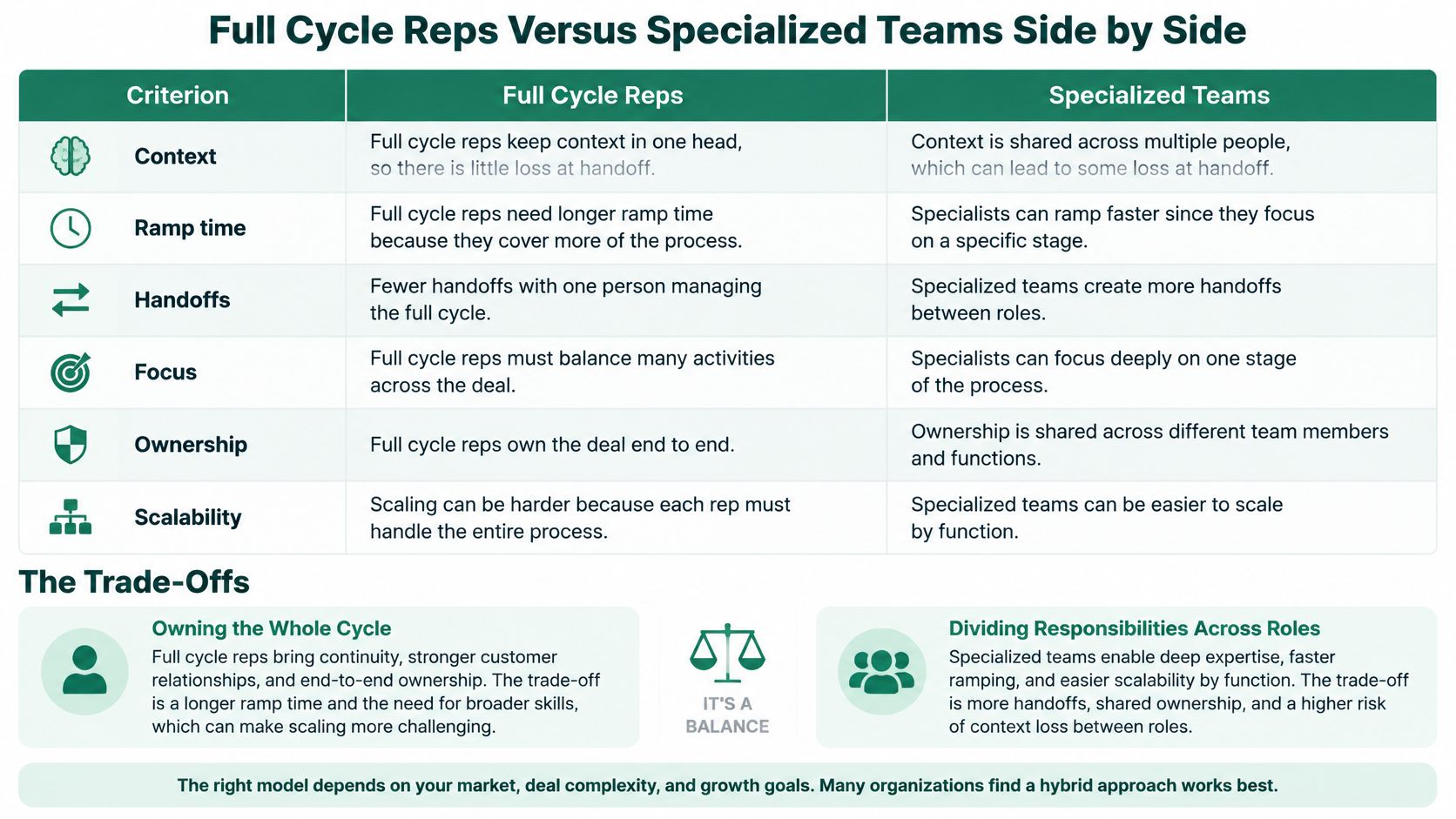
Continuity versus depth
Full cycle reps retain the details behind a buyer's request. They know why the prospect answered, which alternatives they considered and what changed during discovery. That context helps them challenge a weak brief rather than fulfilling it.
The cost is a broader training requirement. A strong closer may avoid cold outreach. A capable prospector may struggle with commercial negotiation. Don't assume excellence at either end means competence throughout the process.
Specialists can practise a narrower skill with greater focus. But the SDR's definition of qualified must match what the AE can progress. Otherwise, the team produces meetings that look successful in activity reports and disappear from the pipeline.
Scale the constraint, not the org chart
A split team needs written handoff notes, shared CRM stage definitions, and an explicit rule for account ownership. The AE should accept or reject a handoff with a reason, not leave it untouched.
Adding SDR capacity won't help if AEs can't handle the resulting discovery workload. Equally, hiring another expensive closer makes little sense when existing sellers spend their available time finding contact details.
Use this video as a discussion prompt when aligning the team on sales responsibilities.
My recommendation: Start with full cycle ownership for a small team selling repeatable services or software. Introduce specialists when sustained outbound volume or buying complexity justifies them. Don't choose the model by headcount alone, and don't claim better productivity until you've measured qualified opportunities and seller effort.
Where Selling Time Goes and What to Hand Off
Reporting based on Salesforce's State of Sales findings puts direct selling at only about 28 to 30 percent of sellers' working week, according to HumCommerce's analysis of non-selling time. Research, CRM updates, preparation, internal meetings, quotes and approvals consume much of the remainder.
That makes full cycle sales a work allocation problem before it becomes a hiring problem. Giving the rep every task doesn't strengthen accountability. It often leaves the most valuable customer work competing with administrative chores.
Keep judgement with the seller
The rep should retain diagnosis, account prioritization, pricing decisions, objection handling and requests for commitment. Support can prepare those decisions, but it shouldn't make them.
Hand off work with a clear acceptance standard:
- Account research: Return relevant evidence with its source and date.
- Trigger detection: Explain what changed and why it could create a need.
- Contact verification: Confirm the person's responsibility and usable contact details.
- Call preparation: Provide the account context, likely problem and suggested opening.
- CRM updates: Capture factual notes and next actions for seller review.
- Email drafting: Prepare a draft that the rep checks for accuracy and relevance.
In a survey of sales professionals, sellers expected fully implemented agents to reduce prospect research time by 34%, according to Salesforce's State of Sales announcement. That's an expectation, not a guaranteed saving for your team.
Measure recovered capacity
Say a founder spends the available prospecting time cleaning a static spreadsheet. Replacing it with a researched account queue only helps if the founder can move directly into relevant conversations. Another list requiring fresh investigation hasn't solved the problem.
Track seller hours per qualified opportunity, alongside customer conversation time, stage aging and progression to proposal. Use the same qualification definition before and after changing the workflow.
If conversations themselves are the bottleneck, outsourced B2B appointment setting is a different intervention from research support. Set acceptance criteria for the meetings and keep an owner responsible for progressing them.
Capacity check: Saved research time counts only when the seller uses it for better conversations or more reliable deal progression.
Buyer Timing and Channel Choice Across the Cycle
Buyers can dislike sales involvement and still need a seller's help with a difficult decision. The distinction is whether the intervention helps them make progress.
Reporting on Gartner's survey of B2B buyers says 67 percent preferred a buying experience without a sales representative, while 73 percent deliberately avoided suppliers that sent irrelevant messages, according to Commerce Partner's discussion of B2B buying behaviour.
Channel and seller role by buying stage
| Buying stage | Best channel | Seller role |
|---|---|---|
| Early research, buyer learning on their own | Content and self serve resources | Share one relevant diagnostic, no pitch |
| Trigger event, buyer needs clarity | Short phone call with a specific reason | Explain why the account was chosen, offer a diagnostic |
| Evaluation with several stakeholders | Email plus scheduled calls | Coordinate the buying group and internal approvers |
| Proposal and procurement | Email and direct meetings | Own pricing, terms and the approval path |
Relevance isn't permission
A public hiring announcement can justify a hypothesis about demand. It doesn't prove that the buyer has a problem, wants your solution or welcomes repeated contact.
Use B2B buying signals for services to decide where to investigate, then let the buyer confirm or reject your interpretation. On the phone, explain the observed change, connect it to a plausible operational issue and ask whether that issue is relevant.
For example, a consultancy approaching a company expanding its compliance team could offer a readiness checklist. That's more useful than insisting that expansion must mean the company needs external support.
Phone can resolve ambiguity quickly when the right decision maker answers. Email gives them something they can review and circulate. During evaluation, use scheduled conversations to settle disagreements rather than adding everyone to an endless email thread.
Less intrusive selling doesn't mean passive inbound. It means fewer interventions with a clear purpose, a useful contribution and an easy way for the buyer to decline. A full cycle rep should coordinate the purchase when help is needed, not insert themselves into every learning activity.
Choose Your Model Before You Hire
Start with an ownership audit. Write down the sales stages, assign a named owner to each and record who can approve exceptions. Where the founder is covering a gap, make that visible rather than treating their time as unlimited.
Then run a capacity test over a normal operating month. Track hours per qualified opportunity and classify the work as research, customer conversations, commercial execution or administration. Compare the results with the buying complexity and available capacity in your fit assessment.
Use a weekly operating log
Keep the log short enough that reps will maintain it:
- Reason for contact: The dated event behind the latest approach, with supporting evidence.
- Decision maker: The verified person responsible for the relevant purchase.
- Approval status: Confirmed approvers, unresolved responsibilities and the action needed.
- Next commitment: What the buyer and seller have each agreed to do.
- Time consumed: Effort spent preparing and progressing the account.
Choose the intervention from the log. Research delays call for better evidence gathering. Unworked accounts may require prospecting capacity. Repeated technical stalls call for specialist support. The comparison of a prospecting agency and software can help distinguish buying execution from buying a tool.
At Trefle.ai, we identify suitable companies using public and private data, hiring trends, company news, LinkedIn activity and market signals. We then identify the people responsible for buying solutions and gather their accurate emails, LinkedIn profiles and phone numbers. That work can sit outside the seller's day while the seller retains diagnosis and commercial ownership.
The final test is simple: if a rep can't name the last dated reason they called an account, fix the operating model before adding headcount. More sellers won't make an unexplained prospecting list more useful.
Trefle.ai offers Noa, a weekly feed of call ready opportunities with a dated buying signal, proof link, named decision maker, direct phone number and suggested opener. For teams that also need calling capacity, our phone first Managed Outbound service prospects on your behalf and books qualified meetings. Visit Trefle.ai to decide which work to remove from your full cycle seller's workload.