Scaling Sales Team Playbook: Hiring, Process and Metrics
Scaling sales team done right: measure selling time, hire in the right order, route leads fast and track the metrics that prove growth.
Top-performing B2B organizations generated roughly 2.5 times more gross margin for every dollar invested in sales than bottom-performing companies in McKinsey's analysis of nearly 500 B2B companies. The distinction matters: scaling a sales team isn't a matter of putting more people on payroll. It's about getting more productive customer work from the money you already spend.
For a small B2B company, the constraint is often timing. Buyers need a response before a new hire can become productive, while experienced sellers lose time preparing calls and updating records. A useful scaling sales team playbook starts with capacity, then routing, then hiring. Otherwise, you risk adding salaries to a process that still leaves buyers waiting.
Measure Selling Time Before You Add Headcount
Sales representatives reported spending 70% of their time on non-selling tasks in Salesforce's 2024 State of Sales research, covering 5,500 sales professionals across 27 countries. Treat that as a warning about work design, not permission to accept it.
Start with a one week time log for every seller. Record the day in 30 minute blocks, using the same definitions across the team. Explain that you're measuring the process, not building a surveillance system.
Separate conversations from preparation
Use these buckets consistently:
- Live conversations with prospects: Discovery, qualification, demonstrations and discussions that advance a buying decision.
- Research: Finding contacts, checking account fit and preparing a relevant reason to call.
- Admin and CRM updates: Entering notes, correcting records and creating follow-up tasks.
- Other work: Internal coordination, meetings and everything that doesn't fit the other categories.
The visual below gives the team a common way to record its work.
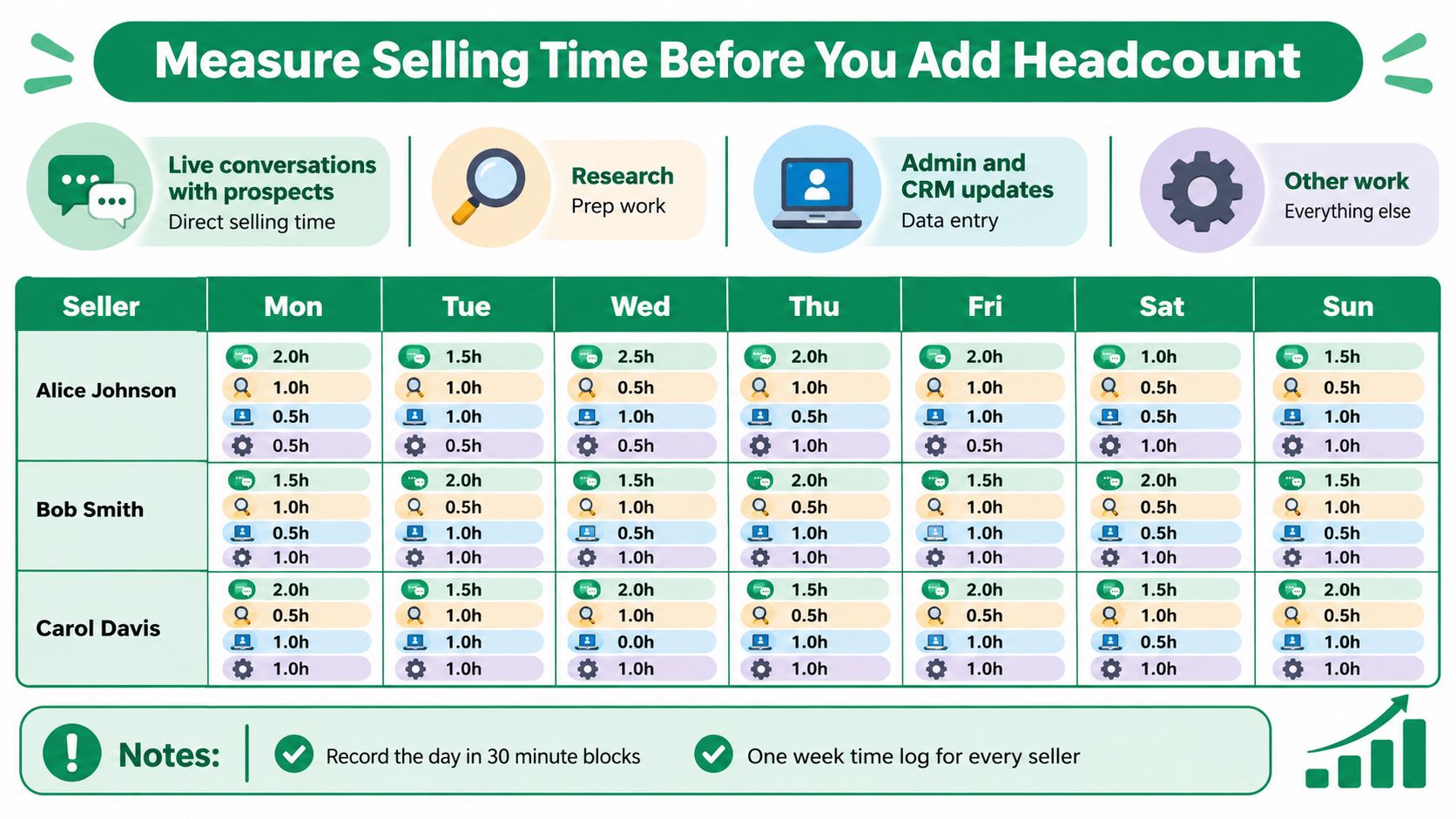
Total live selling hours and divide them by paid hours. Keep preparation visible rather than relabeling it as selling because it feels commercially useful. Research can be necessary without requiring a seller to do all of it.
Next, list accounts by revenue and record the attention each received last month. Separate service obligations from expansion work. An important account may deserve substantial support, but that doesn't mean your best closer should personally coordinate every request.
Name the constraint before approving a role
Bring these measures to the planning meeting:
- Selling hours per rep per week: How much usable customer capacity exists?
- Open pipeline touched in the last 14 days: Are sellers advancing opportunities or merely carrying them?
- Leads waiting more than one hour for a first call: Is demand arriving faster than the team responds?
Practical rule: When selling time is low and buyers wait, repair the workflow before adding another person to it.
If sellers already spend most of their available week in productive conversations, investigate lead supply and coverage. Hiring may be appropriate, but distinguish insufficient capacity from insufficient demand. A new seller can't fix an offer that nobody wants to discuss.
Write down one bottleneck to test this quarter, its owner and the measure that will prove improvement.
Hiring Order and Ramp Times for Your First Sales Roles
Typical ramp time by sales role
| Role | Typical ramp to full output | Benchmark source | First sign it is working |
|---|---|---|---|
| Account executive | 5.3 months | Blossom Street Ventures' 2024 survey of 172 B2B SaaS companies | Opportunities moving to the next stage each week |
| SDR or outbound caller | About 3.0 months | Common Room's reporting of a 2025 benchmark covering 351 B2B companies | Meetings booked from their own call list |
These are ramp benchmarks, not payback periods. Becoming productive doesn't mean a hire has recovered recruiting costs, compensation and management time. Closed revenue also depends on your sales cycle and whether the opportunities entering it are qualified.
A January start therefore isn't a January capacity increase. Plan for a period when the new hire consumes coaching time while established sellers still carry the revenue target. Don't budget as though a signed offer immediately fills a pipeline gap.
Hire for the work you've validated
For a company with 1 to 50 people, I would use this hiring sequence as a starting rule, not a universal staffing ratio:
- Founder or strongest seller first: Keep the person who closed the first ten deals involved until they can explain the buyer, the message and the objections. Document what made those deals progress.
- Caller or SDR next: Add prospecting capacity once a message generates credible replies and live conversations. Don't hire someone to discover the entire market and deliver a meeting quota simultaneously.
- Account executive after qualification repeats: Add closing capacity when meetings consistently meet your acceptance criteria. Otherwise, you'll pay an AE to reject meetings or rebuild discovery.
- Manager when daily coaching becomes a separate job: Four or more sellers calling every day is a useful planning trigger. Consider complexity and founder availability before treating it as a fixed rule.
The trade-off is specialization versus handoff cost. A dedicated caller can protect prospecting time, but the buyer shouldn't have to repeat everything to the AE. Require the receiving seller to read the notes and accept or reject the opportunity with a reason.
Cover the gap without hiding weak economics
A temporary calling layer can test segments while internal hires ramp. Keep the same qualification fields, call outcomes and objection log across both groups. Your next hire should inherit evidence about what works, not an untouched spreadsheet.
Compare how managed outbound scope and pricing work against the work your team can supervise. Delegation removes phone execution from your calendar, but it doesn't remove your responsibility for offer clarity or meeting acceptance.
A booked meeting proves someone accepted a calendar invitation. It doesn't yet prove you have a qualified opportunity.
For the next hiring decision, set a concrete gate: the current team meets its meeting target for two consecutive months, and available pipeline and cash cover the expected ramp period. Treat this as an internal approval rule. If either condition fails, diagnose the gap before opening another role.
Onboard New Sellers to Full Output in 90 Days
Use 90 days as an onboarding sequence, not a promise that every seller will reach full commercial productivity within that window. An AE can learn the operating routine before they've completed a full buying cycle.
Write the plan before the offer letter. Assign a named coach, put reviews on the calendar and define what the rep must demonstrate.
Build independence in stages
- Week one: Read winning message templates, the call script and qualification definitions. Listen to live calls by a strong seller, then explain why each question was asked.
- Weeks two and three: Work a fixed daily account list. The manager reviews call notes every Friday, checking the opening, discovery and agreed next step rather than just activity totals.
- Weeks four to six: Own a segment, send first messages from approved templates and log every objection in the CRM. Keep the segment stable long enough to distinguish a messaging problem from a targeting problem.
- Month three: Run lead routing, follow-up and the Monday deal review without someone directing every action. Escalate exceptions with a proposed answer, not just a question.
Coach against observable gates
Set an initial gate of at least one qualified meeting a week by week six. Require qualification fields to be completed on most call notes as a second gate. These are proposed management standards, not industry benchmarks.
If a rep misses a gate, identify the failed step. Weak contact rates call for different coaching than conversations that never produce an agreed next action.
Don't extend the same routine indefinitely. Change the list, coach the question or demonstrate the handoff, then check whether the specific behavior improves.
How to Build a Lead Routing and Speed to Lead Process
A six-company Lead Response Management study found that the odds of making contact dropped by more than ten times during the first hour; across response delay tiers, such as responding in 30 minutes rather than 10, the percentage of leads becoming qualified fell by 4.3%. Use this historical finding to justify prompt handling, not to forecast an identical lift for your business.
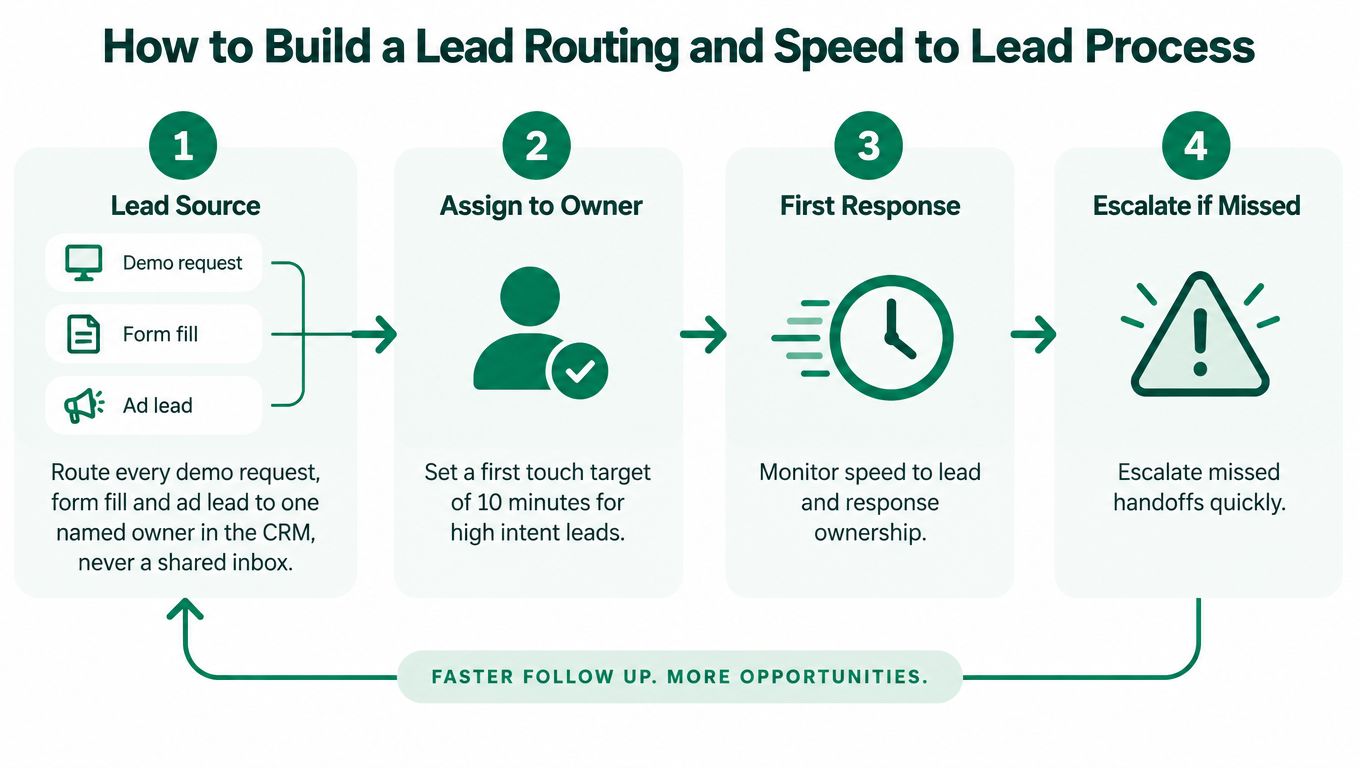
Make ownership and escalation visible before adding more acquisition spend. This workflow shows the essential handoffs.
Give every handoff an owner
- Route each request to a named person. Every demo request, form fill and ad lead needs an owner in the CRM, not just a notification in a shared inbox. Set a backup owner for absence and overflow.
- Set a 10 minute first touch target for high intent inquiries. Treat this as your operating target, with staffed hours clearly defined. Escalate missed assignments rather than assuming someone else noticed.
- Call promptly, then retry the same day when appropriate. Respect consent, local calling rules and the buyer's stated preferences. A failed first attempt should create a dated task, not an abandoned record.
- Qualify against written criteria. Record interest, need, urgency, budget and decision-making authority. Mark unknown information as unknown rather than encouraging callers to guess.
- Capture the reason, objection and outcome. Include what prompted contact, what the buyer said and the next agreed action. The next person should be able to continue the conversation without restarting it.
- Review open deals every Monday. Flag deals with no activity for 14 days and decide whether a fresh reason justifies a call. If there's no credible next step, correct the stage or remove the deal from active pipeline.
Keep callbacks inside the same system
InsideSales' lead-management overview describes historical waits of 48 to 72 hours before attempted live contact, with leads typically called only four to five times. Don't turn those figures into a recommended cadence. The practical issue is whether someone owns each next attempt.
At Trefle.ai, the AI-native, call-first GTM partner for B2B companies, our two offers are Managed Outbound and the GTM System. We prioritize the hottest leads each day, prepare a good reason to call, and return outcomes, notes and callbacks to the system.
An outsourced B2B appointment-setting process should preserve that accountability rather than produce a separate reporting silo.
For a one week test, inspect the last 20 inbound records. Record minutes to first call and count how many reached a live person within an hour. Separate time to attempted contact from time to actual conversation.
Which Sales Tools to Add and When
Buying software before defining the work creates another job: maintaining software. Each tool needs an owner, a replacement target and a measure it should improve.
For a team of one to five sellers, a sensible starting setup is a CRM with required fields and pipeline stages, a calling tool that logs activity automatically, and a single email sequence tool once the message works. That's a proposed setup, not a requirement to purchase everything immediately.
Match the purchase to the constraint
Sales tools by job and trigger
| Tool job | Example tools | Add when |
|---|---|---|
| Contact data | Apollo, ZoomInfo, Lusha, Cognism | Reps lose time finding verified contacts |
| Enrichment and signals | Clay, Common Room | Research is the bottleneck the CRM cannot answer |
| AI SDR tools | Vendor options differ | You have a high volume of standard messages that already get replies |
The examples identify categories to evaluate, not interchangeable capabilities. Check whether your CRM already handles the task before adding another integration.
Use the stuck metric to choose the purchase, rather than building a stack from a vendor checklist.

A large static contact list won't resolve an unclear message. A sequencer won't fix a call script that never establishes relevance. Automation can repeat a weak approach just as reliably as a strong one.
Decide who will make the calls
A team with little budget and people willing to call can build its own daily list. Protect a calling block, prepare contact context together and keep the feedback loop short. If nobody can staff the phone consistently, compare an outbound agency with prospecting software before purchasing tools that still need an operator.
Our AI agents research, enrich and prepare, while humans decide and call. That division keeps preparation from swallowing the seller's day without asking automation to exercise every commercial judgment.
Before signing, answer these questions:
- Who owns the data? Confirm export access, field ownership and responsibility for correcting records.
- What does it replace? Name the manual task or existing subscription you'll stop.
- How will you judge it within 60 days? Choose a measurable change, such as less preparation time or more complete call records.
Buying test: If you can't name the work you'll stop doing, you probably haven't justified the tool.
Metrics That Prove the Team Is Scaling
Scaling metrics to review each month
| Metric | How to calculate it | Healthy direction | Red flag |
|---|---|---|---|
| Selling time share | Selling hours divided by paid hours | Rising each quarter | Flat for a full quarter while headcount grows |
| Human minutes per qualified opportunity | Call, research and admin minutes divided by qualified opportunities | Falling as playbooks mature | Rising while incoming volume is flat |
| Revenue per selling hour | Closed revenue divided by selling hours | Rising | Flat while headcount grows |
| Minutes to first call on hot leads | Median time from lead creation to first live attempt | Under your 10 minute operating target | Target repeatedly missed or unowned requests |
| Qualified meetings share | Qualified meetings divided by meetings booked | Rising as criteria tighten | Falling while meetings booked keep rising |
Read these measures together. Selling time share shows whether you're protecting customer capacity; human minutes per qualified opportunity shows how much labor it takes to produce something worth advancing.
Revenue per selling hour tests the commercial result. If it stays flat while headcount grows, you're adding cost without demonstrating better productivity. That can still support profitable expansion, but it isn't evidence of greater operating efficiency.
Keep definitions stable
Review the dashboard monthly, on the same day, with the same stage definitions. Include caller preparation and relevant administrative work in the labor calculation, including work delegated outside the sales team. Otherwise, shifting tasks makes productivity look better without reducing total effort.
The importance of support work appears in McKinsey's sales growth analysis, which found that better cross-functional coordination and teaming produced a 5% to 10% sales increase. The lesson for a small team is to examine handoffs and support capacity, not just individual seller activity.
Use separate views for new and established sellers. Evaluate AEs across a planning window of about six months and SDRs across about three, adjusting for your sales cycle rather than treating those windows as performance guarantees.
Investigate before labeling a rep weak
A falling qualified meetings share doesn't automatically mean the caller is careless. It may reflect changed targeting, an overly broad invitation or different interpretations of qualification between the caller and AE.
Check the evidence in this order:
- Call notes: Was there a specific reason to speak and a relevant problem?
- Meeting acceptance: Did the AE apply the agreed criteria consistently?
- Stage progression: Did accepted meetings lead to a meaningful next action?
- Timing: Has enough time passed for the cohort to produce the outcome you're measuring?
Keep meetings booked and qualified meetings separate. A rising calendar count alongside weakening qualification should trigger a review of the invitation and discovery questions, not applause for activity.
If two or more measures remain red for a full quarter, repeat the time audit before approving another hire. Use that as a management trigger for investigation, not an automatic hiring freeze. A profitable territory expansion and a broken handoff can produce similar dashboard symptoms but require different decisions.
Pick One Bottleneck to Fix This Quarter
Choose the constraint that prevents the next useful customer conversation. Don't launch a CRM rebuild, a hiring round and a new outbound motion simultaneously unless you can assign separate accountable owners.
Use the time audit to select the work, rather than choosing the most visible project.

If sellers spend too little time with buyers, remove preparation and administrative friction first. If high intent inquiries wait more than an hour, install ownership and escalation this week, then track response time for 30 days. Those are different problems, and hiring the same role for both won't necessarily solve either.
If sellers already have full calendars of qualified conversations but coverage remains thin, add capacity. Hire the next validated role or use an outside calling layer while that person learns. If calendars are empty, check targeting, offer relevance and available demand before assuming you need another seller.
Use a 90 day decision cycle
- Week one: Run the time log and identify urgent inquiries and stalled deals. Establish the baseline before changing assignments.
- Weeks two to four: Name lead owners, implement the first touch target and test backup coverage. Review missed handoffs with the people responsible.
- Month two: Keep or cut each tool against its intended measure. Fix adoption problems before concluding that software or callers failed.
- Month three: Review capacity, qualification and revenue together. Approve the next hire only when the work, coaching capacity and funding are clear.
Maintain multiple sources of relevant conversations. Our calling inputs include hot leads from sequences, ads and the website, deals already in the CRM, and cold leads identified through signals and lookalikes. The deciding factor is a good reason to call, not the source label.
This video provides another format for considering the approach.
The next hiring decision should explain what work the person will own, how they'll learn it and when you'll judge the outcome. Without those answers, a larger team may inherit the same delays.
Protect productive conversations first. Then invest in additional people when you can give them a repeatable job and enough qualified work to perform it.
Trefle.ai offers Managed Outbound for delegated calling and the GTM System for an engine your team owns, helping B2B companies add selling capacity without leaving preparation and follow-up unmanaged. Each free targeted call includes the company, the reason to call now, the decision maker, their number and what to say. Get 10 targeted calls, free.